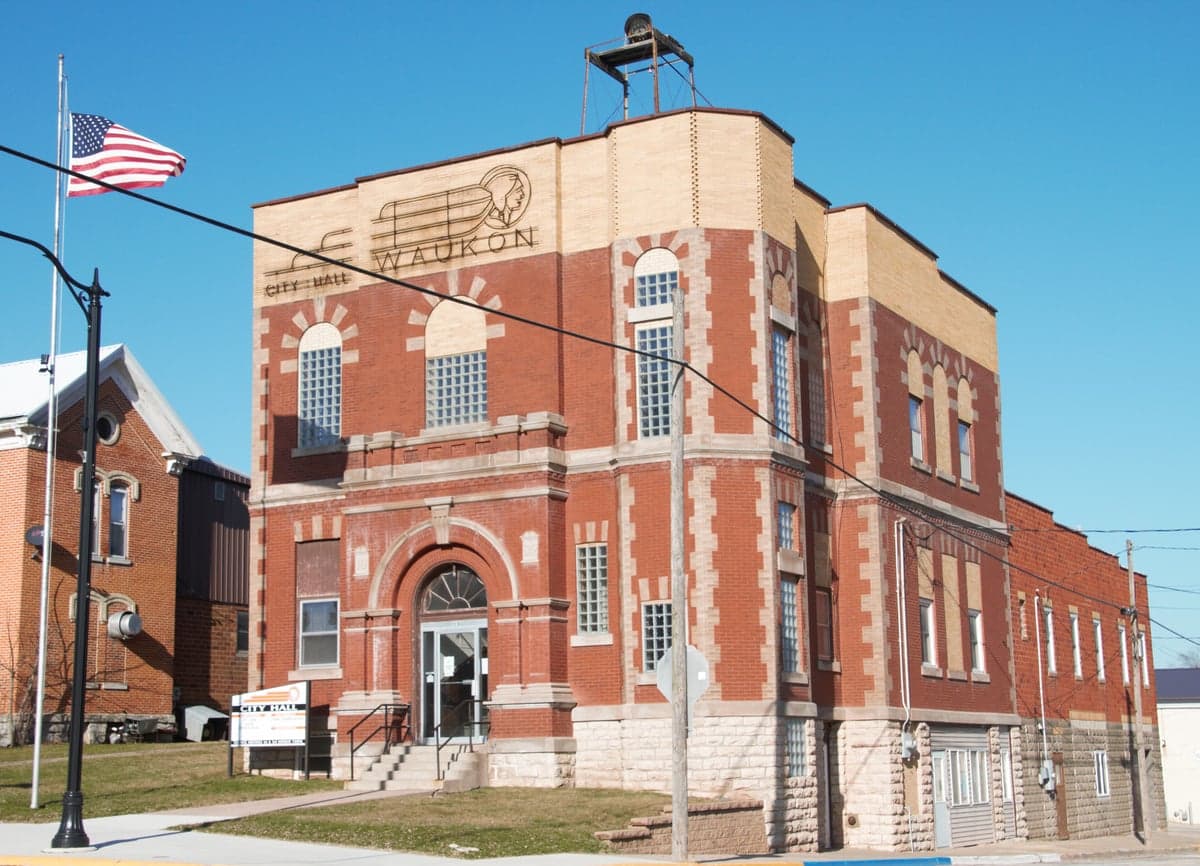
Photo: Wikipedia
Demographics of Waukon, IA
Affluence Level in Waukon, IA
A middle-class area roughly in line with national averages across income, home values, education, and employment.
People of Waukon, IA
The people of Waukon, Iowa, today number 3,796, forming a predominantly white (92.5%) community with a small but growing Hispanic population (4.8%) and a tiny East/Southeast Asian presence (1.1%). The city’s identity is rooted in its Norwegian and German heritage, visible in the downtown’s historic storefronts and the annual Nordic Fest celebration. With a low foreign-born rate of 0.8% and a college attainment rate of 21.0%, Waukon remains a tight-knit, working-class town where family ties and local institutions like the Allamakee County Fairgrounds anchor daily life.
How the city was settled and grew
Waukon was founded in 1853 as the seat of Allamakee County, drawing its first wave of settlers from New England and New York via the Upper Mississippi River valley. These early arrivals—mostly Yankee farmers and merchants—built the first homes along what is now West Main Street and around the courthouse square, establishing a commercial core that still functions today. The real demographic shift came in the 1860s and 1870s, when Norwegian immigrants, fleeing land scarcity and religious pressures in their homeland, poured into the area. They settled heavily in the Norwegian Valley district, a rural-to-urban corridor just south of downtown, where they built the First Norwegian Lutheran Church (now First Lutheran) and established a tight-knit farming community. German immigrants followed in the 1880s, concentrating in the North Side neighborhood near the railroad depot, where they worked as blacksmiths, brewers, and grain traders. By 1900, the population had reached roughly 2,000, with Norwegian and German surnames dominating the tax rolls and church registries. The city’s growth plateaued after World War I, as the agricultural economy stabilized and out-migration to larger Midwestern cities began.
Modern era (post-1965)
The post-1965 era brought little foreign immigration to Waukon, reflecting its inland, non-metropolitan location. The foreign-born share today is just 0.8%, and the city’s racial composition has remained overwhelmingly white. The most notable demographic change has been the gradual arrival of Hispanic families, primarily of Mexican descent, who began moving to the area in the 1990s to work in the Waukon Feed Ranch and other agricultural processing facilities. These families have concentrated in the South Side district, near the industrial park along Highway 76, where rental housing and mobile home parks offer affordable entry points. The Hispanic share rose from under 1% in 1990 to 4.8% today, though the community remains small and largely integrated into the broader working-class fabric. East/Southeast Asian residents (1.1%) are a newer presence, mostly professionals at Veterans Memorial Hospital and the local school district, and they tend to live in the East Side neighborhood near the hospital campus. The Black population remains at 0.0%, and Indian-subcontinent residents are also absent from the census data. Domestic in-migration has been minimal; most new residents are either returning natives or retirees from nearby farms.
The future
Waukon’s population is projected to remain stable or decline slightly over the next decade, mirroring trends across rural northeast Iowa. The Hispanic share is likely to grow gradually, possibly reaching 7-8% by 2035, as younger families move in for affordable housing and agricultural jobs. These new residents are expected to continue settling in the South Side and along the Rossville Road corridor, where land is cheaper and zoning is less restrictive. The white population will age and shrink, with the median age already above 45. The East/Southeast Asian community may grow modestly if the hospital expands its specialist recruitment, but it will remain a tiny fraction. The city’s cultural identity will likely remain anchored in its Norwegian-German heritage, though the annual Nordic Fest may incorporate more Hispanic elements over time. No major new subdivisions or planned communities are on the horizon, so the existing neighborhood pattern—West Main’s historic core, Norwegian Valley’s rural-urban mix, North Side’s blue-collar blocks, and South Side’s newer arrivals—will persist.
For someone moving in now, Waukon offers a stable, low-crime, family-oriented environment where community ties run deep and change comes slowly. The population is aging and becoming slightly more diverse, but the city remains overwhelmingly white and culturally conservative. New residents—especially those from outside the region—should expect a warm but insular welcome, where fitting in means participating in church, school, and fairground events. It is a place for those seeking quiet, affordable, and predictable small-town life, not for those looking for rapid growth or cosmopolitan diversity.

* Values derived from national, state, county, city and local statistics and may differ in a specific area. Last updated: 2026-10-08T00:56:20.000Z
Narrative content on this page is AI-generated and may contain mistakes. Verify any details that matter before acting on them.
ReloMaps may earn a commission from affiliate links at no extra cost to you.

