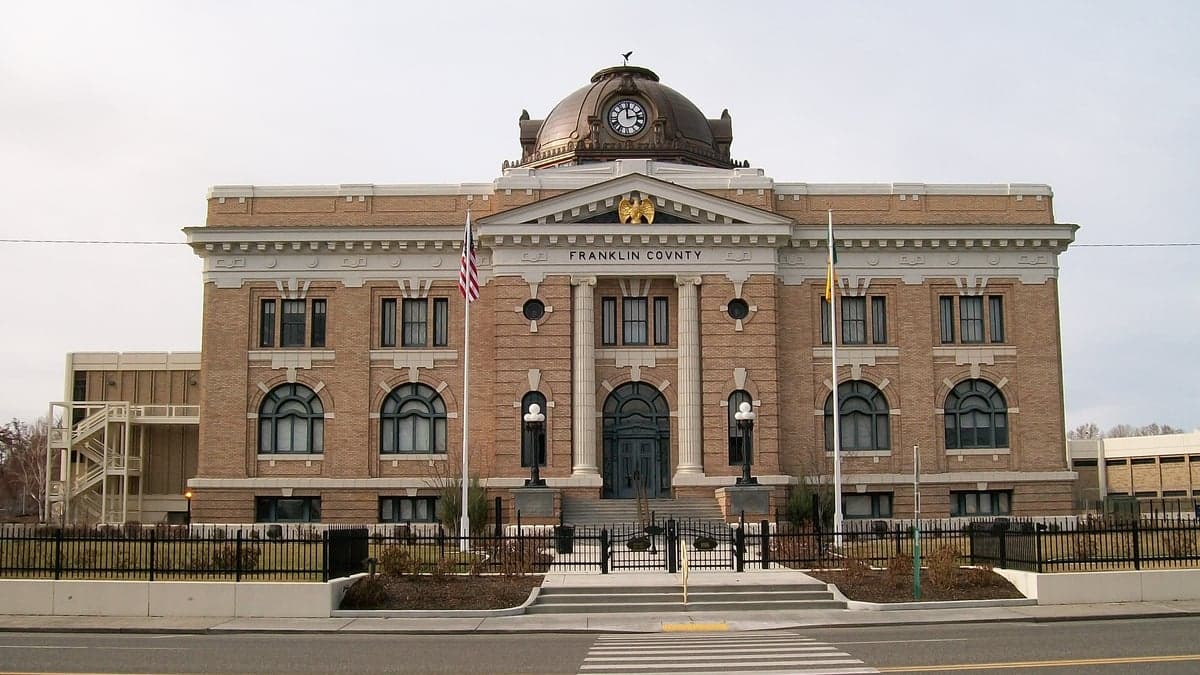
Photo: Wikipedia
Political ClimatePolitical Climate in Franklin County
Showing district-level results — no local-only data available.
Local Political AnalysisPolitical Analysis of Franklin County
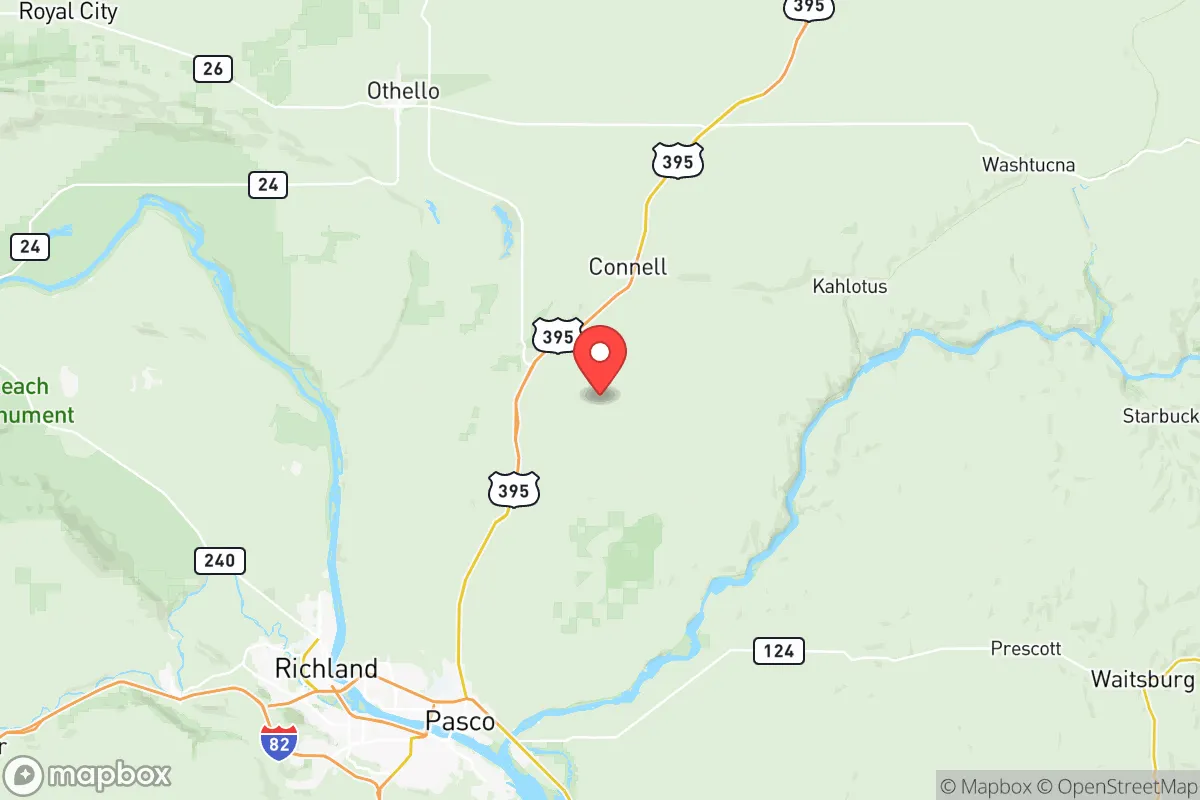
Franklin County, Washington, leans reliably Republican with a Cook PVI of R+5, but that number tells only part of the story. The county has been shifting rightward over the past decade, driven largely by growth in the Tri-Cities metro area—particularly in and around Pasco, the county seat—while smaller agricultural towns like Connell and Kahlotus have remained deeply conservative. The real political action, though, is in the swing precincts of West Pasco and the growing suburban fringe near the border with Benton County, where a mix of new arrivals and shifting demographics keeps things from being a straight red sweep.
How it compares
Compared to Washington state as a whole—which leans Democratic by roughly 8-10 points in statewide races—Franklin County is a clear outlier. The state’s political center of gravity is the Seattle metro area, which votes heavily blue, while Franklin County sits in the conservative eastern half of the state. Within the county itself, the contrast is sharp: Pasco’s older, more established neighborhoods near downtown tend to vote Republican, while newer subdivisions in West Pasco and parts of the city’s east side have shown more competitive margins, sometimes tipping Democratic in local races. The agricultural towns of Connell and Mesa are solidly red, with precincts often going 70% or more for GOP candidates. Meanwhile, the small community of Basin City, with its large Hispanic population, has shown more mixed results, occasionally breaking for Democrats in down-ballot races. The county’s overall R+5 rating masks these internal variations—it’s not a monolith, and the swing precincts in West Pasco are where both parties focus their ground game.
What this means for residents
For conservative residents, Franklin County offers a comfortable environment where Republican candidates are the norm and local policy tends to favor limited government, agricultural interests, and Second Amendment rights. You’ll find conservative values reflected in county commission decisions, school board elections, and local law enforcement priorities. For liberal residents, it’s a different experience—you’re in the minority, but not isolated. Pasco has a growing progressive community, especially among younger professionals and Hispanic organizers, and there are active Democratic clubs and advocacy groups. The practical effect is that political conversations can be more polarized than in a deep-blue or deep-red area, but the swing precincts mean your vote actually matters more here than in a safe seat. Local elections—city council, port commission, school board—are often decided by a few hundred votes, so civic engagement has real impact regardless of your party.
Culturally, Franklin County stands apart from the rest of Washington in ways that go beyond voting. The county’s strong agricultural base—it’s one of the top producers of apples, grapes, and potatoes in the state—shapes a more rural, family-oriented lifestyle that contrasts with the tech-driven, urban culture of the Puget Sound region. You’ll see more pickup trucks than Teslas, and the local news covers water rights and crop prices as much as politics. Policy-wise, the county has pushed back on some state-level mandates, particularly around land use and environmental regulations, which can create friction with Olympia. But there’s also a pragmatic streak—the county has embraced renewable energy projects like wind and solar farms, and the growing Hispanic population (over 50% of residents) has made bilingual services and immigration policy a regular part of local debate. It’s a place where the political climate is shaped as much by the soil and the river as by the ballot box.

State Political ClimatePolitical Climate in Washington
State Political AnalysisPolitical Environment in the State
Washington State has been a reliably blue stronghold for over a decade, but its politics are far more complex than a simple "liberal" label suggests. The state has voted for the Democratic presidential candidate in every election since 1988, with margins widening from a near-tie in 2004 to a 19-point win for Joe Biden in 2020. However, this blue veneer masks a deep and growing urban-rural chasm, where the Seattle metro area and a handful of other cities drive the statewide results, while vast swaths of eastern and southwestern Washington vote as red as any county in Idaho or Texas.
Urban vs. rural divide
The political map of Washington is essentially a tale of two states. King County, home to Seattle, alone casts about 30% of the state's vote and consistently delivers 70-75% Democratic margins. Add in the other Puget Sound counties—Snohomish (Everett), Pierce (Tacoma), and Kitsap (Bremerton)—and you have a massive blue bloc that overwhelms the rest of the state. The I-5 corridor from Olympia north to the Canadian border is the engine of Democratic power. In contrast, the eastern half of the state—places like Spokane, the Tri-Cities (Kennewick, Pasco, Richland), and Yakima—votes solidly Republican. Spokane County, once a swing county, has trended red in recent cycles, voting +7 for Trump in 2020. The rural counties of Ferry, Stevens, and Pend Oreille in the northeast routinely vote 70-80% Republican. Even within the blue metro areas, there are distinct pockets: the suburbs of Sammamish and Redmond are deeply blue, while the exurbs of North Bend and parts of Pierce County lean more conservative. The result is a state where a conservative relocating to Spokane or the Tri-Cities will find a very different political environment than someone moving to Seattle or Bellevue.
Policy environment
Washington's policy environment is defined by a few key features that directly impact daily life. The state has no personal income tax, which is a major draw for many relocators, but it compensates with a high sales tax (state rate of 6.5%, with local add-ons pushing it to 10% or more in some cities) and high property taxes in many areas. The regulatory posture is generally business-friendly in name but heavily regulated in practice, especially in environmental and labor law. The state has a strong public education system, with the Washington State School Directors' Association setting standards, but funding is a perennial political battleground. Healthcare is dominated by the Washington Health Benefit Exchange, and the state has expanded Medicaid under the Affordable Care Act. Election laws are among the most accessible in the country: Washington has all-mail voting, automatic voter registration, and same-day registration, which conservatives often criticize as lacking sufficient security measures. The state also has a strong public records act, though it has been weakened in recent years by legislative exemptions.
Recent policy direction
The last five years have seen a sharp acceleration of progressive policy in Olympia. In 2023, the legislature passed a ban on the sale of assault weapons (HB 1240) and a 10-day waiting period for all firearm purchases (HB 1143), along with a requirement for a permit to purchase a pistol (HB 1630). These laws are currently being challenged in court but remain in effect. On education, the state passed a law requiring all public schools to provide free menstrual products in restrooms (HB 1273) and expanded access to dual-credit programs. On parental rights, the state has moved in the opposite direction of many red states: a 2023 law (SB 5599) allows minors to receive shelter and certain medical services without parental consent, and the state has codified protections for LGBTQ+ students in schools. On medical and bodily autonomy, Washington has enshrined abortion rights into state law (HB 1799) and passed a shield law protecting providers who prescribe abortion pills via telehealth to patients in states with bans. On property rights, the state has implemented a capital gains tax (SB 5096) on high earners, which is being challenged as an unconstitutional income tax. On voting, the state has expanded ballot access, including a law requiring counties to provide ballot drop boxes in every city with a population over 1,000 (HB 1085). For a conservative relocator, the key takeaway is that the state is actively moving in a progressive direction on guns, education, and healthcare, while maintaining a low-income-tax structure that appeals to many.
Civil unrest & political movements
Washington has a history of visible political activism, from the 1999 WTO protests in Seattle to the 2020 Black Lives Matter demonstrations that saw the Capitol Hill Autonomous Zone (CHAZ) in Seattle. The state is home to a strong environmental movement, with groups like 350.org and the Sierra Club active in opposing fossil fuel projects. On the right, the state has a significant Second Amendment movement, with groups like the Washington Arms Collectors and the Citizens Committee for the Right to Keep and Bear Arms organizing against the recent gun laws. The state's sanctuary policies are a major flashpoint: Washington has a "sanctuary state" law (SB 5257) that limits local law enforcement cooperation with federal immigration authorities, and the city of Seattle has its own sanctuary ordinance. This has led to tensions with the federal government and with more conservative counties like Yakima and Grant, which have passed resolutions opposing the policy. Election integrity has been a recurring controversy, with Republican candidates in 2020 and 2022 alleging irregularities in the all-mail system, though no widespread fraud has been proven. A new resident in Seattle will see frequent protests on the University of Washington campus and downtown, while a resident in Spokane will see more conservative rallies and gun rights demonstrations.
Projection
Over the next 5-10 years, Washington's political trajectory is likely to continue its current progressive drift, but with some important caveats. The Seattle metro area is growing faster than the rest of the state, which will further entrench Democratic dominance at the state level. However, the exurbs and smaller cities like Spokane Valley and Wenatchee are also growing, and they are trending red. The state's housing crisis is pushing people out of King County into more affordable, often more conservative, areas like Pierce and Thurston counties, which could shift some legislative districts. The capital gains tax is almost certain to be challenged in court, and if it is struck down, the state will face a budget crisis that could force a conversation about a broader income tax. The gun laws will likely remain in place, but court challenges could narrow them. The biggest wildcard is the state's reliance on technology and aerospace industries: if Amazon, Microsoft, and Boeing continue to grow, the state's tax base will remain strong, but if they face downturns, the political landscape could shift. For a conservative moving in now, expect to see continued progressive legislation on guns, education, and healthcare, but also a growing conservative counter-movement in the eastern and rural parts of the state.
For a new resident, the bottom line is that Washington offers a starkly different political experience depending on where you land. If you move to Seattle or Bellevue, you will be in a deeply progressive environment with high taxes and strong regulations. If you move to Spokane or the Tri-Cities, you will find a more conservative community with lower taxes and a different set of cultural norms. The state's lack of an income tax is a genuine financial benefit, but it comes with high sales and property taxes. The gun laws are among the strictest in the nation, and the education and healthcare systems are heavily influenced by progressive policies. If you are a conservative who values low taxes and outdoor recreation, Washington can still be a great place to live—just be prepared to live in a political minority if you choose the western side of the state.
* Values derived from national, state, county, city and local statistics and may differ in a specific area. Last updated: 2026-07-03T06:29:24.000Z
Narrative content on this page is AI-generated and may contain mistakes. Verify any details that matter before acting on them.
ReloMaps may earn a commission from affiliate links at no extra cost to you.

