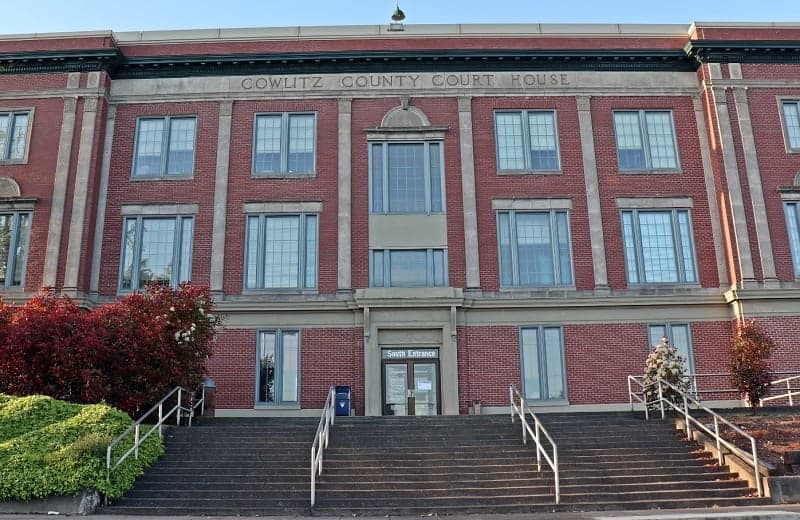
Photo: Wikipedia
Demographics of Cowlitz County
Affluence Level in Cowlitz County
A middle-class area roughly in line with national averages across income, home values, education, and employment.
People of Cowlitz County
The people of Cowlitz County, Washington, today number a Census-estimated 111,539, a population that is notably 80.6% White alone and older than the state average, with a heavy blue-collar identity rooted in timber and manufacturing. The county's character remains distinctly working-class and rural-suburban, centered on the twin cities of Kelso and Longview, with a very low 17.0% college degree rate and a tiny 2.2% foreign-born share—among the smallest of any Washington county. Hispanics, at 10.2%, form the largest minority group, while East/Southeast Asian residents make up just 1.1%, Black residents 0.7%, and Indians from the subcontinent a negligible 0.0%. The county's identity is a quiet, practical one: shaped by the Columbia and Cowlitz rivers, the boom-and-bust cycles of the timber industry, and a deep-rooted, multi-generational White population whose ancestors arrived in distinct waves over 150 years.
Settlement & growth (pre-1960)
Long before European settlement, the Cowlitz people—a Salishan-speaking tribe—lived in permanent villages along the Cowlitz River and the lower Columbia. Their name, meaning "people of the shifting sands," gave the county its name. Tribal life centered on fishing for salmon and sturgeon, hunting deer and elk, and gathering wapato roots. Portions of the tribe were forcibly removed to the Chehalis Reservation west of the county in the 1850s, though many Cowlitz descendants remained in the area as unrecognized bands.
American settlement began in earnest after the 1850 Donation Land Claim Act, which offered free land to White settlers willing to farm in the Oregon Territory. The first Euro-American wave, arriving in the 1850s and 1860s, was overwhelmingly American-born migrants from the Upper South and Midwest—farmers, loggers, and merchants drawn by cheap river-bottom land and stands of old-growth Douglas fir. They founded Kelso (platted in 1884 as "Catsop," then renamed) and the smaller river settlements of Castle Rock, Kalama, and Toledo. Kalama, in fact, briefly served as the northern terminus of the Northern Pacific Railroad in the early 1870s, swelling with railroad workers before the line extended east.
A second, smaller wave came from Scandinavia—Swedes, Norwegians, and Finns—between 1880 and 1910. These immigrants were recruited for logging and mill work, settling in the logging camps around Ryderwood and Silver Lake, and in Kelso's working-class neighborhoods. Their presence gave the county a modest Lutheran and fraternal-organization character that persists in small churches and festivals.
The decisive event for Cowlitz County's population was the founding of Longview in 1923—Washington's last completely planned city. The Long-Bell Lumber Company, led by Missouri lumber baron R.A. Long, built a massive mill and a company town from scratch on the Columbia River floodplain. Between 1923 and 1930, Longview drew thousands of workers and families from the U.S. Midwest and the Dust Bowl—Kansas, Oklahoma, Missouri, and Arkansas—a migration that was both planned and organic. These "Okie" and "Show-Me" transplants gave Longview a distinct Midwestern accent and conservative populist tilt that still flavors the county's politics. By 1930, Cowlitz County's population had more than doubled to over 30,000, with Longview and Kelso as the twin anchors.
Japanese and Filipino farmworkers, recruited into the county's berry and hop fields in the 1910s and 1920s, established small enclaves in the Lexington area south of Kelso and in scattered farmworker camps. The Japanese population was forcibly removed during World War II internment and never returned in significant numbers. By 1960, the county's population had reached roughly 57,000, with a population that was 98% White, heavily native-born, and overwhelmingly employed in timber, pulp, paper, and sawmills at Weyerhaeuser, Longview Fibre, and Reynolds Metals (aluminum smelting).
Modern era (post-1965)
The 1965 Hart-Cellar Act had almost no direct impact on Cowlitz County. Unlike Seattle or Portland, the county did not attract post-1965 immigrants from Asia or Latin America in any substantial numbers. The foreign-born population stagnated at roughly 2.2%—one of the lowest rates in Washington—because the region lacked the urban service economy, ethnic networks, and housing stock that drew new immigrants to coastal cities. The county's main demographic shift since 1965 has been domestic out-migration and aging in place, not new immigration.
Hispanic growth, however, tells a different story. From virtually zero in 1970, the Hispanic share climbed to 10.2% by 2024, driven by Mexican-origin farmworkers and their families settling permanently in the county after the end of the Bracero program (1964) and through ongoing agricultural work in the Cowlitz and Columbia river valleys. Today, Hispanic residents are concentrated in Kelso's southern neighborhoods and in the unincorporated farm areas around Woodland and Carrolls. They work primarily in agriculture, construction, landscaping, and the remaining lumber mills. There is no distinct ethnic enclave or commercial corridor—Hispanic residents are dispersed and integrated into the county's working-class fabric.
East/Southeast Asian residents, at 1.1%, include small numbers of Vietnamese and Filipino families, many with ties to the region's seafood-processing industry on the Columbia River. Black residents, at 0.7%, remain a tiny presence—largely middle-class professionals in healthcare and education, scattered across Longview and Kelso with no distinct neighborhood concentration. The Indian subcontinent population is statistically zero (0.0%), reflecting the absence of the tech and medical sectors that draw Indian professionals to King County.
The most significant demographic event since 1965 was the protracted decline of the timber industry beginning in the 1980s, driven by automation, the spotted-owl litigation, and the shift of millwork to the Southeast U.S. and overseas. Between 1980 and 2000, Cowlitz County lost roughly 5,000 timber and mill jobs. This triggered a steady out-migration of younger workers to the Puget Sound region, Portland, and the Southwest. The population actually declined between 1990 and 2000 from about 82,000 to roughly 80,000. The county's median age rose from 34 (1980) to over 43 (2024). Young adults leave for college and careers; few return.
The future
Cowlitz County's population is projected to grow slowly—perhaps reaching 120,000 by 2040—driven primarily by retirement migration from the Portland and Seattle metro areas. Retirees seeking cheaper housing, lower taxes (no Washington state income tax), and proximity to the Columbia River are buying in Longview's older neighborhoods and in new subdivisions around Kelso and Castle Rock. This influx is slightly increasing the share of college-educated residents (17.0%) and has put modest upward pressure on home prices.
The county is becoming slightly more diverse, but slowly. The Hispanic share is expected to grow to perhaps 14-16% by 2040 through natural increase and continued agricultural settlement, while the White share will decline from 80.6% to the mid-70s. East/Southeast Asian, Black, and Indian subcontinent populations are expected to remain extremely small—likely under 3% combined—because the county lacks the high-tech or biotech sectors that attract these groups to other Washington counties. The county's cultural identity will likely remain predominantly White, working-class, and conservative-leaning, with a growing Hispanic rural presence that is itself culturally conservative and family-oriented.
For someone moving in now, Cowlitz County offers a stable, slow-growth community where the population is older, insular, and deeply tied to the land and river. It is not becoming a diverse or cosmopolitan place; rather, it is becoming a quieter, more retirement-oriented version of its historic self. The timber economy is gone, replaced by warehousing, healthcare, and public-sector jobs. New residents should expect a low-diversity, low-immigrant environment where the dominant rhythms are still shaped by the river, the rain, and the last generation of millworkers. The county's people, for better or worse, are the people continuity built.

* Values derived from national, state, county, city and local statistics and may differ in a specific area. Last updated: 2026-06-29T05:20:43.000Z
Narrative content on this page is AI-generated and may contain mistakes. Verify any details that matter before acting on them.
ReloMaps may earn a commission from affiliate links at no extra cost to you.

