Demographics of Salem City County
Affluence Level in Salem City County
A middle-class area roughly in line with national averages across income, home values, education, and employment.
People of Salem City County
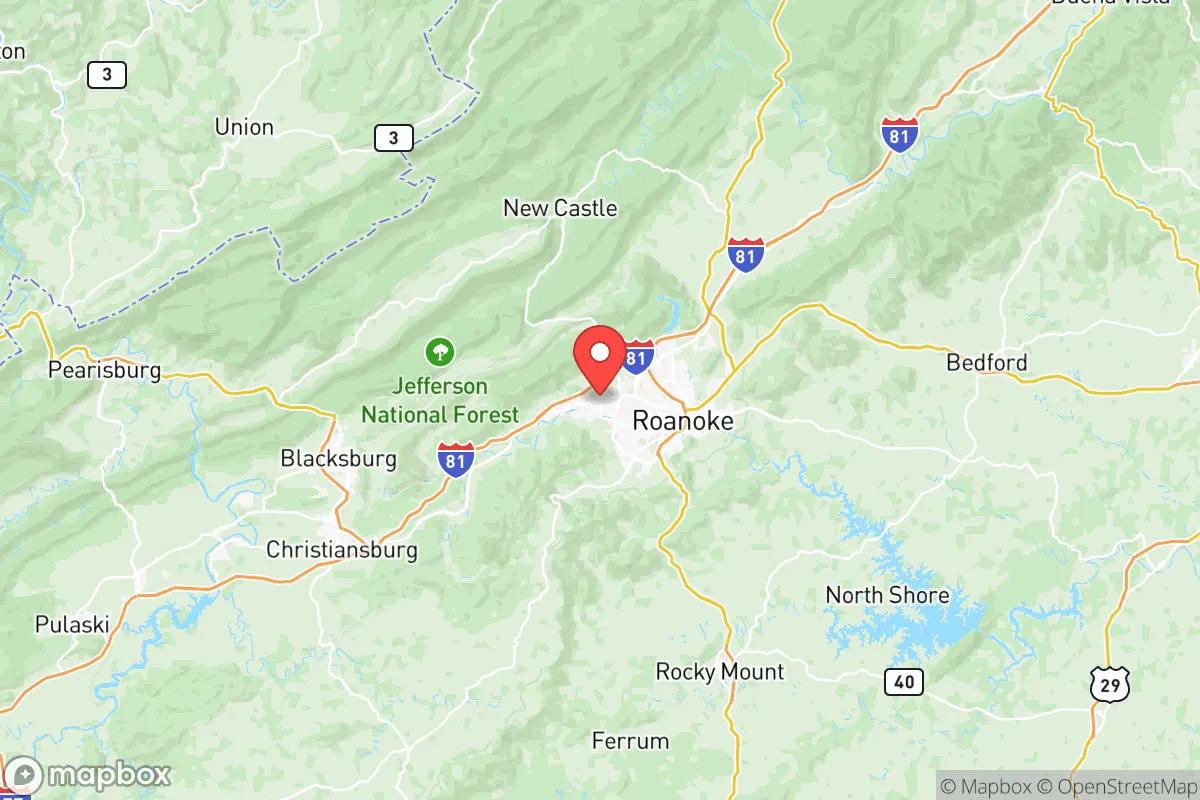
Salem City County, Virginia, is a small, independent city of 25,477 residents that feels more like a tight-knit town than a county, with a population that is 82.4% White and notably less diverse than the national average. Its people are characterized by a strong sense of local identity, rooted in a history of railroad and industrial work, and a demographic profile that has remained remarkably stable over recent decades. The city’s foreign-born population sits at just 2.6%, and its largest minority groups are Black residents at 7.7% and Hispanic residents at 4.5%, with East and Southeast Asian communities making up 1.7% and Indian subcontinent residents 0.3%. This is a place where generational roots run deep, and the population is slowly aging, with a college attainment rate of 31.1% that aligns closely with state averages.
Settlement & growth (pre-1960)
Long before European settlers arrived, the area now known as Salem was part of the homeland of the Siouan-speaking Tutelo and Saponi peoples, who lived along the Roanoke River valley. By the mid-1700s, European colonists—primarily of English, Scots-Irish, and German descent—began pushing westward from the Tidewater region, drawn by the fertile lands of the Shenandoah Valley and the promise of land grants. The Virginia General Assembly officially established the town of Salem in 1802, naming it after the biblical city of peace, and it quickly became a waypoint for travelers on the Great Wagon Road, a major migration route from Pennsylvania into the southern backcountry.
The arrival of the Virginia and Tennessee Railroad in the 1850s transformed Salem from a quiet agricultural hamlet into a bustling railroad town. Irish immigrants, many fleeing the Great Famine, arrived in significant numbers to lay track and work in the rail yards, settling in neighborhoods near the depot in what is now downtown Salem. After the Civil War, freed African Americans established their own community in the area around what became known as the East Salem neighborhood, working as laborers, domestics, and small farmers. The railroad remained the economic backbone through the early 20th century, and by the 1920s, Salem had also become a center for textile manufacturing, drawing additional workers from the surrounding rural counties of Roanoke, Montgomery, and Botetourt. The Great Depression slowed growth, but World War II brought a modest influx of workers to support the nearby Roanoke Army Ammunition Plant and the Norfolk and Western Railway’s expanding operations. By 1960, Salem’s population had reached roughly 16,000, and it was overwhelmingly White and native-born, with a small but established Black community concentrated in East Salem.
Modern era (post-1965)
The 1965 Hart-Cellar Act, which opened immigration from Asia and Latin America, had a muted effect on Salem compared to larger Virginia cities like Northern Virginia or Richmond. The city’s foreign-born population remains low at 2.6%, and the most significant demographic shift since the 1960s has been the gradual suburbanization of the Roanoke Valley. As Roanoke city experienced white flight and economic decline in the 1970s and 1980s, many middle-class families—overwhelmingly White—relocated to Salem for its smaller schools, lower crime rates, and stable property values. This domestic migration reinforced Salem’s existing character rather than diversifying it. The Hispanic population, now 4.5%, began to grow slowly in the 1990s, with families settling in the West Salem area near the industrial parks, drawn by work in construction, landscaping, and poultry processing plants in the broader Roanoke region. The Black population, at 7.7%, has remained relatively stable, with many families still rooted in East Salem and newer arrivals moving into subdivisions near South Salem along Electric Road. East and Southeast Asian residents, at 1.7%, are a small but visible presence, with many families connected to the medical and engineering sectors at nearby Virginia Tech Carilion School of Medicine and LewisGale Medical Center, and they tend to live in the newer developments around North Salem near Interstate 81. The Indian subcontinent population, at 0.3%, is tiny and largely composed of professionals working in healthcare and technology, with no distinct ethnic enclave.
The future
Salem’s population is projected to remain relatively flat or grow only modestly over the next 10 to 20 years, as the city is largely built out with limited land for new development. The population is aging, with a median age slightly above the national average, and the city will likely see a continued slow increase in Hispanic and Asian residents as younger families move in to fill jobs in healthcare, education, and logistics along the I-81 corridor. The Black population share is expected to remain stable, while the White share will gradually decline as the city becomes slightly more diverse, though it will remain predominantly White for the foreseeable future. New residential construction is concentrated in the Glenvar area on the city’s western edge and in infill developments near Salem High School, attracting a mix of young families and retirees. The city’s cultural identity is likely to remain rooted in its small-town, family-oriented character, with a strong emphasis on local schools, community events like the Salem Fair, and a conservative-leaning political culture that values stability over rapid change.
For someone moving in now, Salem offers a predictable, safe, and community-focused environment where the population is slowly diversifying but remains overwhelmingly native-born and White. The city is not a destination for immigrants or a hub of rapid demographic change, but rather a stable, middle-class enclave where newcomers—especially families—will find a place that values tradition, local institutions, and a slower pace of life. The future is one of gentle evolution rather than transformation, making it an attractive option for those seeking continuity in a changing region.

* Values derived from national, state, county, city and local statistics and may differ in a specific area. Last updated: 2026-06-16T03:42:31.000Z
Narrative content on this page is AI-generated and may contain mistakes. Verify any details that matter before acting on them.
ReloMaps may earn a commission from affiliate links at no extra cost to you.

