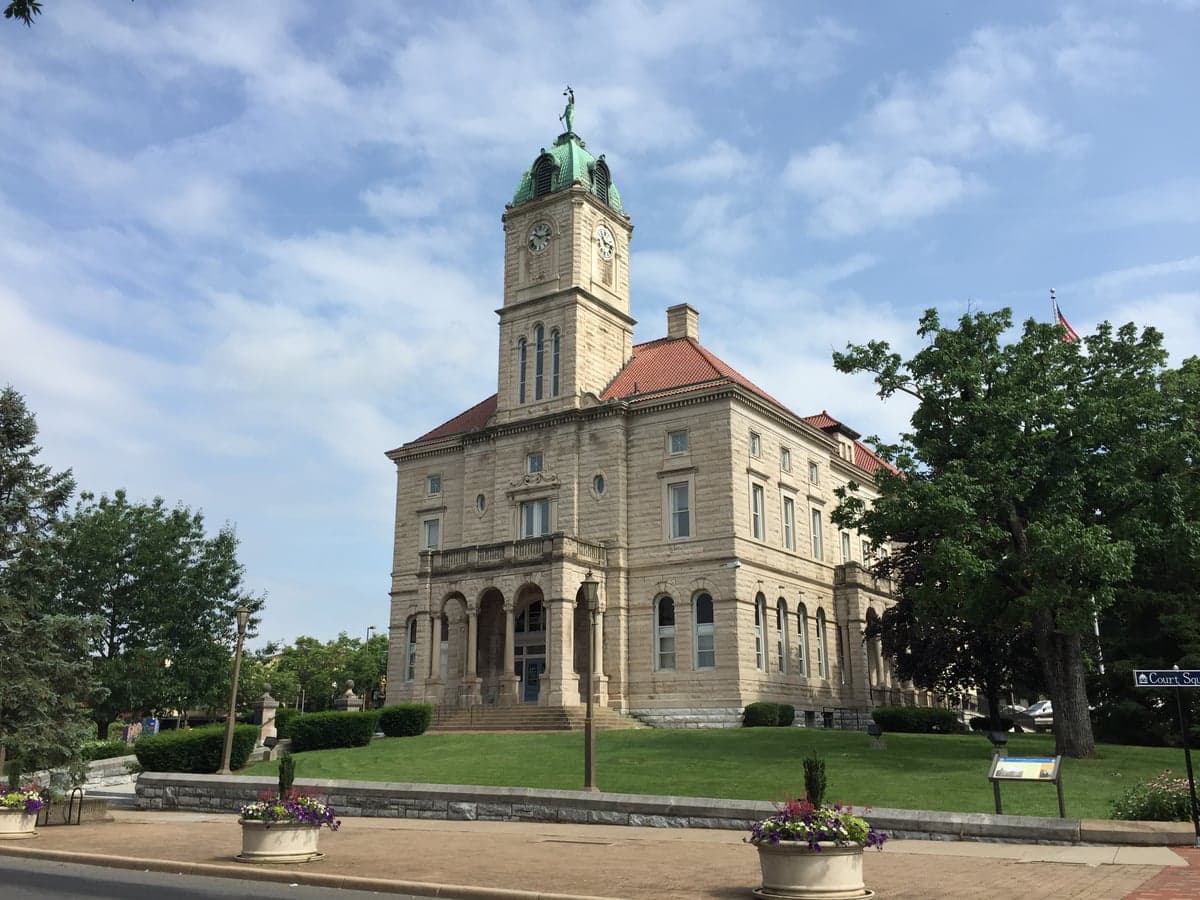
Photo: Wikipedia
Political ClimatePolitical Climate in Rockingham County
Showing state-level results — no local-only data available.
Local Political AnalysisPolitical Analysis of Rockingham County
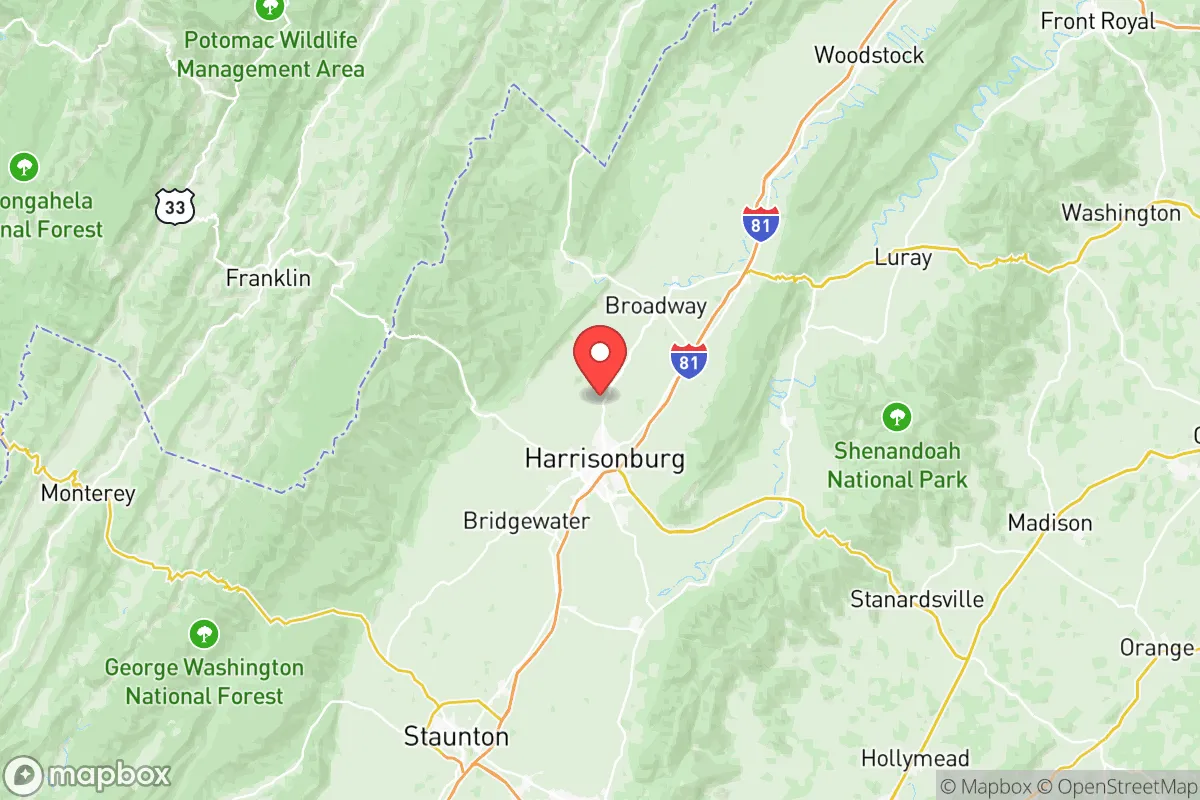
Rockingham County, Virginia, is a reliably conservative area with a Cook Partisan Voting Index of R+12, meaning it votes about 12 points more Republican than the national average. This stands in stark contrast to the state of Virginia as a whole, which has shifted to a D+4 PVI, reflecting the growing Democratic strength in Northern Virginia and urban centers like Richmond and Norfolk. The county has been trending redder over the past decade, even as the state has moved left, driven by a stable base of rural voters and a growing population of conservative-leaning retirees and remote workers seeking lower taxes and more space.
How it compares
Rockingham County is a political outlier within Virginia. While the state swung blue in presidential elections after 2008, Rockingham has consistently voted Republican by wide margins. In 2024, the county gave Donald Trump over 65% of the vote, while Virginia overall went for Kamala Harris by about 5 points. The county's R+12 PVI is a full 16 points more Republican than the state's D+4 rating. This gap is driven by the county's rural character and its distance from the Democratic strongholds of Northern Virginia and the Tidewater region. Within the county, there is variation: the city of Harrisonburg, which is independent but surrounded by Rockingham, leans blue, with precincts near James Madison University often voting Democratic. In contrast, towns like Bridgewater and Dayton are deeply red, while Elkton and Grottoes show more moderate but still Republican tendencies. The swing precincts are typically in the more suburban areas around Harrisonburg, where newer residents sometimes split tickets.
What this means for residents
For conservative residents, Rockingham County feels like a safe haven where their values are reflected in local policy. The county government is reliably Republican, with low taxes and a focus on agricultural and property rights. Gun rights are broadly supported, and there is little appetite for the kind of progressive social policies seen in Richmond. For liberal residents, the political climate can feel isolating, especially in the more rural precincts. However, Harrisonburg provides a progressive counterweight, with its own city council and school board often taking more liberal stances on issues like affordable housing and environmental policy. The practical effect is a kind of political dualism: you can live in the county and drive 15 minutes to Harrisonburg for a more diverse social and cultural scene, or you can stay in the county and enjoy a more traditional, community-oriented lifestyle. The county's growth, driven by proximity to the Shenandoah National Park and a lower cost of living, is slowly bringing in more moderate voices, but the overall trajectory remains solidly red.
Culturally, Rockingham County is defined by its strong Mennonite and Old Order Mennonite communities, which influence local politics around land use, education, and transportation. There is a notable resistance to large-scale development, with many residents favoring agricultural preservation over suburban sprawl. This creates a unique policy distinction: while the county is fiscally conservative, it also supports some government intervention to protect farmland and rural character, which can sometimes align with environmental goals. The local paper, the Daily News-Record, covers county politics with a conservative bent, but Harrisonburg's alternative press offers a different perspective. For anyone moving here, the key is understanding that the county and the city of Harrisonburg are two different political worlds, and your experience will depend heavily on which side of the line you choose to live on.

State Political ClimatePolitical Climate in Virginia
State Political AnalysisPolitical Environment in the State
Virginia is a classic purple state that has drifted blue over the past two decades, now carrying a Cook PVI of D+4, but it remains deeply divided between a rapidly growing, Democratic-leaning urban crescent and a staunchly Republican rural and exurban interior. The shift has been dramatic: as recently as 2008, Virginia voted for a Republican president (John McCain lost it narrowly, but the state had gone red in 2004), but by 2020 and 2024, it was reliably blue at the presidential level, driven by massive population growth in Northern Virginia and the Richmond and Hampton Roads metros. However, the state legislature and governor’s mansion have seesawed between parties, with Republicans winning the governorship in 2021 (Glenn Youngkin) and the House of Delegates in 2023, while Democrats control the state Senate. For a conservative relocator, the reality is that you can find deep-red communities within an hour of deep-blue cities, but the statewide trend is toward Democratic control on most cultural and economic issues.
Urban vs. rural divide
The political map of Virginia is essentially a story of two Virginias. The urban crescent runs from Northern Virginia (Arlington, Alexandria, Fairfax County) down through Richmond and into Hampton Roads (Virginia Beach, Norfolk, Chesapeake). This corridor accounts for roughly two-thirds of the state’s population and votes overwhelmingly Democratic — Fairfax County alone delivered nearly 300,000 more votes for Joe Biden than Donald Trump in 2020. In contrast, rural Southside Virginia (Danville, Martinsville, the counties along the North Carolina border) and the Shenandoah Valley (Harrisonburg, Staunton, Winchester) are deeply red, often voting 65-70% Republican. The exurban counties that ring the DC metro — Loudoun, Prince William, Stafford — have flipped from red to blue over the past decade as high-income professionals and federal contractors moved in. Loudoun County, once a Republican stronghold, now votes Democratic by double digits. Meanwhile, the coal country of Southwest Virginia (Bristol, Wise County) remains some of the most conservative territory east of the Mississippi. The practical takeaway: if you want a conservative environment, look at the Shenandoah Valley, the Richmond suburbs like Chesterfield and Hanover, or the Virginia Beach area (which is more purple than the rest of Hampton Roads). If you want a blue bubble, Northern Virginia is as progressive as anywhere on the East Coast.
Policy environment
Virginia’s policy environment is a mixed bag that reflects its purple status. On taxes, the state has a flat income tax rate of 5.75% (as of 2025), with a standard deduction of $9,000 for individuals. Sales tax is 5.3% statewide, but Northern Virginia and Hampton Roads add an extra 0.7% for local transportation projects. Property taxes are set locally and vary widely — Loudoun County’s rate is around $1.20 per $100 of assessed value, while rural counties like Pittsylvania are under $0.60. The state has a right-to-work law, which keeps union influence low, and it’s a “Dillon Rule” state, meaning local governments only have powers explicitly granted by the state legislature — this limits the kind of patchwork local ordinances you see in places like California. On education, Virginia has a strong public school system overall, but there’s been a fierce battle over parental rights and curriculum: in 2022, Governor Youngkin issued an executive order banning “inherently divisive concepts” in public schools, and the state has seen heated school board meetings over library books and transgender policies. Healthcare is a mixed bag — Virginia expanded Medicaid under the Affordable Care Act in 2019, but the state also has some of the strongest certificate-of-need laws in the country, which limit the number of hospitals and surgical centers. Election laws are moderately restrictive: voter ID is required, early voting is available for 45 days, and same-day registration is not allowed. The state has no straight-ticket voting option.
Recent policy direction
The last five years have seen Virginia swing back and forth on key liberty issues. On gun rights, Virginia is a “shall-issue” state for concealed carry, and in 2024 the Republican-controlled House passed a bill to allow permitless carry, but it died in the Democratic Senate. The state still has a one-handgun-per-month law and universal background checks for private sales, passed in 2020 when Democrats held the trifecta. On parental and education rights, the Youngkin administration pushed through the “Parents’ Bill of Rights” in 2022, which requires schools to notify parents about sexually explicit instructional materials and allows them to opt their children out. On speech, Virginia has no statewide hate speech law, but local school boards have been sued over book bans. On privacy and surveillance, the state passed the Virginia Consumer Data Protection Act in 2021, one of the strongest data privacy laws in the country, but it does not cover government surveillance. On medical and bodily autonomy, abortion is legal up to 26 weeks (the second trimester), with a 24-hour waiting period and parental consent for minors — this was codified in 2020 and has not been rolled back despite Republican control of the House. On property rights, Virginia has no statewide rent control, but localities in Northern Virginia have imposed their own. On voting and ballot access, the state has no-excuse absentee voting and automatic voter registration at the DMV, but it also purges voter rolls regularly — a 2024 lawsuit challenged the removal of 3,400 voters who were flagged as non-citizens. The overall direction is that Democrats have the upper hand on cultural issues (abortion, LGBTQ rights, gun control) while Republicans have held the line on taxes and education, but neither party has a clear enough majority to push through a radical agenda.
Civil unrest & political movements
Virginia has been a flashpoint for political movements on both sides. The 2017 Unite the Right rally in Charlottesville, which turned violent, remains the most infamous event in recent memory, and it galvanized both white nationalist groups and anti-fascist counter-protesters. Since then, the state has seen periodic protests over Confederate monuments — Richmond’s Monument Avenue was the site of massive demonstrations in 2020, leading to the removal of most statues. On the right, the “Parents Matter” movement has been strong in Loudoun and Fairfax counties, with thousands of parents packing school board meetings over critical race theory and transgender policies. On immigration, Virginia is not a sanctuary state, but several localities — including Alexandria, Arlington, and Richmond — have declared themselves sanctuary cities, limiting cooperation with ICE. The state has seen a surge in immigration enforcement debates, particularly in Northern Virginia, where the 2023 “Secure Virginia” bill (which would have required local police to cooperate with ICE) failed in the Democratic Senate. Election integrity has been a hot-button issue: after the 2020 election, Republicans in the state legislature pushed for stricter voter ID laws and a ban on drop boxes, but Democrats blocked most of these efforts. In 2024, the state’s voter roll purge became a national story when the DOJ sued Virginia for removing voters too close to an election. A new resident would notice that political signs are ubiquitous — you’ll see “Youngkin for Governor” signs next to “Black Lives Matter” signs in the same suburban neighborhood, and the culture war is fought out in local school board and county supervisor races as much as in statewide contests.
Projection
Over the next 5-10 years, Virginia is likely to continue its slow drift toward the Democratic column, but the pace will depend on migration patterns. Northern Virginia is still growing faster than the rest of the state, and the influx of federal workers and tech professionals (Amazon’s HQ2 in Arlington is bringing 25,000 jobs) will reinforce the blue tilt. However, the exurbs are also growing — places like Spotsylvania and Stafford are seeing an influx of conservatives fleeing higher taxes in Northern Virginia, which could keep the state competitive. The wild card is the Shenandoah Valley and Southside, which are losing population, reducing their electoral weight. For a conservative moving in now, the realistic expectation is that Virginia will be a blue-leaning purple state for the foreseeable future, meaning you’ll have a Democratic governor about half the time and a Republican governor the other half. The state Senate is likely to remain Democratic for the next decade due to district boundaries, while the House of Delegates will flip back and forth. On policy, expect continued fights over education (school choice, curriculum, transgender rights), gun laws (permitless carry will probably pass if Republicans ever win the Senate), and abortion (Democrats will try to remove the 26-week limit, but it’s unlikely to pass). The biggest change will be in the courts — the Virginia Supreme Court is currently 5-2 Republican, but two justices will reach mandatory retirement age by 2028, and if Democrats control the legislature, they’ll flip the court, which could reshape everything from redistricting to property rights.
For a new resident, the bottom line is that Virginia offers a genuine choice: you can live in a deep-red county with low taxes and conservative schools, or in a blue city with high amenities and progressive policies, all within a two-hour drive. The state’s political climate is not for someone who wants ideological purity — you’ll have to share power with the other side, and the culture war is constant. But if you value a state where your vote actually matters (presidential elections are close, state legislative races are competitive), and you’re willing to pick a community that matches your values, Virginia is one of the few places left where both sides have a real shot at winning. Just know that the statewide trend is blue, and if you’re a conservative, you’ll need to be comfortable living in a state where your governor is often a Democrat and your local school board might be controlled by progressives — unless you pick your county carefully.
* Values derived from national, state, county, city and local statistics and may differ in a specific area. Last updated: 2026-09-23T20:13:59.000Z
Narrative content on this page is AI-generated and may contain mistakes. Verify any details that matter before acting on them.
ReloMaps may earn a commission from affiliate links at no extra cost to you.

