
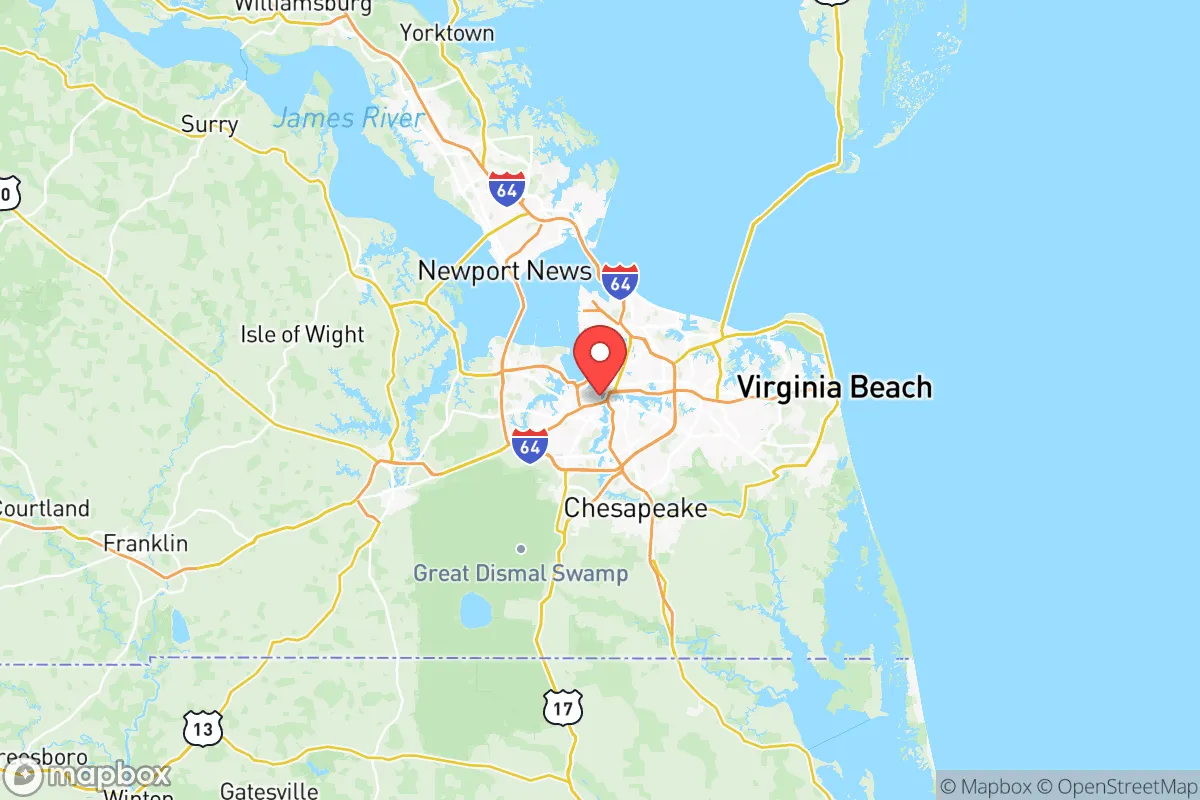
Photo by Matt Hardison on Unsplash
Political ClimatePolitical Climate in Portsmouth City County
Showing district-level results — no local-only data available.
Local Political AnalysisPolitical Analysis of Portsmouth City County
Portsmouth City County, Virginia, is a solidly Democratic stronghold with a Cook PVI of D+18, making it one of the most reliably blue jurisdictions in the Hampton Roads region. This isn't a recent shift—Portsmouth has voted Democratic in every presidential election since 2000, and the margin has only widened over time. In 2024, the county backed Kamala Harris by roughly 30 points, a stark contrast to the statewide Virginia PVI of D+4, which reflects a much more competitive purple state. The political energy here is driven by a predominantly African American population (over 50%), a strong union presence tied to the Norfolk Naval Shipyard, and a working-class base that has consistently favored Democratic economic and social policies.
How it compares
Portsmouth's D+18 rating is 14 points more Democratic than Virginia as a whole, placing it in the same league as Richmond City (D+19) and Norfolk (D+16). While Virginia has swung toward the center in recent cycles—electing Republican governors in 2021 and 2025—Portsmouth has moved in the opposite direction, becoming more uniformly blue. The county's internal geography tells a nuanced story: the western neighborhoods like Churchland and the area around the Western Branch High School lean more moderate, occasionally producing competitive city council races, while the historic downtown, Olde Towne, and the southern precincts near the shipyard are deep blue. There are no true red precincts in Portsmouth, but the swing areas are concentrated in the Cradock and Port Norfolk neighborhoods, where independent and moderate voters can tip local elections. By contrast, neighboring Chesapeake (R+8) and Suffolk (R+6) are reliably Republican, making Portsmouth a blue island in a region that's otherwise politically mixed.
What this means for residents
For liberal residents, Portsmouth's political climate means consistent alignment with city policies on affordable housing initiatives, public transit expansion (like the Elizabeth River Ferry), and police reform measures. The city council has been Democratic-controlled for decades, and local elections rarely feature competitive Republican challengers. For conservative residents, the reality is more about adaptation: you'll find a vocal minority of GOP voters, especially in Churchland and the more suburban western edge, but they have little influence on citywide outcomes. School board meetings and zoning hearings are where conservative voices get heard, but major policy shifts—like the 2023 decision to remove a Confederate monument from the courthouse lawn—pass with little opposition. The practical effect is that property taxes remain moderate (around $1.05 per $100 of assessed value), and city services are stable, but there's little appetite for the kind of tax-cutting or deregulation seen in redder Virginia counties.
Culturally, Portsmouth stands apart from the rest of Virginia in its deep-rooted naval identity and its embrace of progressive urbanism. The city's Olde Towne district is a hub for LGBTQ+ friendly events and art galleries, while the annual "Portsmouth Seawall Festival" draws a diverse crowd. Unlike the more suburban, car-dependent feel of Chesapeake or Virginia Beach, Portsmouth's compact footprint and historic architecture foster a walkable, community-oriented vibe. The biggest policy distinction is the city's aggressive approach to flood mitigation and climate resilience, which has bipartisan support given the tidal flooding risks, but is funded through bonds and grants that align with Democratic priorities. For anyone moving here, the political climate is less about daily friction and more about understanding that Portsmouth is a blue-collar blue city in a purple state—proud, stable, and unlikely to change its stripes anytime soon.

State Political ClimatePolitical Climate in Virginia
State Political AnalysisPolitical Environment in the State
Virginia has shifted from a reliably purple swing state to a solidly Democratic-leaning one over the past two decades, now carrying a Cook PVI of D+4. The transformation is driven by explosive growth in the Washington, D.C. suburbs, particularly in Northern Virginia, which now supplies a massive Democratic vote margin that overwhelms the rest of the state. While the state still elects a Republican governor (Glenn Youngkin won in 2021) and has a competitive House of Delegates, the long-term trajectory is clearly blueward, with Democrats controlling both chambers of the General Assembly and the governorship alternating between parties.
Urban vs. rural divide
The political map of Virginia is a stark study in contrast. The Democratic stronghold is Northern Virginia, anchored by Arlington, Alexandria, and Fairfax County, which together cast over 1.5 million votes and deliver margins of 60-70% for Democrats. The Richmond metro area, including Henrico County and Chesterfield County, has also trended blue, with Chesterfield flipping from red to purple in the last decade. Hampton Roads (Norfolk, Virginia Beach) is a mixed bag: Virginia Beach leans slightly right, while Norfolk and Portsmouth are solidly Democratic. The rural southside and Southwest Virginia—places like Roanoke, Lynchburg, and the coal country around Wise County—remain deeply Republican, often voting 70-80% for GOP candidates. The key battlegrounds are the exurban counties like Loudoun and Prince William, which were once swing areas but have moved decisively Democratic as D.C. commuters and tech workers have moved in. The 2021 gubernatorial race saw Youngkin win by flipping some of these exurban precincts back to the GOP, but the underlying demographic trend is still blueward.
Policy environment
Virginia’s policy environment is a mixed bag that reflects its purple-to-blue status. The state has a flat income tax rate of 5.75%, which is moderate by national standards, and a state sales tax of 4.3% (plus local add-ons). Property taxes are set locally and vary widely—Loudoun County has rates around $1.20 per $100 of assessed value, while rural counties like Grayson County are under $0.50. The regulatory posture is business-friendly in many respects, with a right-to-work law and a corporate tax rate of 6%. However, the state has moved left on social issues: it expanded Medicaid under the Affordable Care Act in 2018, legalized marijuana possession (up to one ounce) in 2021, and abolished the death penalty in 2021. Education policy is a flashpoint: Governor Youngkin pushed for expanded school choice and parental rights, including a model policy on transgender students that requires parental notification, but the Democratic legislature has blocked many of his initiatives. Election laws are moderately accessible: Virginia has no-excuse absentee voting, early voting starting 45 days before an election, and same-day voter registration. Voter ID is required but can be a photo ID or a utility bill.
Recent policy direction
The last five years have seen Virginia lurch left on several fronts, then partially pull back. In 2020, the Democratic-controlled General Assembly passed a sweeping gun control package including universal background checks, a red flag law, and a one-handgun-per-month limit. In 2021, the state legalized marijuana possession and set up a retail market (which has been slow to launch). On education, the 2022 "Model Policies on the Treatment of Transgender Students" required schools to notify parents if a child requests a name or pronoun change, and to restrict transgender athletes from participating in sports matching their gender identity. These policies were challenged in court and are currently in flux. On property rights, Virginia has seen a push for more renewable energy siting, with the Virginia Clean Economy Act of 2020 mandating a carbon-free grid by 2050, which has led to conflicts over solar farm placement in rural areas. On voting, the 2021 Voting Rights Act (the Virginia Voting Rights Act) expanded protections against voter suppression, but also drew criticism from conservatives who argued it could lead to ballot harvesting. The state has not passed any major privacy or surveillance laws, though a 2021 law limited the use of facial recognition by police. On medical and bodily autonomy, Virginia remains a relative safe haven for abortion access in the South, with no gestational limit on abortion before the third trimester, though a 2024 law requires a 24-hour waiting period and an ultrasound.
Civil unrest & political movements
Virginia has been a flashpoint for political movements on both sides. The 2017 "Unite the Right" rally in Charlottesville was a national shock, leading to the removal of Confederate statues and a renewed push for racial justice. The 2020 Black Lives Matter protests in Richmond saw the toppling of the Robert E. Lee statue on Monument Avenue, which became a symbol of the cultural war. On the right, the "Parents Matter" movement has been strong in Loudoun County, where school board meetings became heated over critical race theory and transgender policies. The 2021 gubernatorial race was heavily influenced by these education battles. Immigration politics are less visible than in border states, but Prince William County has been a battleground over sanctuary policies, with the county board voting in 2020 to limit cooperation with ICE. Election integrity controversies have been muted compared to other states, though the 2020 election saw Trump’s legal team challenge results in Fairfax County without success. The state has not seen serious secession or nullification rhetoric, though some rural counties have discussed joining West Virginia.
Projection
Over the next 5-10 years, Virginia will likely continue its slow drift leftward, driven by the continued growth of Northern Virginia and the urbanization of the Richmond and Hampton Roads metros. The state’s population is projected to grow by about 1 million people by 2035, with most of that growth in the D.C. suburbs. This will make it increasingly difficult for Republicans to win statewide, though the party can still compete in gubernatorial races by focusing on education and economic issues. The rural-urban divide will deepen, with rural areas becoming more Republican and urban areas more Democratic. The state’s policy environment will likely see further moves on gun control, environmental regulation, and social issues, though the pace may slow if Republicans retake the governorship in 2025. A new resident moving in now should expect a state that is politically competitive at the top of the ticket but increasingly blue in its policy direction, with a strong progressive tilt in the D.C. suburbs and a conservative counterweight in the rest of the state.
For a conservative relocator, Virginia offers a mixed picture: low taxes and a business-friendly climate, but a social and regulatory environment that is moving left. You’ll find like-minded communities in the exurbs and rural areas, but you’ll also face a state government that is increasingly Democratic. For a liberal relocator, Virginia is a solid choice: good schools, strong job market, and a government that is generally aligned with your values, though you’ll need to navigate a state that is still purple enough to elect a Republican governor. The bottom line: Virginia is a state in transition, and your experience will depend heavily on which county you choose to call home.
* Values derived from national, state, county, city and local statistics and may differ in a specific area. Last updated: 2026-07-29T07:22:06.000Z
Narrative content on this page is AI-generated and may contain mistakes. Verify any details that matter before acting on them.
ReloMaps may earn a commission from affiliate links at no extra cost to you.

