
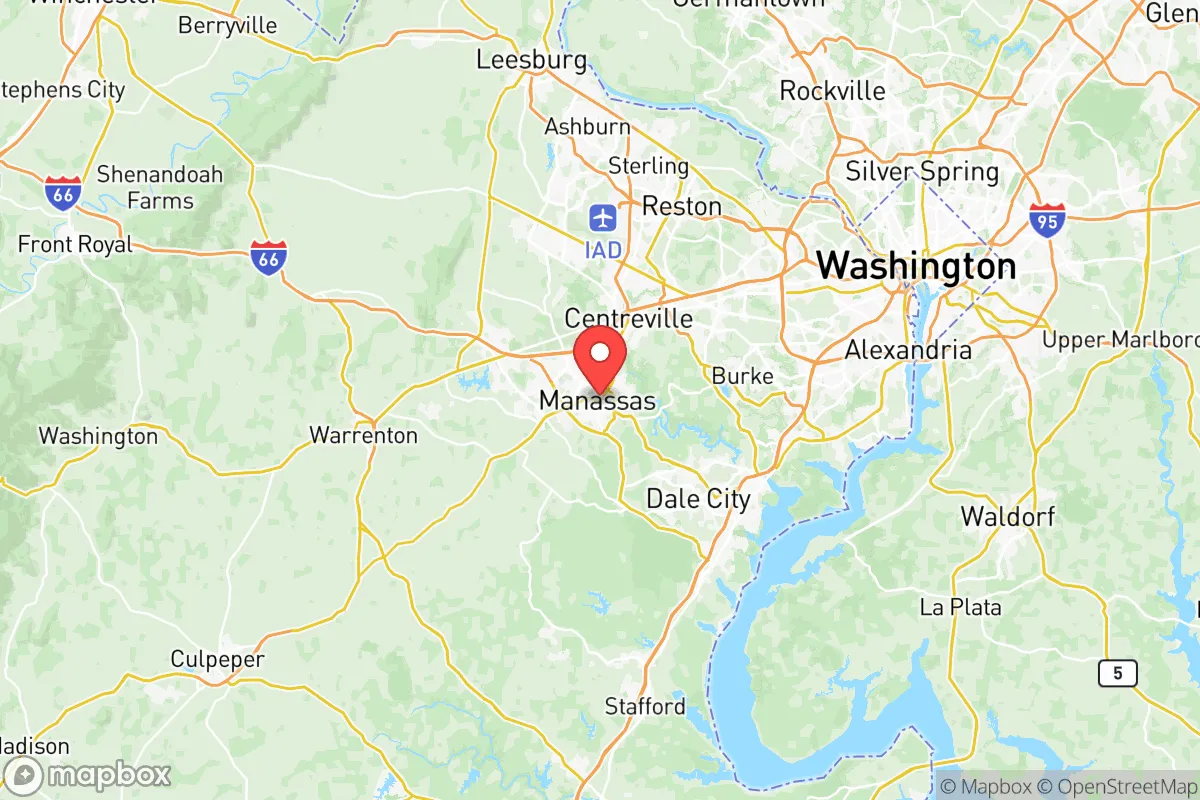
Photo by Brian LeFevre on Unsplash
Political ClimatePolitical Climate in Manassas City County
Showing district-level results — no local-only data available.
Local Political AnalysisPolitical Analysis of Manassas City County
Manassas City County is a reliably Democratic-leaning jurisdiction in Northern Virginia, carrying a Cook Partisan Voting Index (PVI) of D+6, which makes it two points more Democratic than the state of Virginia as a whole (D+4). This isn't a deep-blue stronghold like Arlington or Alexandria, but rather a solidly blue city in a region that has shifted leftward over the past two decades. The city's trajectory has been steadily Democratic since the early 2000s, driven by rapid suburbanization, an increasingly diverse population, and the gravitational pull of the D.C. metro economy. In 2020, Joe Biden won Manassas City by roughly 18 points, while the state overall went for Biden by about 10 points — a pattern that has held in recent cycles.
How it compares
Compared to Virginia as a whole, Manassas City is noticeably more Democratic, but the gap is narrower than you might expect given its location in the D.C. suburbs. The key difference is that Manassas City lacks the deep-red rural and exurban precincts that pull the state's PVI toward the center. Within the city itself, political variation is minimal — it's a compact, 10-square-mile jurisdiction with no unincorporated areas or separate towns. That said, there are subtle neighborhood-level divides. The western side of the city, near the Prince William County line and the historic downtown, tends to lean slightly more moderate, with some precincts around the Manassas Regional Airport showing a 5-7 point Democratic edge rather than the 15+ point margins seen in the eastern neighborhoods near the Bull Run and Sudley areas. The eastern precincts, particularly around Sudley Manor Drive and the neighborhoods near the Prince William Forest Park, are the most reliably blue, driven by younger families and a higher concentration of federal government workers. There are no red-leaning towns within Manassas City — the entire city is a single political entity — but the contrast with surrounding Prince William County (also D+6) is negligible, while the contrast with neighboring Manassas Park (D+8) is slightly more pronounced.
What this means for residents
For liberal residents, the political climate is broadly comfortable. Local elections are dominated by Democrats, and the city council and school board reflect that majority. Progressive policies on housing density, transit-oriented development, and environmental initiatives tend to pass without major opposition. For conservative residents, the situation is more nuanced. While they are a clear minority, they are not marginalized — the city's Republican committee remains active, and conservative voices are heard in local debates, particularly around tax rates and school curriculum. The practical effect of the D+6 lean is that conservative candidates rarely win citywide office, but they can influence outcomes in primaries and single-issue ballot measures. The city's politics are less polarized than in many parts of Virginia — there's a pragmatic, business-friendly streak among local Democrats that keeps the tone civil. The biggest cultural distinction from the rest of Virginia is the city's heavy reliance on federal employment and defense contracting, which makes local politics unusually sensitive to federal budget cycles and D.C. policy shifts.
One cultural and policy distinction worth noting: Manassas City has a notably higher proportion of Hispanic residents (about 35%) than Virginia as a whole (about 10%), and this demographic reality shapes local politics in ways that are less visible in the state's broader political landscape. Immigration policy, language access in schools, and affordable housing are front-burner issues here in a way they aren't in, say, Roanoke or Virginia Beach. The city's Democratic lean is reinforced by this diversity, but it also creates internal tensions within the local party between more moderate, pro-business factions and a progressive wing focused on social services and tenant protections. On the whole, Manassas City is a place where the political temperature is warm but not hot — a blue city in a purple state, where the real action is less about partisan warfare and more about the nuts and bolts of managing a fast-growing, diverse, economically dynamic community.

State Political ClimatePolitical Climate in Virginia
State Political AnalysisPolitical Environment in the State
Virginia has shifted from a reliably purple swing state to a solidly Democratic-leaning one over the past two decades, carrying a Cook Partisan Voting Index of D+4. The transformation has been driven primarily by explosive population growth in the Washington, D.C. suburbs—specifically in counties like Loudoun, Prince William, and Fairfax—which now dominate statewide elections. While the state voted for Democrats in every presidential election since 2008, the margins have tightened in recent cycles, and Republicans have shown resilience in down-ballot races, particularly for Governor, where Glenn Youngkin won in 2021 by threading a needle between the urban and rural coalitions.
Urban vs. rural divide
The political map of Virginia is a textbook study in geographic polarization. The Democratic stronghold is the densely populated crescent from Northern Virginia (Arlington, Alexandria, Fairfax County) down through Richmond and into Hampton Roads (Norfolk, Virginia Beach). These three regions alone account for roughly two-thirds of the state's vote. Loudoun County, once a Republican bastion, flipped decisively blue in the 2010s and now delivers margins of 20+ points for Democrats. Meanwhile, rural and exurban Virginia—places like the Shenandoah Valley (Harrisonburg, Staunton), Southside (Danville, Martinsville), and Southwest Virginia (Bristol, Abingdon)—votes overwhelmingly Republican, often by 40-50 point margins. The dividing line runs roughly along the I-95 corridor and the fall line; west of that, the landscape and politics shift dramatically. A notable exception is the city of Charlottesville, a liberal island in a conservative sea of central Virginia, while Virginia Beach remains a genuine swing area within the Hampton Roads region.
Policy environment
Virginia's policy environment reflects its split personality. The state has a relatively low corporate income tax rate (6%) and a flat individual income tax rate of 5.75%, though Democrats have pushed for progressive brackets. Property taxes are set at the local level and are generally moderate, though Northern Virginia's rates are higher to fund well-regarded public schools. The state's regulatory posture is mixed: it's a right-to-work state with a business-friendly reputation, but recent Democratic majorities have enacted stricter environmental regulations (including joining the Regional Greenhouse Gas Initiative, though Youngkin later withdrew) and expanded Medicaid under the Affordable Care Act. Education policy has been a flashpoint: Youngkin championed "parental rights" and ended mask mandates, while Democrats have pushed for increased funding and diversity initiatives. Election laws are relatively accessible—no-excuse absentee voting, same-day registration during early voting, and automatic voter registration—but the state maintains voter ID requirements.
Recent policy direction
The last five years have seen Virginia swing back and forth on key liberty-related issues. On gun rights, the 2020 Democratic trifecta passed a package of laws including universal background checks, a "red flag" law, and a one-handgun-per-month limit, but a 2021 court ruling and Youngkin's election have stalled further restrictions. Self-defense law remains relatively strong: Virginia is a shall-issue state for concealed carry, and permitless open carry is legal for adults. On parental and education rights, Youngkin's 2022 executive order on "inherent parental rights" and the subsequent model policies on transgender students have created a patchwork—some school boards follow the state guidance, others (like Fairfax County) openly defy it. Medical and bodily autonomy: Virginia has codified abortion access up to the second trimester, with a 2020 law removing many restrictions, making it a regional destination for the procedure. Property rights are generally strong, though localities in Northern Virginia have imposed rent control and inclusionary zoning. On privacy and surveillance, Virginia passed the Consumer Data Protection Act in 2021, one of the strongest state-level privacy laws in the country. Voting access has been expanded under Democrats, but Republicans have raised concerns about ballot drop-box security and the state's automatic voter registration system.
Civil unrest & political movements
Virginia has been a stage for some of the most visible political flashpoints in the country. The 2017 "Unite the Right" rally in Charlottesville and the subsequent violence put the state in the national spotlight and galvanized both anti-racist activism and conservative backlash. The 2020 racial justice protests in Richmond, which included the toppling of Confederate statues on Monument Avenue, were among the largest in the South. More recently, the 2021 parental rights movement—sparked by school mask mandates and critical race theory debates—mobilized thousands of conservative parents, particularly in Loudoun and Chesterfield counties, and directly contributed to Youngkin's victory. Immigration politics are less heated than in border states, but Northern Virginia's sanctuary city policies (Fairfax County limits cooperation with ICE) have been a recurring legislative battleground. Election integrity remains a live issue: the 2020 election ran smoothly, but Republican activists continue to push for stricter ballot security measures, and the state's automatic voter registration system has been criticized for potential errors. A new resident in Northern Virginia will notice political yard signs and activist energy year-round; in rural areas, the politics are quieter but deeply held.
Projection
Over the next 5-10 years, Virginia's Democratic lean is likely to deepen, but not uniformly. The D.C. suburbs will continue to grow and become more diverse, pushing the state further left on social and environmental issues. However, the in-migration pattern includes both liberal professionals from the Northeast and conservative retirees from other states, creating a complex demographic stew. The key battleground will be the exurban counties—places like Spotsylvania, Stafford, and Hanover—where growth is fastest and political affiliation is fluid. Republicans can still win statewide by running moderate, business-friendly candidates who can peel off suburban women and independents, as Youngkin demonstrated. But the state's electoral college-like structure (with its heavily Democratic population centers) means that a generic Republican will struggle in presidential years. For a new resident, the practical takeaway is that Virginia will remain a state where your experience depends heavily on your zip code: Northern Virginia will feel like a progressive Northeast corridor, while the rest of the state will feel like a traditional Southern commonwealth.
For someone moving to Virginia, the bottom line is that you are choosing a state that is politically divided at every level—geographically, culturally, and in its policy direction. If you are a conservative, you will find welcoming communities in the Shenandoah Valley, Southside, and Southwest, but you will be voting in a state where your presidential vote is effectively moot. If you are a liberal, you will find your people in the cities and suburbs, but you will pay higher taxes and housing costs for the privilege. The state's trajectory suggests that these divisions will not resolve anytime soon, but Virginia's tradition of pragmatic governance—even in divided government—means that most residents can find a comfortable niche without feeling constantly at war with their neighbors.
* Values derived from national, state, county, city and local statistics and may differ in a specific area. Last updated: 2026-08-24T19:33:11.000Z
Narrative content on this page is AI-generated and may contain mistakes. Verify any details that matter before acting on them.
ReloMaps may earn a commission from affiliate links at no extra cost to you.

