Photo: Wikipedia
Demographics of Vergennes, VT
Affluence Level in Vergennes, VT
A middle-class area roughly in line with national averages across income, home values, education, and employment.
People of Vergennes, VT
The people of Vergennes, Vermont, today number 2,571, forming a tight-knit, predominantly white community with a distinctive small-city identity rooted in industrial history rather than college-town culture. With a foreign-born population of just 0.5% and a 94.3% white share, Vergennes remains one of Vermont's most ethnically homogeneous municipalities, though its 35.1% college-educated rate signals a modest professional class. The city's character is defined by its compact, walkable downtown along Otter Creek, a strong sense of local pride, and a population density that feels more like a working village than a typical Vermont town.
How the city was settled and grew
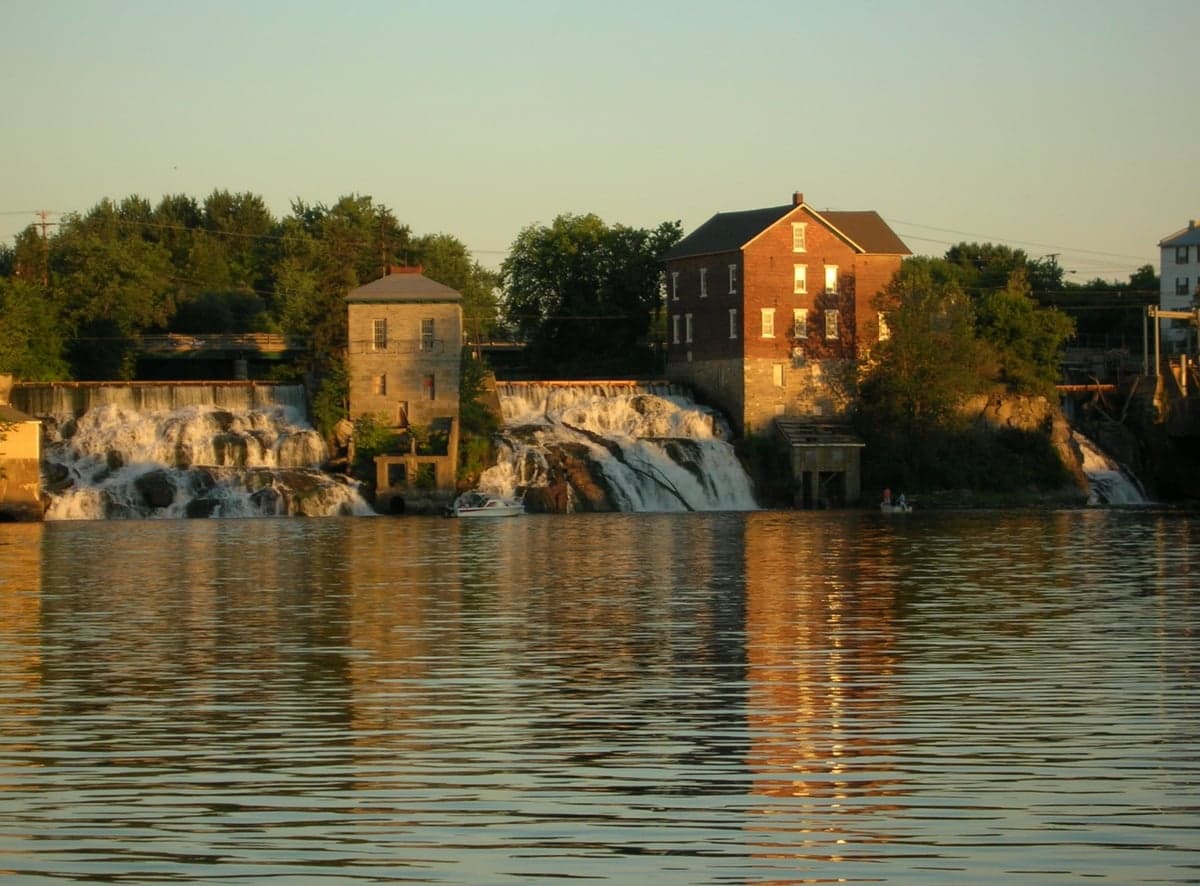
Vergennes was chartered in 1763 and formally incorporated as Vermont's first city in 1788, predating even Montpelier. Its original settlers were primarily Yankee farmers and millwrights from southern New England, drawn by the water power of Otter Creek and the promise of fertile Champlain Valley bottomland. The first wave built homes in what is now the City Center Historic District, clustering around the falls where gristmills and sawmills rose. By the 1820s, the Champlain Canal connected Vergennes to Lake Champlain and the Hudson River, triggering a second wave of Irish laborers who dug the canal and settled in the Battery Street and Green Street neighborhoods, building the city's first Catholic parish. A third wave arrived after the Civil War: French Canadian mill workers from Quebec, who took jobs in the city's iron foundries, marble mills, and the massive Vergennes Machine Company. They concentrated in the North End along Main Street and in the Ferry Street corridor, establishing St. Peter's Church and French-language schools that persisted into the 1950s. By 1900, Vergennes was a bustling industrial city of 2,200, with a population that was roughly 60% Yankee Protestant, 25% French Canadian Catholic, and 15% Irish Catholic.
Modern era (post-1965)
The post-1965 period brought no significant immigration wave to Vergennes. The city's foreign-born share peaked at roughly 2% in the 1970s and has since declined to 0.5%. Instead, the major demographic shift has been domestic: a slow out-migration of younger adults seeking jobs in Burlington or beyond, partially offset by an influx of retirees and remote workers from southern New England and the mid-Atlantic. These newcomers have gravitated toward the South End and Panton Road corridor, where newer single-family subdivisions and renovated historic homes offer walkable access to downtown. The city's Hispanic share (1.6%) and Black share (2.0%) are small but represent a slight increase from near-zero in 1990, driven largely by a handful of families employed at the nearby Sabic Innovative Plastics plant or in seasonal hospitality. The East/Southeast Asian and Indian subcontinent populations remain at 0.0%, reflecting the city's limited economic draw for immigrant communities. The college-educated share has risen from roughly 20% in 2000 to 35.1% today, as the remote-work trend has brought in professionals who value Vergennes' affordability relative to Burlington and its historic downtown character.
The future
Vergennes' population is projected to remain stable or decline slightly over the next decade, with the median age (currently 42) likely rising as younger families continue to leave for larger job markets. The city is not homogenizing further—it is already as homogeneous as a Vermont municipality can be—but it is also not tribalizing into distinct ethnic enclaves, as no single immigrant group has reached a critical mass to form a neighborhood. The small Hispanic and Black populations are dispersed across the City Center and Ferry Street areas, with no concentrated ethnic district emerging. The most likely demographic change is a continued increase in the share of college-educated remote workers, who will further gentrify the North End and Battery Street neighborhoods, potentially pricing out the remaining working-class families. The foreign-born share is unlikely to rise above 1-2% given the city's limited job base and housing stock.
For someone moving in now, Vergennes offers a stable, historically grounded community where the population is aging in place and new arrivals are overwhelmingly white, native-born, and professional. It is not a place of rapid demographic change or cultural diversity, but rather a small city where the past remains visible in its neighborhoods and the future looks much like the present—quiet, homogeneous, and rooted in local tradition.

* Values derived from national, state, county, city and local statistics and may differ in a specific area. Last updated: 2026-04-30T14:48:33.000Z
Narrative content on this page is AI-generated and may contain mistakes. Verify any details that matter before acting on them.
ReloMaps may earn a commission from affiliate links at no extra cost to you.

