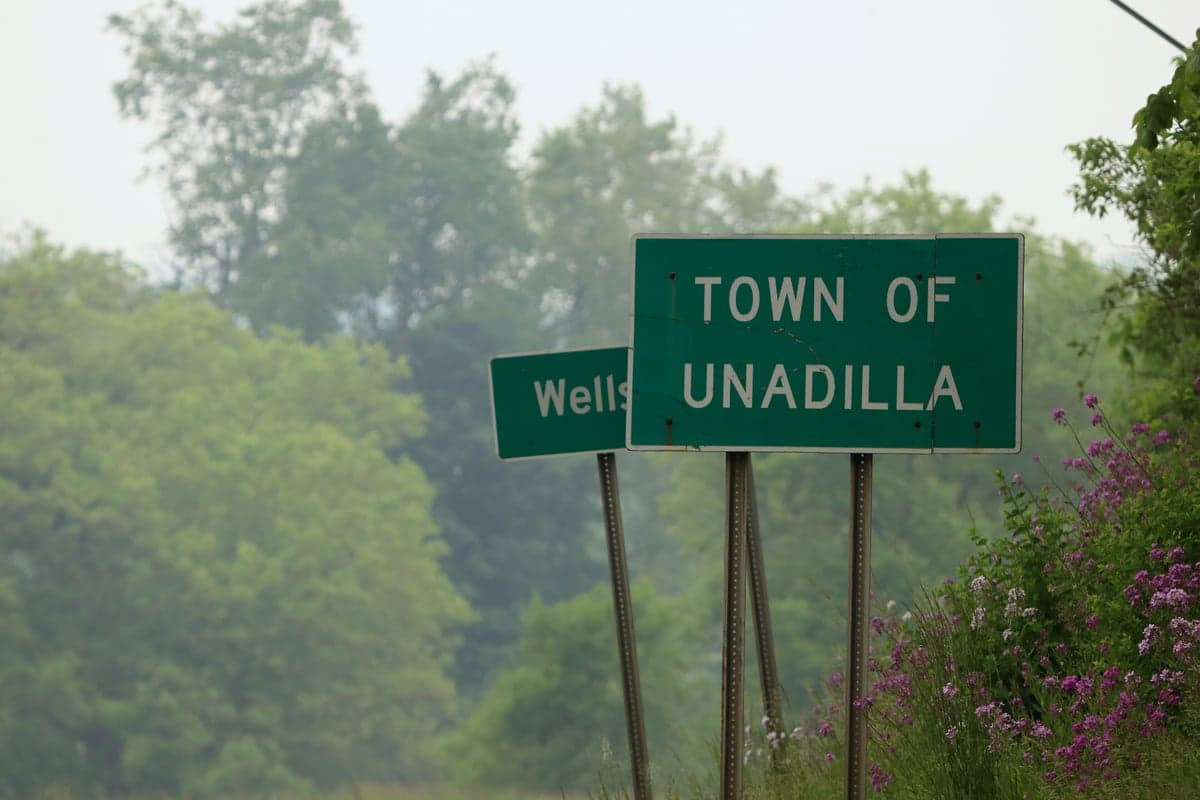
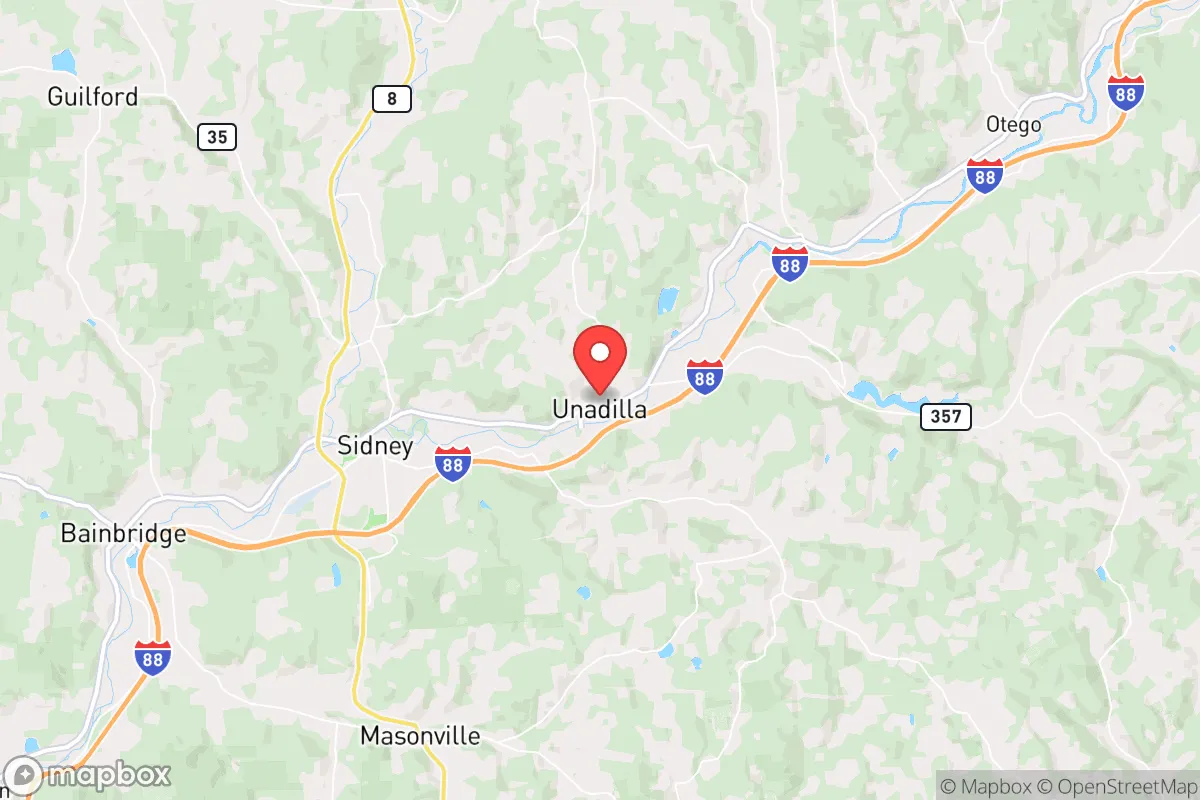
Photo: Wikipedia
Demographics of Unadilla, NY
Affluence Level in Unadilla, NY
A below-average socioeconomic profile. Incomes, home values, and educational attainment trail the U.S., with higher poverty and unemployment.
People of Unadilla, NY
The people of Unadilla, New York, today form a small, predominantly white community of 1,140 residents, with a distinctive 6.1% Indian-subcontinent population—a share roughly triple the national average for a village its size. The village is notably less diverse than the national average in other categories, with no Black residents and a 3.4% Hispanic population. Characterized by a 25.4% college-educated rate and a 7.6% foreign-born share, Unadilla’s identity is shaped by its historic role as a Susquehanna River mill town and a more recent, quiet wave of professional immigration tied to the regional dairy and manufacturing economy.
How the city was settled and grew
Unadilla was first settled by European colonists in the 1770s, primarily by farmers of English and Dutch descent who purchased land from the Oneida people. The village was formally incorporated in 1827, and its growth was driven by the construction of the Chenango Canal (1837) and later the railroad, which made it a hub for dairy, lumber, and hop production. The original settlement clustered around what is now Main Street and the riverfront, where mills and warehouses lined the banks. By the late 19th century, Irish and German immigrants arrived to work in the tanneries and hop fields, settling in the South Side neighborhood along the river. A smaller wave of Italian immigrants followed around 1900, concentrating near the railroad depot in what locals call Depot Hill. The population peaked at roughly 1,800 in the 1910 census, then declined as rail and canal traffic faded.
Modern era (post-1965)
After the 1965 Hart-Cellar Act, Unadilla saw little of the large-scale immigration that transformed larger U.S. cities. Instead, the most notable demographic shift came from domestic in-migration: a small but steady arrival of Indian-subcontinent professionals, primarily doctors and engineers, who began settling in the 1990s and 2000s. These families, drawn by positions at the regional hospital and nearby dairy-processing plants, concentrated in the West End neighborhood, a newer subdivision of single-family homes built in the 1990s and 2000s. The Indian-subcontinent population now stands at 6.1%, making it the largest non-white group. Meanwhile, the white population declined from over 95% in 1990 to 84.6% today, reflecting both out-migration of younger locals to larger cities and the aging of the remaining white cohort. The Hispanic population (3.4%) is small and dispersed, with no distinct ethnic neighborhood. The East/Southeast Asian population remains at 0.0%.
The future
Unadilla’s population is projected to remain stable or decline slightly over the next 10–20 years, mirroring broader trends in rural upstate New York. The village’s foreign-born share (7.6%) is likely to hold steady or increase modestly, driven by continued Indian-subcontinent professional immigration to the region’s healthcare and agribusiness sectors. These families are expected to continue settling in the West End and, increasingly, in the River Road corridor, where newer housing stock is available. The white population will likely continue its slow decline as older residents pass away and younger adults move to larger employment centers like Binghamton or Albany. The village is not becoming more diverse in the broad sense—Hispanic and Black populations are expected to remain very low—but the Indian-subcontinent community is becoming a more visible and integrated part of local life, with families participating in school boards and local businesses. No new large-scale housing developments are planned, so growth will be infill and replacement.
For someone moving in now, Unadilla offers a stable, quiet, and predominantly white community with a notable Indian-subcontinent professional enclave. It is not a place of rapid demographic change or cultural flux, but rather a small village where a modest wave of professional immigration has added a layer of diversity without fundamentally altering the area’s rural, conservative character. New residents should expect a tight-knit, low-density environment where the school, the hospital, and the local dairy industry are the primary anchors of community life.

* Values derived from national, state, county, city and local statistics and may differ in a specific area. Last updated: 2026-10-21T11:36:40.000Z
Narrative content on this page is AI-generated and may contain mistakes. Verify any details that matter before acting on them.
ReloMaps may earn a commission from affiliate links at no extra cost to you.

