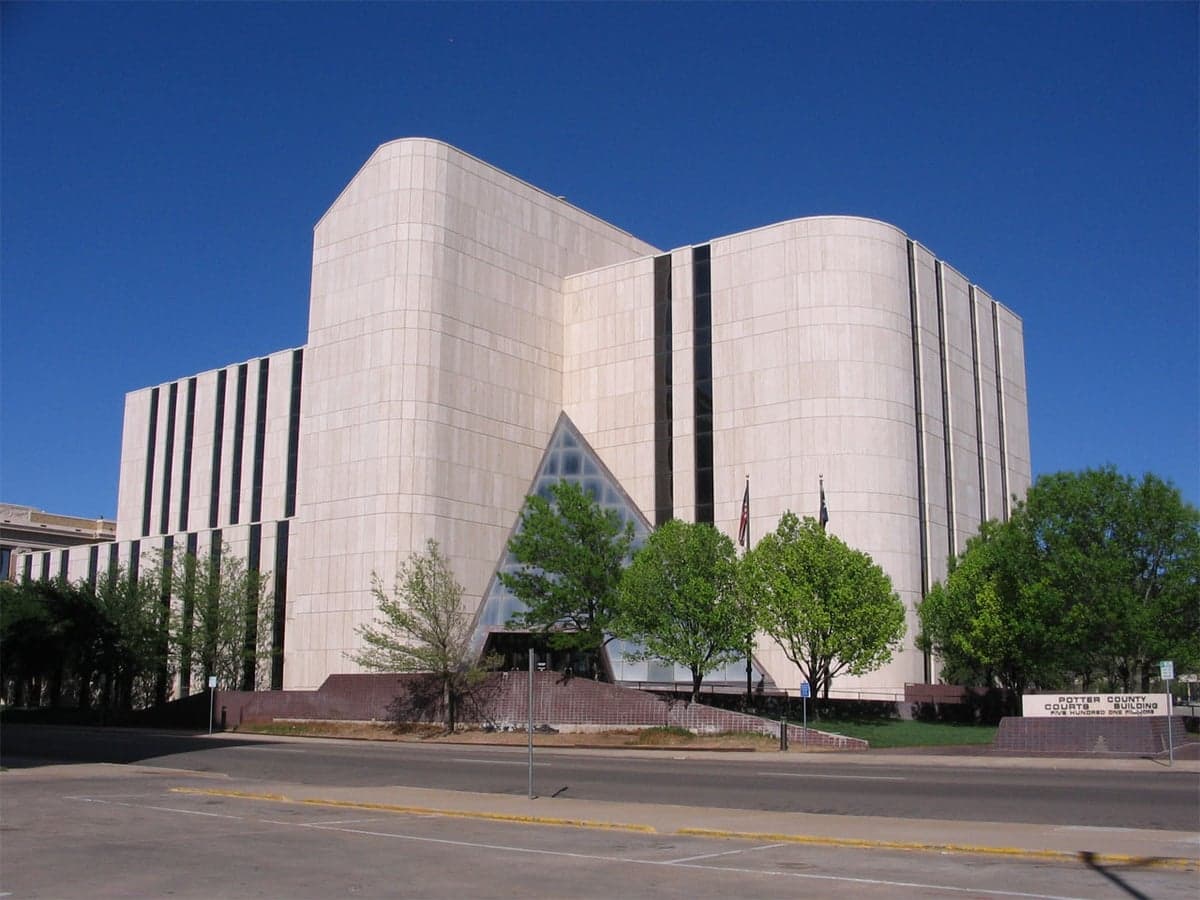
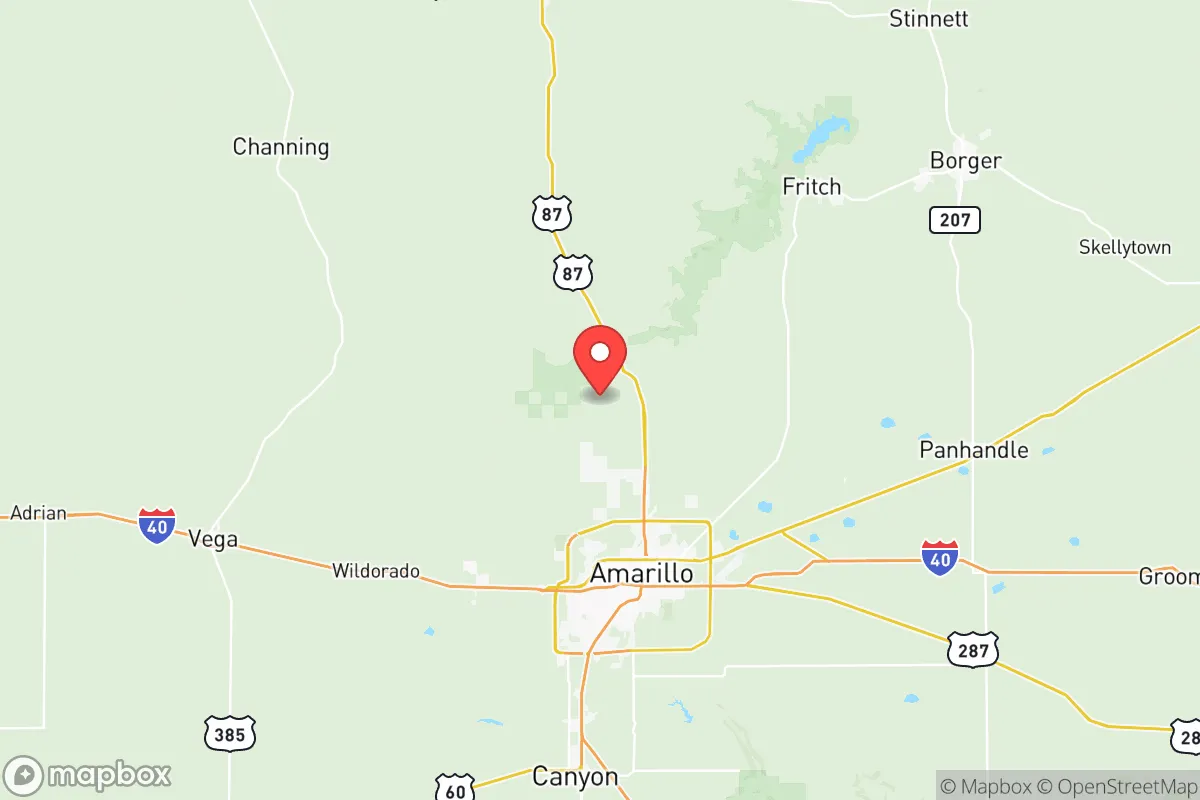
Photo: Wikipedia
Demographics of Potter County
Affluence Level in Potter County
A below-average socioeconomic profile. Incomes, home values, and educational attainment trail the U.S., with higher poverty and unemployment.
People of Potter County
Potter County, anchored by Amarillo, is a community shaped by ranching, railroads, and energy, where a historically white, native-born population is giving way to a more diverse, Hispanic-majority future. With a population of 116,634, the county today is 42.9% White, 38.8% Hispanic, 10.2% Black, and 4.7% East/Southeast Asian, with a foreign-born share of 9.4%. Its identity remains rooted in the Texas Panhandle's agricultural and oil heritage, but the demographic center of gravity is shifting toward younger, more Hispanic families, particularly in Amarillo's north and east sides.
Settlement & growth (pre-1960)
Before Anglo-American settlement, the High Plains of Potter County were the domain of the Comanche and Kiowa, who followed bison herds across the Llano Estacado. Spanish explorers and traders passed through as early as the 16th century, but no permanent Spanish or Mexican settlements took root in this arid region. The U.S. Army's removal of Native nations after the Red River War (1874–1875) opened the land to cattle ranching.
The first permanent Anglo settlers arrived in the 1880s, drawn by the vast, cheap grasslands of the XIT Ranch and the Fort Worth and Denver City Railway, which reached the area in 1887. The railroad established the town of Amarillo as a shipping point for cattle, and the city quickly became the commercial hub of the Panhandle. These early settlers were overwhelmingly native-born whites from the South and Midwest—many of Scots-Irish and English descent—who came as ranchers, cowboys, and railroad workers. The town of Bushland, founded in the 1890s as a farming community, attracted a smaller wave of German and Czech homesteaders who broke the prairie sod for wheat and corn.
By 1910, Amarillo's population had reached 9,957, and the discovery of oil in the Panhandle Field in 1921 transformed the county. The 1920s and 1930s brought a new wave of domestic migrants—white laborers from Oklahoma, Arkansas, and the Dust Bowl-ravaged Plains—who poured into Amarillo to work in oil refineries, pipelines, and the growing helium industry. The city's population surged past 50,000 by 1940. African Americans, who had been present since the 1890s as railroad porters and domestic workers, formed a small but distinct community in the northeast quadrant of Amarillo, centered around the historic 10th Street district. The county's Black population remained under 5% through 1950, constrained by Jim Crow-era segregation and limited economic opportunity.
World War II and the Cold War brought the Amarillo Army Air Field (later Rick Husband Amarillo International Airport) and the Pantex Plant, which opened in 1942 as a bomb-loading facility and later became the nation's primary nuclear weapons assembly plant. These federal installations drew a steady stream of white engineers, technicians, and military personnel from across the country, reinforcing the county's conservative, patriotic character.
Modern era (post-1965)
The 1965 Hart-Cellar Act had a modest but growing impact on Potter County compared to coastal cities. The most significant post-1965 demographic shift has been the rapid growth of the Hispanic population, driven primarily by domestic migration from South Texas and northern Mexico, as well as higher birth rates. Hispanic residents made up roughly 10% of the county in 1970; by 2020, they had reached 38.8%. This community is concentrated in Amarillo's Barrio and San Jacinto neighborhoods, as well as the town of Bushland, where many work in agriculture and meatpacking. The Tyson Foods beef plant in Amarillo has been a major employer for Hispanic immigrants since the 1980s.
East and Southeast Asian communities, now 4.7% of the population, began arriving in the 1970s and 1980s, primarily as Vietnamese and Lao refugees resettled by church groups and the federal government. A smaller wave of Korean and Filipino immigrants came in the 1990s and 2000s, drawn by medical and engineering jobs at Amarillo's hospitals and Pantex. These families are concentrated in southwest Amarillo near the medical district. The Indian-subcontinent population remains tiny at 0.3%, mostly professionals in healthcare and academia.
The Black population has grown from under 5% in 1960 to 10.2% today, driven by both domestic migration from the South and natural increase. The community remains centered in northeast Amarillo, though suburbanization has spread Black families into the city's southern and western edges. The county's white population, while still the largest single group at 42.9%, has declined in absolute numbers since 2000 as younger whites move to Dallas-Fort Worth or Austin for jobs and lifestyle, while older whites age in place.
Suburbanization has been limited by the county's small size and rural character. The unincorporated community of Timbercreek Canyon, a bedroom community of Amarillo, has attracted some white and Hispanic families seeking larger lots, but the county remains overwhelmingly urbanized within Amarillo's city limits.
The future
Potter County is on track to become Hispanic-plurality within the next 10–15 years, driven by higher birth rates among Hispanic families and continued in-migration from South Texas and Mexico. The white population will continue to shrink as a share, though it will remain a significant minority. The East/Southeast Asian and Black populations are likely to grow slowly, primarily through natural increase rather than new immigration, as the county lacks the diversified economy to attract large new immigrant waves.
The county is not tribalizing into distinct, hostile enclaves; rather, it is experiencing a gradual, generational blending. Hispanic and white residents increasingly share neighborhoods, schools, and workplaces, particularly in Amarillo's newer subdivisions. The Pantex Plant and the medical sector remain the largest employers for college-educated workers, but the county's low college attainment rate (17.3%) limits its ability to attract knowledge-economy migrants. The cultural identity of Potter County is becoming more distinctly Southwestern and bilingual, while retaining its conservative political leanings and ranching heritage.
For someone moving in now, Potter County offers a stable, family-oriented community where the cost of living is low and the pace of change is slow. The demographic transition is real but orderly, and the county's future likely resembles a more Hispanic version of its present—still rooted in agriculture and energy, still politically conservative, but increasingly diverse in its daily life.

* Values derived from national, state, county, city and local statistics and may differ in a specific area. Last updated: 2026-05-21T02:27:14.000Z
Narrative content on this page is AI-generated and may contain mistakes. Verify any details that matter before acting on them.
ReloMaps may earn a commission from affiliate links at no extra cost to you.

