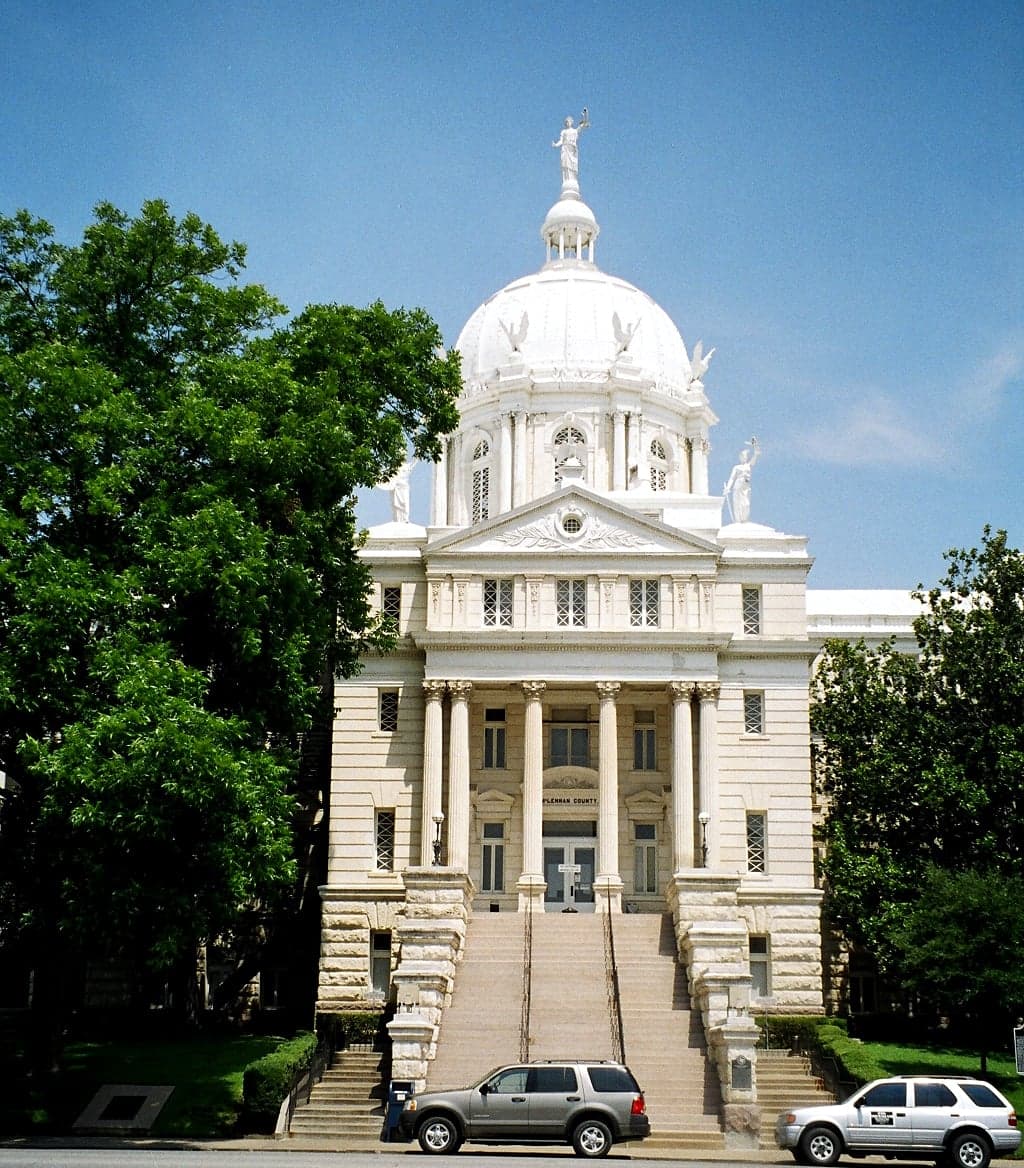
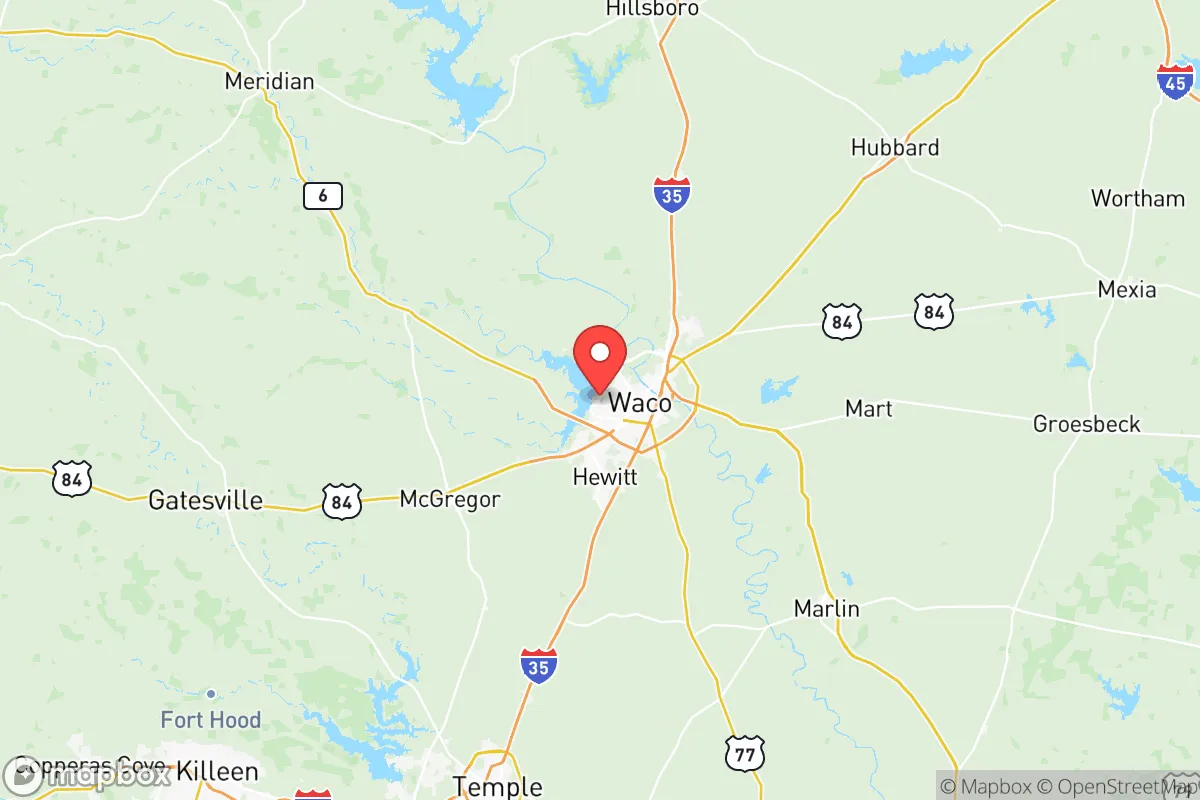
Photo: Wikipedia
Demographics of Mclennan County
Affluence Level in Mclennan County
A middle-class area roughly in line with national averages across income, home values, education, and employment.
People of Mclennan County
Today, McLennan County is home to roughly 263,600 residents, a population that remains majority White (54.7%) but is notably more Hispanic (26.6%) and Black (13.6%) than the national average, with a small but growing East/Southeast Asian community (1.2%) and Indian subcontinent population (0.4%). The county’s character is shaped by its dual identity as both a historic agricultural hub and the anchor of the Waco metropolitan area, where Baylor University and a robust healthcare sector drive a more educated workforce than much of Central Texas. With only 27.8% of adults holding a bachelor’s degree, the county sits below the Texas average, reflecting a blue-collar and service-oriented economy that still bears the imprint of its ranching and manufacturing roots. The people of McLennan County are predominantly native-born (93.8% U.S.-born), and the region retains a distinctly Southern and Southwestern cultural identity, with a conservative political tilt that has moderated slightly as Waco has grown more urban and diverse.
Settlement & growth (pre-1960)
Long before European settlement, the area that is now McLennan County was home to the Waco (also spelled Huaco) band of the Wichita people, who established a village along the Brazos River near present-day downtown Waco. The Waco were a semi-sedentary agricultural and trading people, and their name was later adopted for the city. Spanish and French explorers passed through the region in the 17th and 18th centuries, but no permanent colonial settlements took root. After Texas independence in 1836, Anglo-American settlers began arriving in significant numbers, drawn by cheap land grants from the Republic of Texas. McLennan County was formally created in 1850, and the town of Waco was established as the county seat, quickly becoming a trading center for cotton and cattle.
The first major wave of settlers were primarily Anglo-Americans from the Deep South — Tennessee, Alabama, Mississippi, and Georgia — who brought enslaved Black people with them to work cotton plantations along the Brazos River floodplain. By 1860, enslaved African Americans made up roughly 25% of the county’s population, a share that remained high after Emancipation as freedmen and women stayed in the region to work as sharecroppers and laborers. After the Civil War, the county saw an influx of German and Czech immigrants, who settled in smaller communities like West (famous for its Czech heritage and kolaches), Lorena, and Hewitt, where they established family farms and Catholic churches. These European ethnic enclaves remain culturally distinct today, with West in particular preserving its Czech traditions through annual festivals and bakeries.
The early 20th century brought a second wave of Black migration within the county, as African Americans moved from rural areas into Waco’s East Waco neighborhood, which became a vibrant cultural and commercial hub. The discovery of oil in the nearby Ranger field in 1917 briefly boosted the county’s economy, but the Great Depression hit hard, and many farmers left for California or urban centers. World War II and the postwar boom brought new industry to Waco, including the James Connally Air Force Base (later Texas State Technical College), which attracted military families and workers from across the country. By 1960, McLennan County’s population was roughly 75% White, 20% Black, and 5% Hispanic, with the Hispanic share still small but growing as Mexican-American migrant workers settled in agricultural areas like Bellmead and Lacy-Lakeview.
Modern era (post-1965)
The 1965 Hart-Cellar Act had a relatively muted effect on McLennan County compared to major urban centers, but it did open the door for a modest wave of immigration that reshaped the county’s ethnic composition. The most significant post-1965 change has been the growth of the Hispanic population, which rose from about 5% in 1970 to 26.6% today. This growth has been driven primarily by Mexican-American families from South Texas and northern Mexico, who settled in Waco’s North Waco and South Waco neighborhoods, as well as in the smaller towns of Mart and McGregor, where they work in construction, food processing, and agriculture. The Hispanic community is now the county’s fastest-growing demographic segment, and its presence is visible in the proliferation of taquerias, panaderias, and Spanish-language church services across the county.
The East/Southeast Asian community, while small at 1.2%, has grown steadily since the 1980s, largely through professional migration tied to Baylor University and the healthcare sector. Vietnamese, Chinese, and Korean families have concentrated in Waco’s Woodway and Robinson suburbs, where good schools and newer housing stock attract middle-class professionals. The Indian subcontinent population (0.4%) is even smaller but similarly professional, with many families connected to Baylor’s engineering and medical programs. The Black population, which peaked at roughly 22% in the 1990s, has declined slightly to 13.6% as some African American families have moved to Dallas-Fort Worth or Houston for better economic opportunities, while others have shifted from rural areas into Waco’s East Waco and Beverly Hills neighborhoods.
Domestic migration has been a major force since 2000, with the county attracting newcomers from California, the Rust Belt, and other parts of Texas who are drawn by lower housing costs and a slower pace of life. This influx has been particularly noticeable in the suburbs of Woodway, Hewitt, and Robinson, which have seen new subdivisions and retail development. The county’s foreign-born share remains low at 6.2%, well below the Texas average of 17%, meaning that most demographic change is driven by domestic migration and natural increase rather than international immigration.
The future
McLennan County is projected to become more diverse over the next 10-20 years, with the Hispanic share likely approaching 35% by 2040 as younger Hispanic families have children at higher rates and continue to move into the area from South Texas and Mexico. The White share will continue to decline gradually, while the Black share is expected to stabilize around 12-13% as outmigration slows. The East/Southeast Asian and Indian communities will likely grow modestly, reaching 2-3% combined, as Baylor University expands its international programs and the healthcare sector attracts more professionals. New residential development is concentrating in the southern and western suburbs — Woodway, Hewitt, and McGregor — where land is cheaper and schools are perceived as stronger, while Waco’s urban core is seeing a slow but steady revival of older neighborhoods like Baylor University-adjacent areas and Downtown Waco.
Culturally, the county is becoming less uniformly Southern and more Southwestern, with Hispanic traditions increasingly woven into the fabric of daily life — from bilingual signage to the growing popularity of quinceañeras and Cinco de Mayo celebrations. The conservative political character of the county remains intact, but it is moderating slightly as younger, more diverse voters and Baylor-affiliated professionals shift the electorate. For someone moving in now, McLennan County offers a relatively affordable, family-oriented environment with a strong sense of local identity, but one that is gradually evolving from its Anglo- and Black-dominated past into a more multiethnic, suburbanized future.
McLennan County is becoming a more diverse, suburban, and moderately educated place — still rooted in its agricultural and industrial past, but increasingly shaped by Hispanic growth, Baylor’s institutional presence, and the spillover of domestic migrants seeking a lower-cost alternative to the booming metros of Dallas and Austin. For a family or individual moving in today, the county offers a stable, conservative-leaning community with a clear trajectory toward greater ethnic diversity and suburban expansion, particularly in the southern and western suburbs that are absorbing most new development.

* Values derived from national, state, county, city and local statistics and may differ in a specific area. Last updated: 2026-07-08T22:34:47.000Z
Narrative content on this page is AI-generated and may contain mistakes. Verify any details that matter before acting on them.
ReloMaps may earn a commission from affiliate links at no extra cost to you.

