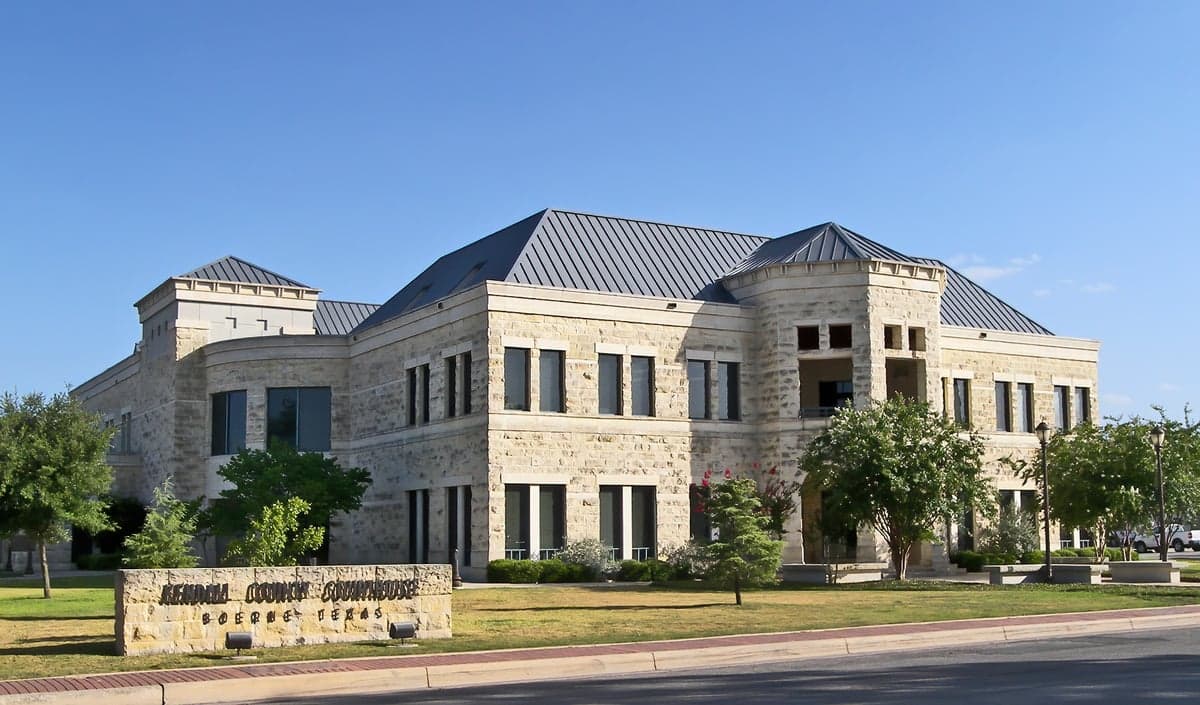
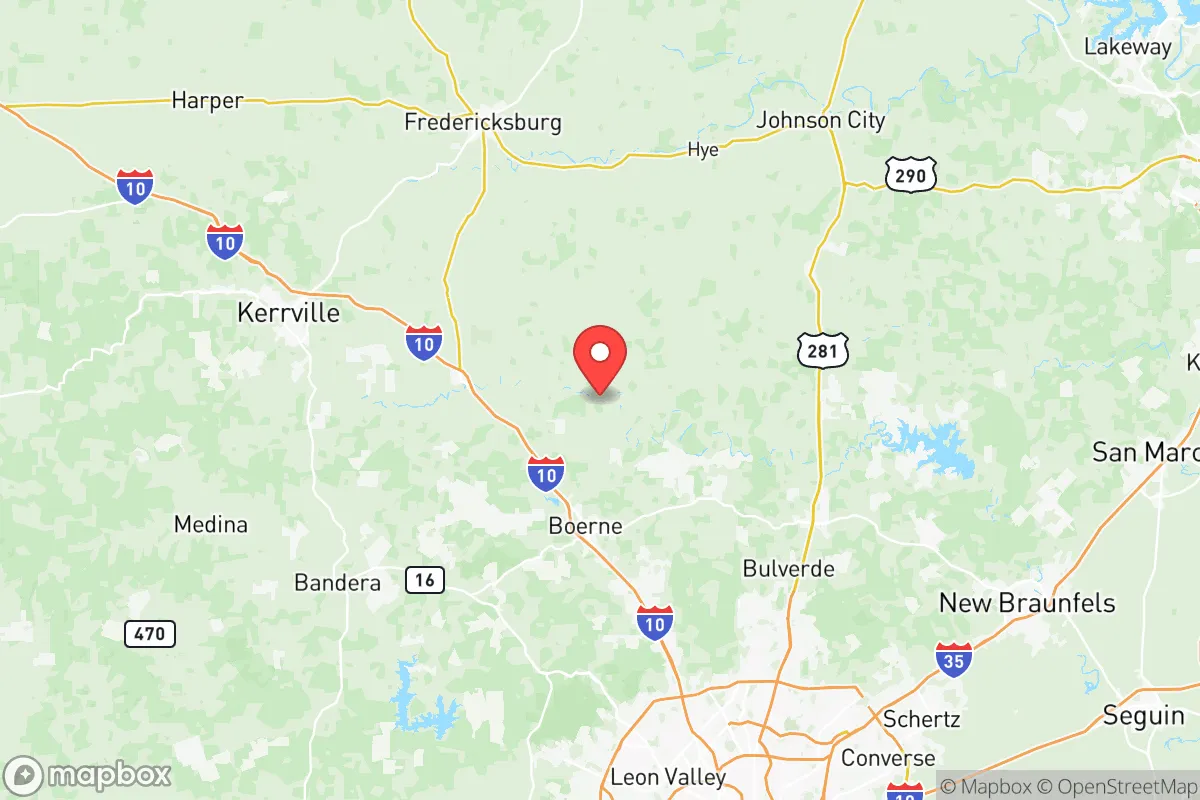
Photo: Wikipedia
Political ClimatePolitical Climate in Kendall County
Showing district-level results — no local-only data available.
Local Political AnalysisPolitical Analysis of Kendall County
Kendall County is a solidly conservative stronghold, with a Cook PVI of R+11 that puts it well to the right of Texas as a whole (R+4). The county has been reliably Republican for decades, and that trend has only strengthened in recent cycles, driven by rapid growth in exurban subdivisions and a deep-rooted ranching and hunting culture. While the county as a whole is deep red, there are subtle variations: the historic town of Boerne (the county seat) has a small but visible liberal-leaning pocket near the Hill Country Mile and the newer mixed-use developments, while unincorporated areas like Comfort and Bergheim are overwhelmingly conservative, with precincts that routinely vote 75-80% Republican. The swing precincts are almost nonexistent — the county hasn't gone Democratic in a presidential race since 1964.
How it compares
Kendall County's R+11 rating is a full seven points more conservative than Texas's statewide R+4. That gap is significant: while Texas is a competitive red state with growing Democratic strength in urban cores (Houston, Dallas, San Antonio, Austin), Kendall County has moved in the opposite direction. The county's population has nearly doubled since 2000, but the newcomers have been predominantly conservative-leaning families and retirees fleeing Bexar County (San Antonio) and other more moderate areas. This contrasts with neighboring Comal County (R+14) and Bandera County (R+18), which are even more conservative, but Kendall stands out for its relative affluence and higher education levels — Boerne's school system is among the best in the state, which attracts a more professional-class conservative demographic rather than the rural populist base seen further west. The county's Republican primary is often more competitive than the general election, with factions divided between establishment conservatives and more libertarian-leaning or tea-party-aligned candidates.
What this means for residents
For conservative residents, Kendall County offers a deeply supportive environment: local elected officials are uniformly Republican, school board meetings rarely feature progressive policy debates, and the county's tax policies are among the most business-friendly in the region. The county has no property tax for county operations (it's funded by sales tax and fees), which is a point of pride for many. For liberal residents, the reality is more isolating. While Boerne has a small but active Democratic club and a handful of progressive-leaning churches, there are no Democratic elected officials at the county level, and social issues like abortion access or LGBTQ+ nondiscrimination ordinances are nonstarters in local politics. Liberal residents often drive to San Antonio (about 30 minutes south) for cultural events, political organizing, or simply to find like-minded community. The county's rapid growth has brought some tension: newer subdivisions near the Bexar County line are slightly more moderate than the historic core, but not enough to shift the overall balance.
Culturally, Kendall County is defined by its German-Texan heritage (Comfort's historic district is a National Register-listed German settlement), a strong ranching tradition, and a growing wine and craft beer scene that attracts tourists but hasn't diluted the area's conservative character. The county's policy distinctions are notable: it is a Second Amendment sanctuary county, has resisted state-mandated affordable housing requirements, and its school district (Boerne ISD) has avoided the culture-war battles seen in larger districts, largely because the community is so uniformly conservative that such fights rarely gain traction. For anyone moving here, the political climate is straightforward: if you're conservative, you'll feel at home; if you're liberal, you'll need to be comfortable being in the minority and finding your community outside the county's borders.

State Political ClimatePolitical Climate in Texas
State Political AnalysisPolitical Environment in the State
Texas is a solidly Republican state with a Cook PVI of R+4, but that number barely hints at the political earthquake happening beneath the surface. For the last two decades, the state has been a reliable red anchor in presidential elections — no Democrat has won statewide office since 1994 — yet the margins have been shrinking steadily. In 2012, Mitt Romney carried Texas by nearly 16 points; by 2020, Donald Trump’s margin had fallen to just under 6 points. The story isn’t a blue wave so much as a slow demographic and suburban shift, driven by explosive growth in the metroplexes of Dallas-Fort Worth, Houston, San Antonio, and Austin, alongside an influx of out-of-state transplants who don’t always vote like native Texans.
Urban vs. rural divide
The political map of Texas is a study in extremes. The state’s major urban counties — Harris (Houston), Dallas, Tarrant (Fort Worth), Bexar (San Antonio), Travis (Austin), and El Paso — are Democratic strongholds that collectively cast millions of blue votes. Travis County, home to Austin, is one of the most liberal counties in the South, routinely delivering 70%+ for Democratic presidential candidates. Meanwhile, the vast rural and exurban expanses of West Texas, the Panhandle, and East Texas are deeply Republican, often voting 80-90% red. The real battleground is the suburbs. Counties like Collin (north of Dallas), Denton, Fort Bend (southwest of Houston), and Williamson (north of Austin) have been trending leftward as educated, affluent professionals move in. Collin County, once a Republican fortress, voted for Trump by only 7 points in 2020 — down from 27 points in 2012. The Rio Grande Valley, historically Democratic-leaning but culturally conservative, has also shown signs of shifting right, with Trump improving his margins there significantly in 2020 and 2024.
Policy environment
Texas’s policy environment is defined by a low-tax, low-regulation posture that has been consistent for decades. There is no state income tax — funded instead by a mix of high property taxes and a state sales tax of 6.25% (local options can push it over 8%). The regulatory climate is business-friendly, with minimal zoning in many areas and a right-to-work law that limits union power. On education, the state has embraced school choice and charter expansion, though the 2023 legislative session saw a bitter fight over a universal school voucher program that ultimately failed due to rural Republican opposition. Healthcare policy remains a flashpoint: Texas is one of the 10 states that has not expanded Medicaid under the ACA, leaving roughly 1.5 million low-income adults in a coverage gap. Election laws have tightened in recent cycles — SB 1 (2021) added ID requirements for mail-in voting, limited drive-through and 24-hour voting, and expanded poll watcher access. Abortion is effectively banned after SB 8 (2021) and the trigger law that took effect after Dobbs, with no exceptions for rape or incest. Gun laws are among the most permissive in the nation: permitless carry (HB 1927, 2021) allows most adults to carry a handgun without a license or training.
Recent policy direction
The last few legislative sessions have pushed Texas decisively to the right on a broad front. On gun and self-defense law, the 2021 permitless carry law was the headline, but the state also passed a “Second Amendment Sanctuary” resolution and preempted local governments from enforcing federal gun restrictions. Parental and education rights saw major action: HB 3979 (2021) and SB 3 (2023) restricted how race and current events can be taught in public schools, and a 2023 law banned diversity, equity, and inclusion offices at public universities. Speech has been a contested area — the state passed a law in 2023 (HB 20) that requires social media platforms with over 50 million users to host content without viewpoint discrimination, though it’s been tied up in court. Privacy and surveillance are mixed: Texas passed a biometric privacy law (CUBI) in 2023 that restricts companies from collecting facial recognition data without consent, but local police use of license plate readers and drones is largely unregulated. Medical and bodily autonomy is dominated by the near-total abortion ban and a 2023 law (SB 14) banning gender-affirming care for minors. Property rights remain strong — Texas has no state property tax, and eminent domain reform has been a recurring issue. Taxation saw a major shift in 2023 with the passage of a $18 billion property tax cut package (SJR 2 and HB 2), which raised the homestead exemption and compressed school tax rates. Voting and ballot access has tightened, as noted, but Texas also expanded early voting hours in some counties and maintains no-excuse absentee voting for those 65+ or with disabilities.
Civil unrest & political movements
Texas has been a stage for high-profile political flashpoints. The 2020 protests following George Floyd’s murder in Minneapolis were particularly intense in Austin and Houston, with Austin seeing sustained demonstrations and a controversial police budget cut that was later partially restored. On the right, the “constitutional sheriff” movement has gained traction in rural counties, with sheriffs in places like Smith County (Tyler) and Montgomery County (Conroe) publicly refusing to enforce certain state or federal gun laws. Immigration politics are ever-present: Operation Lone Star, launched by Governor Greg Abbott in 2021, deployed state troopers and National Guard to the border and bused migrants to Democratic-led cities like New York and Chicago. Sanctuary city policies are banned by state law (SB 4, 2017), and local officials who refuse to cooperate with federal immigration enforcement face criminal penalties. Secession rhetoric flares up periodically — the Texas Nationalist Movement has some grassroots support but no serious political viability. Election integrity remains a live issue: the 2020 and 2022 cycles saw intense scrutiny of Harris County’s election administration, leading to a state takeover of elections in the state’s largest county in 2023.
Projection
Over the next 5-10 years, Texas is likely to continue its slow leftward drift in the suburbs while rural areas harden further right. The state’s population growth — roughly 1,000 new residents per day — is driven disproportionately by young, diverse, and college-educated people moving to the major metros, which will continue to shift the political center of gravity. The Texas House, currently held by a narrow Republican majority, could flip to Democratic control by the early 2030s if current trends hold, though gerrymandering and the state’s voter ID laws may slow that transition. The U.S. Senate seats held by Ted Cruz (up in 2024) and John Cornyn (up in 2026) will be national battlegrounds. On policy, the state’s tax and regulatory posture is unlikely to change dramatically — the no-income-tax model is politically sacred — but fights over school funding, abortion, and voting access will intensify. A new resident moving in now should expect a state that remains Republican-controlled for the near term but is becoming more competitive and polarized, with the political conversation increasingly dominated by the tension between the booming, diverse cities and the vast, conservative countryside.
For someone relocating to Texas, the practical takeaway is that your day-to-day experience will vary enormously depending on where you land. In Austin or Dallas, you’ll find a blue-leaning, culturally liberal environment with high housing costs and progressive city policies on homelessness and policing. In Lubbock, Midland, or Tyler, you’ll find a deeply conservative community where gun rights, church attendance, and low taxes are the norm. The state government in Austin will continue to push right on social and cultural issues regardless of local sentiment, so if you live in a blue city, you’ll experience a constant tension between local and state policy. If you’re conservative, you’ll find a state that largely aligns with your values on taxes, guns, and regulation, but you may be frustrated by the growing political competition. Either way, Texas is not a monolith — it’s a collection of fiercely distinct regions under one big, complicated political roof.
* Values derived from national, state, county, city and local statistics and may differ in a specific area. Last updated: 2026-06-18T17:11:30.000Z
Narrative content on this page is AI-generated and may contain mistakes. Verify any details that matter before acting on them.
ReloMaps may earn a commission from affiliate links at no extra cost to you.

