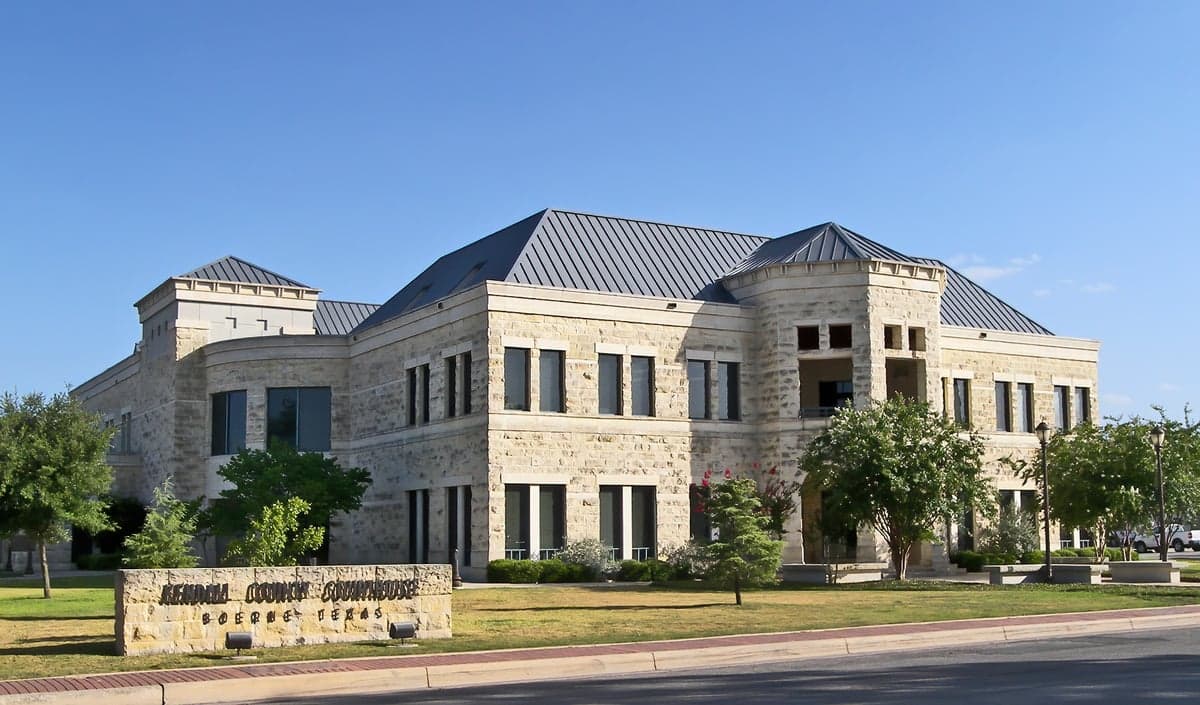
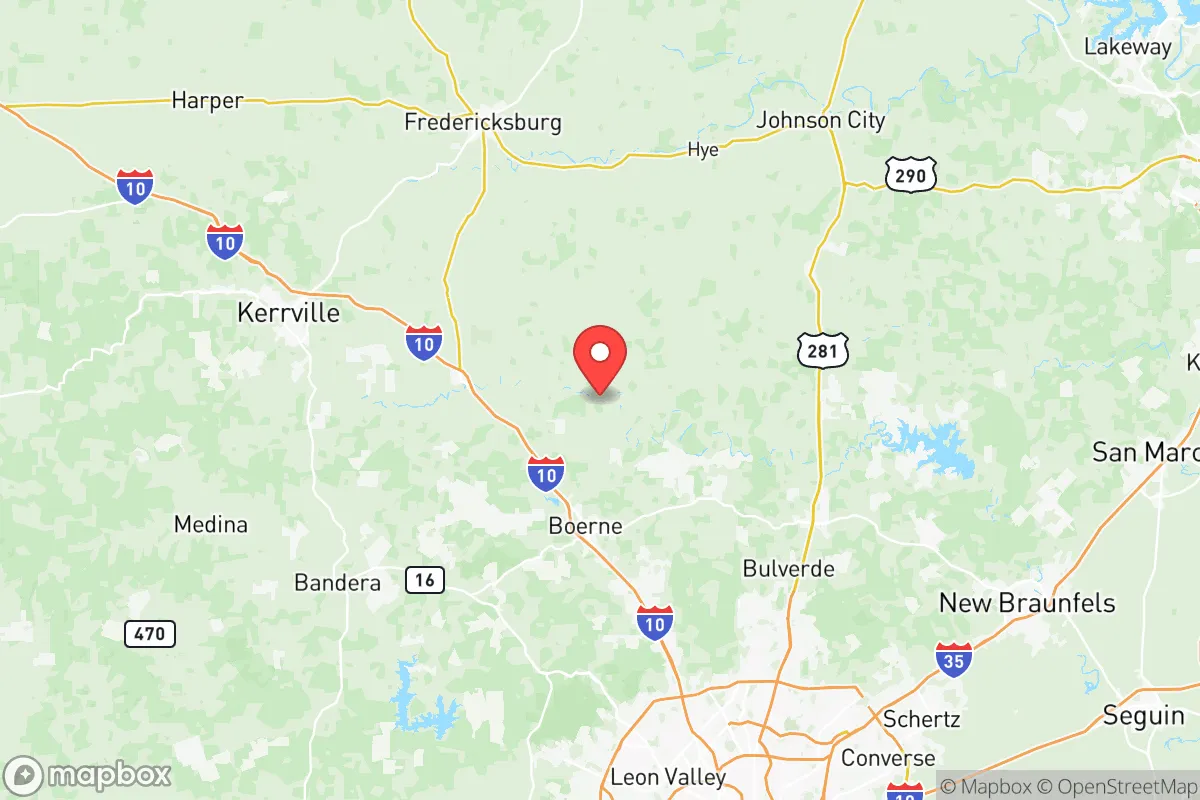
Photo: Wikipedia
Demographics of Kendall County
Affluence Level in Kendall County
An upper-middle-class area. Household wealth, education levels, and homeownership run ahead of national benchmarks.
People of Kendall County
The people of Kendall County, Texas, today form a predominantly white, politically conservative, and highly educated community of roughly 47,000 residents, concentrated in the historic German-Texan town of Boerne and the surrounding Hill Country. With a population that is 71.0% white and 23.7% Hispanic, the county retains a distinctly European-American cultural character, shaped by its 19th-century German immigrant roots and a modern influx of professionals and retirees from other parts of Texas and the United States. Nearly half of all adults hold a college degree, a figure that far exceeds state and national averages, reflecting the county's role as a bedroom community for San Antonio and a destination for those seeking a slower pace without sacrificing economic opportunity. The county's identity is a blend of deep local tradition and selective growth, where newcomers are drawn by the landscape and low crime rates, but the social fabric remains notably homogeneous compared to the rapidly diversifying metros to the south and east.
Settlement & growth (pre-1960)
Before European settlement, the land now known as Kendall County was home to seasonal encampments of the Lipan Apache and Comanche peoples, who used the Balcones Escarpment and the Guadalupe River valley for hunting and travel. Spanish and Mexican authorities made few attempts to colonize this rugged Hill Country terrain, and it remained a frontier buffer zone through the early 1800s. The first permanent non-Native settlers arrived in the 1840s and 1850s, part of a wave of German immigrants sponsored by the Adelsverein, a society that promoted organized colonization of Texas. These settlers founded the town of Boerne in 1852, naming it after the German writer Ludwig Börne, and established smaller communities like Comfort and Bergheim along creeks and river bottoms. The Germans were drawn by cheap land, political freedom, and the promise of a new life far from the upheavals of 19th-century Europe; they brought with them a strong work ethic, a tradition of small-scale farming and ranching, and a distinct dialect and culture that persisted for generations.
Kendall County was formally created in 1862 from parts of Blanco and Kerr counties, named for U.S. Army officer and artist George Wilkins Kendall. The German settlers were largely Unionist in sympathy during the Civil War, leading to the infamous "Treue der Union" (Loyalty to the Union) monument in Comfort, which commemorates German-Texans killed while trying to flee to Mexico to avoid Confederate conscription. After the war, the county's economy shifted from subsistence farming to sheep and goat ranching, with wool and mohair becoming major exports. The arrival of the San Antonio and Aransas Pass Railway in 1887 connected Boerne to San Antonio, spurring modest growth and allowing ranchers to ship goods more efficiently. The population remained overwhelmingly white and of German descent through the early 20th century, with small numbers of Anglo-American settlers from the South and Midwest trickling in. By 1960, Kendall County had just over 5,000 residents, a stable, rural, and deeply insular community where German was still spoken in homes and churches, and where the social order revolved around family, land, and the Lutheran and Catholic faiths.
Modern era (post-1965)
The 1965 Hart-Cellar Act had little direct effect on Kendall County, as the area attracted almost no international immigration during the late 20th century. Instead, the county's modern demographic transformation has been driven overwhelmingly by domestic migration — specifically, the suburbanization of San Antonio and the broader Sun Belt shift. Beginning in the 1970s and accelerating after 1990, professionals, military retirees from nearby Lackland and Fort Sam Houston, and families seeking larger lots and better schools began moving to Boerne and the unincorporated areas along Interstate 10. The completion of the Highway 46 bypass and improvements to Interstate 10 made commuting to San Antonio feasible, and the county's population more than doubled between 1990 and 2010. This wave was overwhelmingly white and non-Hispanic, drawn by the area's reputation for safety, conservative politics, and high-performing schools like Boerne Independent School District.
The Hispanic share of the population, now 23.7%, grew primarily through the natural increase of families who had lived in the region for generations, as well as some migration from South Texas and Mexico for construction, landscaping, and service work tied to the housing boom. Unlike in many Texas counties, this growth has not produced large ethnic enclaves; Hispanic residents are dispersed throughout the county, with slightly higher concentrations in the older neighborhoods of Boerne and in the smaller community of Welfare. The Black population remains minuscule at 0.8%, and East/Southeast Asian residents account for just 0.4%, with a small Indian-subcontinent community at 0.6% — most of these are professionals in healthcare and technology who moved to the area for jobs in San Antonio or for the lifestyle. The foreign-born share of 5.1% is low by Texas standards, and the county has not experienced the kind of immigrant-driven diversification seen in Houston, Dallas, or even Austin. Instead, Kendall County has become whiter and more affluent relative to the state as a whole, a pattern of selective in-migration that reinforces its existing cultural character.
The future
Kendall County is projected to continue growing steadily, with the Texas Water Development Board estimating a population of roughly 60,000 by 2035. This growth will be driven almost entirely by domestic migration from other parts of Texas and from out of state, particularly from California and the Northeast, as remote work and the appeal of the Hill Country lifestyle draw new residents. The county is likely to become slightly more diverse, as younger families and professionals include a higher share of Hispanic and Asian households than the current retiree-heavy cohort, but the pace of diversification will be slow. The Hispanic share may rise to around 28-30% by 2040 through natural increase and continued migration, while the white non-Hispanic share will remain dominant. New subdivisions are spreading west from Boerne along Highway 46 toward Pipe Creek and south toward Fair Oaks Ranch, and these areas are attracting a mix of San Antonio commuters and out-of-state transplants. The cultural identity of the county is evolving from a purely German-Texan ranching community to a more generic "Hill Country lifestyle" brand, but the political and social conservatism that has defined the area for generations shows no sign of weakening. For someone moving in now, Kendall County offers a stable, safe, and educationally strong environment where the population is growing but not transforming — a place that is becoming more populous and more connected to the San Antonio metro, but that remains, at its core, a white, conservative, and family-oriented community.
Kendall County is becoming a more populous and prosperous version of its former self, not a fundamentally different place. The German-Texan heritage is increasingly a historical backdrop rather than a living culture, but the values of self-reliance, community, and tradition that it fostered remain central to the county's identity. For a family or individual moving here, the trade-off is clear: you gain excellent schools, low crime, and beautiful scenery, but you join a community that is demographically and politically homogeneous, and that is likely to remain so for the foreseeable future.

* Values derived from national, state, county, city and local statistics and may differ in a specific area. Last updated: 2026-06-18T17:11:30.000Z
Narrative content on this page is AI-generated and may contain mistakes. Verify any details that matter before acting on them.
ReloMaps may earn a commission from affiliate links at no extra cost to you.

