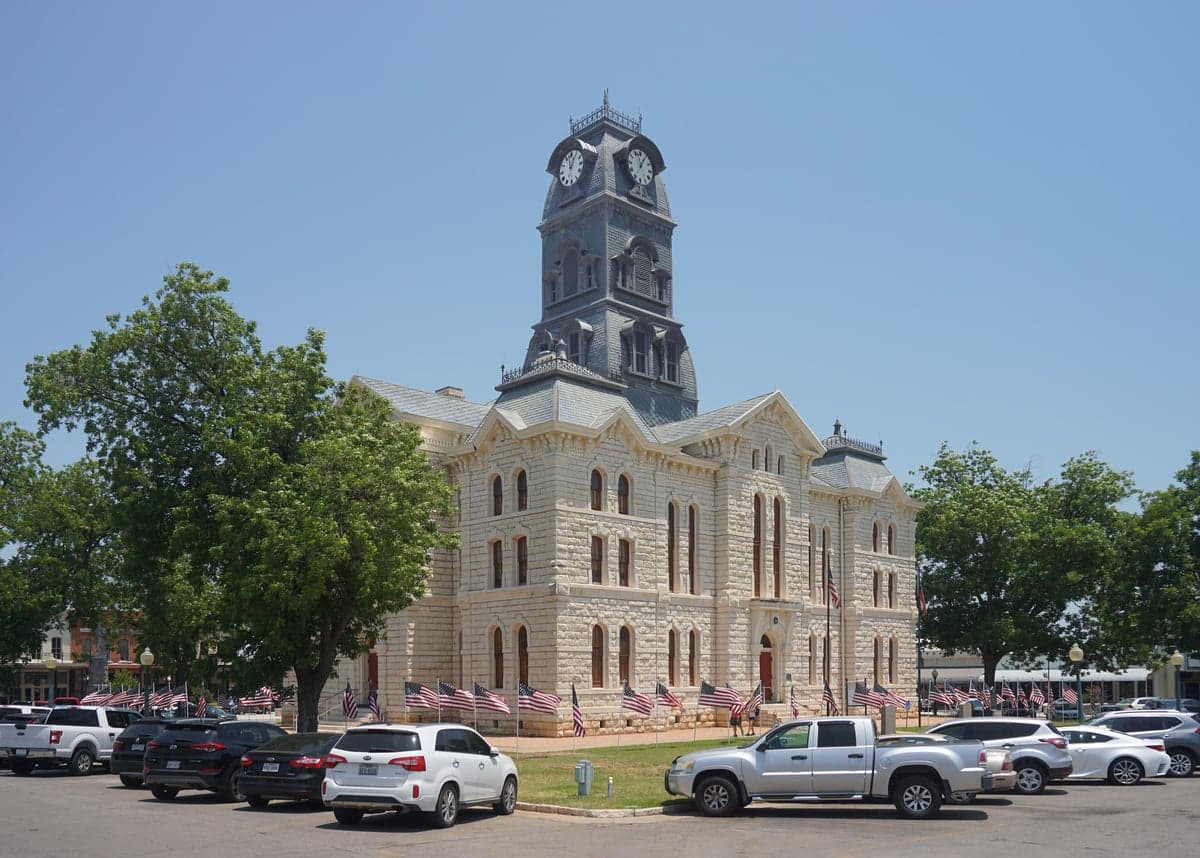
Photo: Wikipedia
Personal Sovereignty in Hood County
Strong independent fundamentals that actively favor personal liberty and low regulation.
What does Personal Sovereignty tell us?
Personal Sovereignty measures your capacity for self-reliance and independence with minimal government friction. Higher scores mean fewer barriers between you and the way you want to live... but it assumes you have the space you need and good neighbors.
What does this tell us?
Personal Sovereignty measures your capacity for self-reliance and independence with minimal government friction. Higher scores mean fewer barriers between you and the way you want to live... but it assumes you have the space you need and good neighbors.
State Policy
Energy independence: Net exporter (220% of energy produced in-state)
Personal Liberty
Homesteading

Personal Liberty Analysis
Hood County, Texas, offers a notably high degree of personal sovereignty, particularly when compared to the regulatory-heavy environments of nearby urban centers like Fort Worth or Dallas. The county’s political culture, rooted in deep conservative values, translates into a governance approach that generally prioritizes individual autonomy over collective mandates. For those seeking to minimize government overreach into daily life—whether through taxation, property use, or personal defense—Hood County presents a compelling option, though the specific experience varies between the more rural outskirts and the slightly denser town centers like Granbury and Acton.
Tax burden and regulatory posture: How local policies protect your wallet and choices
Hood County benefits from Texas’s lack of a state income tax, but the real story for personal sovereignty lies in its local fiscal and regulatory restraint. The county’s property tax rate is competitive, with the effective rate hovering around 1.8% of assessed value, which is manageable given the lower home prices compared to the Dallas-Fort Worth metroplex. More importantly, the county has resisted adopting many of the zoning and land-use restrictions common in urban areas. For example, unincorporated areas near Lipan and Tolar have minimal building codes, allowing property owners to construct workshops, storage sheds, or even small livestock shelters without the costly permits and inspections that plague homeowners in cities like Austin. The regulatory posture is one of "leave us alone," with county commissioners frequently voting down proposals that would expand government oversight into private property decisions. This hands-off approach extends to business licensing, where starting a home-based operation—say, a welding shop or a small-scale food production venture—requires far less red tape than in neighboring Johnson County or Parker County.
Self-defense and gun law specifics: What the Second Amendment looks like on the ground
Hood County is a stronghold for Second Amendment rights, with local law enforcement and elected officials openly supportive of unencumbered firearm ownership. Texas is a permitless carry state, meaning any law-abiding adult can carry a handgun openly or concealed without a license, and Hood County’s sheriff’s office has publicly stated it will not enforce any federal overreach on gun control. The county is home to several gun ranges and firearms dealers, particularly around Granbury and Oak Trail Shores, where the culture of self-reliance is palpable. Stand your ground laws are fully in effect, and the county’s courts have a track record of siding with homeowners in self-defense cases. For preppers and survivalists, this means you can build a defensive capability—whether for personal protection or community security—without fear of local ordinances restricting magazine capacity, firearm types, or ammunition storage. The only notable limitation is the state-level prohibition on carrying in certain posted locations (like schools and bars), but even these are rarely enforced aggressively in Hood County’s more rural precincts.
Self-reliance and homesteading viability: Lot sizes, zoning, and off-grid feasibility
For those serious about self-reliance, Hood County’s rural character is a major asset. Minimum lot sizes in unincorporated areas are typically one acre, but many parcels near Cresson and Godley are available in 5- to 20-acre tracts, providing ample space for gardens, orchards, and small livestock. Zoning is virtually nonexistent outside the city limits of Granbury, meaning you can raise chickens, goats, or even a few head of cattle without needing a special permit. Off-grid living is feasible, though not without some practical hurdles. Rainwater harvesting is legal and encouraged, and many rural properties already rely on private wells and septic systems. Solar panel installations face no county-level restrictions, and several local contractors specialize in off-grid setups. However, the Electric Reliability Council of Texas (ERCOT) grid is notoriously unreliable during winter storms, so a backup generator or battery system is a wise investment. The county’s building codes are minimal, but you’ll still need to comply with state-level septic and well regulations, which are straightforward. For the truly independent, areas near Thorp Spring offer the best balance of seclusion and accessibility, with large parcels and a community that values self-sufficiency.
Personal liberties: Parental rights, medical autonomy, speech, and property
Hood County is a bastion for parental rights, with the local school board in Granbury consistently opposing federal overreach in curriculum and health mandates. Parents have significant influence over what their children are taught, and the county has seen active resistance to vaccine mandates and mask requirements in schools. Medical autonomy is similarly respected; while Texas has not legalized medical marijuana in the same way as some states, Hood County’s health care providers generally defer to patient choice, and there is a growing network of alternative medicine practitioners in the area. Free speech is robust, with public meetings often featuring heated but protected debate on local issues. Property rights are the crown jewel of personal sovereignty here. The county’s approach to eminent domain is restrictive, and property owners near Acton have successfully fought off attempts to expand utility easements without fair compensation. The lack of a county-wide noise ordinance or nuisance laws means you can run machinery, host gatherings, or engage in hobbies like shooting on your own land without fear of government interference. This stands in stark contrast to the heavily regulated suburbs of Tarrant County, where homeowners associations and city codes can dictate everything from grass height to paint colors.
Overall, Hood County ranks among the top areas in Texas for personal sovereignty, especially for those with a survivalist or prepper mindset. The combination of low taxes, minimal regulation, strong gun rights, and a culture that prizes individual liberty creates an environment where you can live largely on your own terms. While it lacks the extreme isolation of far West Texas, it offers a practical middle ground—close enough to Fort Worth for supplies and work, but far enough to avoid the creeping government overreach that defines so much of modern urban life. For single individuals and families alike, Hood County provides a rare opportunity to reclaim personal autonomy in an increasingly controlled world.

* Values derived from national, state, county, city and local statistics and may differ in a specific area. Last updated: 2026-06-06T08:43:49.000Z
Narrative content on this page is AI-generated and may contain mistakes. Verify any details that matter before acting on them.
ReloMaps may earn a commission from affiliate links at no extra cost to you.

