Photo: Wikipedia
Political ClimatePolitical Climate in Erath County
Showing district-level results — no local-only data available.
Local Political AnalysisPolitical Analysis of Erath County
Erath County has long been a rock-solid conservative stronghold, and that hasn't changed. With a Cook PVI of R+18, it's significantly more Republican than the state of Texas as a whole, which sits at R+4. You can feel that difference the moment you leave the interstate and hit the county roads—this is a place where traditional values and personal liberty aren't just talked about, they're lived. The trajectory here is steady red, though like anywhere, you'll see some subtle shifts if you know where to look.
How it compares
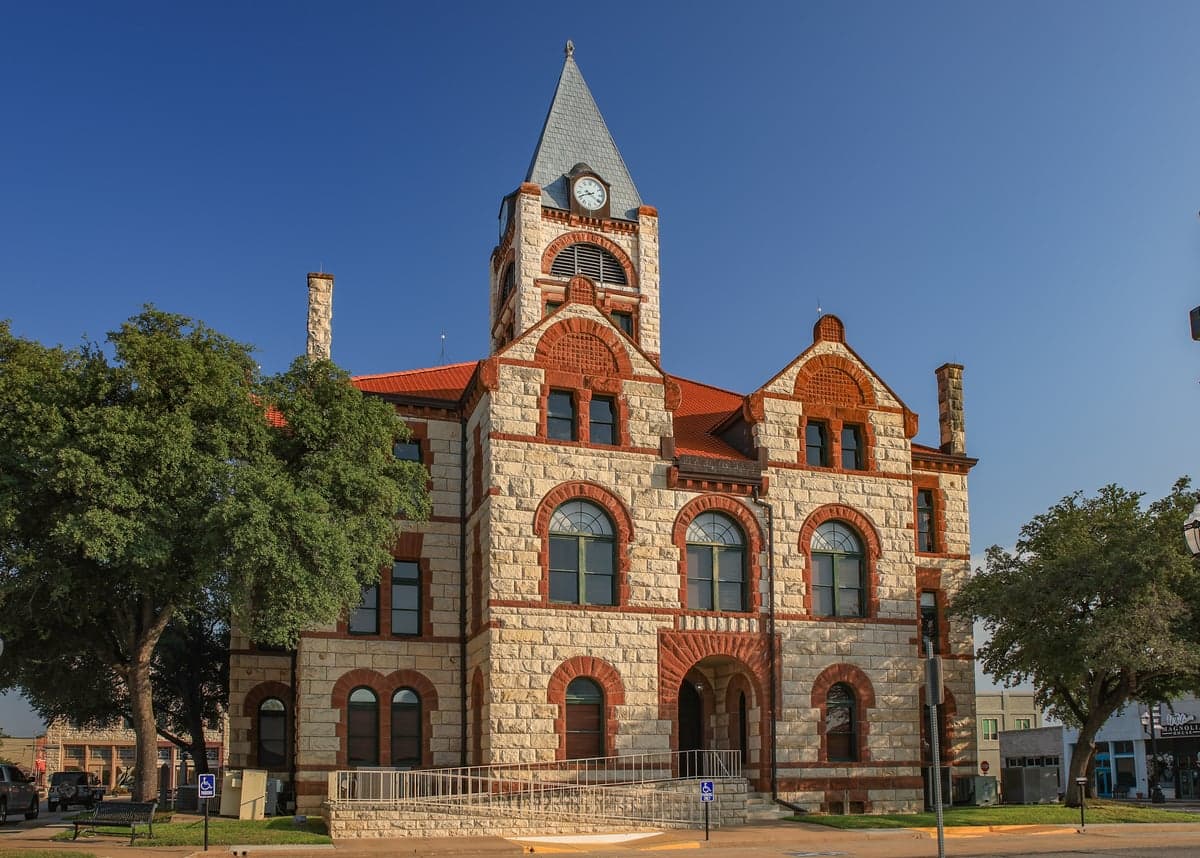
To put it bluntly, Erath County is to Texas what Texas is to the rest of the country—a deeper shade of the same color. The state's R+4 rating means it's already a reliably Republican state, but Erath County's R+18 shows a community that's even more skeptical of big government and more committed to local control. The biggest difference you'll notice is in the towns themselves. Stephenville, the county seat and home to Tarleton State University, is the most politically mixed area. The university brings in a younger, slightly more progressive crowd, and you'll see a few more Harris/Walz signs in yards near campus than you would out in the county. But even Stephenville's city council and school board remain overwhelmingly conservative. Head west to Dublin or Hico, and you're in deep red territory—these are farming and ranching communities where the Second Amendment and property rights are practically sacred. The swing precincts are almost nonexistent; the closest thing you'll find is the area around the university, but even that leans right by a comfortable margin.
What this means for residents
For folks who value personal freedom and limited government, Erath County is a breath of fresh air. You won't see the kind of overreach you hear about in Austin or Dallas. Property taxes are a constant concern—that's true everywhere in Texas—but the county commissioners here are generally responsive and keep a tight lid on unnecessary spending. The school boards in Stephenville, Dublin, and Hico have resisted the kind of progressive curriculum mandates that have caused headaches in larger districts. There's a strong sense that if something isn't broken, you don't fix it, and that includes keeping government out of your business. The recent push for more state-level control over local elections and voting procedures has been met with a shrug here—most folks already feel their votes count and their voices are heard. The bigger worry is what comes down from the state or federal level, not what's decided at the county courthouse.
One thing that sets Erath County apart from the state's urban centers is the cultural cohesion. You don't get the same kind of political tribalism that divides neighborhoods in Houston or Austin. Here, your neighbor might vote differently than you on a local bond issue, but you'll still help them haul hay or watch their kids during a storm. That said, there's a growing unease about the direction of the state as a whole. The influx of people from California and the Northeast into Texas has started to shift the state's politics, and while Erath County remains insulated for now, there's a quiet concern that the same progressive policies that have eroded freedoms elsewhere could eventually creep in. For now, though, this is still a place where you can live your life without a lot of interference, and that's exactly how most folks want it.

State Political ClimatePolitical Climate in Texas
State Political AnalysisPolitical Environment in the State
Texas remains a solidly Republican state with a Cook PVI of R+4, but that number masks a dramatic 20-year shift: in 2004, George W. Bush carried the state by 23 points; in 2024, Donald Trump won it by just under 14. The dominant coalition is still conservative — anchored by rural voters, suburban families, and the oil-and-gas economy — but the GOP’s margin has been steadily eroding as fast-growing metros like Austin, Dallas, and Houston pull leftward. If you’re moving here expecting the Texas of 2005, you’ll find a state that’s still red, but increasingly purple at the edges.
Urban vs. rural divide
The political map of Texas is a story of three distinct regions. The big metros — Harris County (Houston), Dallas County, Bexar County (San Antonio), and Travis County (Austin) — are now reliably blue, with Travis County delivering Joe Biden a 47-point margin in 2020. These urban cores are growing fast, driven by tech transplants, young professionals, and minority voters, and they’ve flipped several state legislative seats in the last decade. Meanwhile, the rural and exurban counties — Collin County (north of Dallas), Denton County, and Montgomery County (north of Houston) — have become the GOP’s firewall, often voting 65-70% Republican. The real battleground is the suburbs: Tarrant County (Fort Worth) flipped blue in 2018 and 2020 before flipping back red in 2024, while Williamson County (north of Austin) went from +20 R in 2012 to +2 D in 2020, then back to +5 R in 2024. If you’re looking for a reliably conservative community, stick to the outer-ring suburbs like Keller, Southlake, or Frisco — but even those are seeing demographic churn as Californians and New Yorkers arrive.
Policy environment
Texas’s policy posture is still broadly conservative, but with notable exceptions. The state has no personal income tax, which is a major draw, but property taxes are among the highest in the nation — averaging 1.6% of home value, with some counties hitting 2.5%. The 2023 property tax reform (SB 2) did cut rates and raise the homestead exemption to $100,000, but it’s a temporary fix, not a structural change. On education, the state passed school choice legislation in 2025 (HB 3), creating education savings accounts for all students, which is a win for parental rights. Healthcare remains a mixed bag: Texas has the highest uninsured rate in the country (18%), and the state has refused Medicaid expansion under Obamacare, which keeps costs down for taxpayers but leaves a gap for low-income residents. Election laws tightened after 2020 with SB 1 (2021), which banned drive-through voting, added ID requirements for mail ballots, and limited early voting hours — a move that critics call suppression but supporters call integrity. For a conservative, the policy environment is generally friendly, but the property tax burden and lack of medical freedom (no right-to-try for experimental treatments, for instance) are real concerns.
Trajectory & freedom
On personal liberty, Texas has moved in two directions at once. On the plus side, the state enacted constitutional carry (permitless carry) in 2021 (HB 1927), allowing any law-abiding adult to carry a handgun without a license — a major expansion of Second Amendment rights. The 2023 parental rights bill (HB 900) restricted sexually explicit content in school libraries and gave parents more control over curriculum, which was a win for family autonomy. On the negative side, the state has aggressively expanded government power in medical and social spheres. The Texas Heartbeat Act (SB 8, 2021) banned abortion after six weeks and created a private enforcement mechanism, which conservatives applaud, but it also set a precedent for state-level surveillance of private conduct. More concerning for libertarian-leaning residents: the state has no medical freedom protections — during COVID, Governor Abbott issued a mask mandate and vaccine passport ban, but the latter was later struck down by courts, and the state still requires certain vaccines for school attendance. Property rights are generally strong, but the 2023 eminent domain reform (SB 2112) gave pipeline companies more power to seize land for carbon capture projects, which angered rural landowners. Overall, Texas is freer than California or New York on guns and taxes, but less free than, say, New Hampshire on medical choice and property rights.
Civil unrest & political movements
Texas has seen its share of political flashpoints. The 2020 Black Lives Matter protests in Austin, Dallas, and Houston were large and occasionally violent, with Austin alone seeing over $10 million in property damage. The “People’s Budget” movement in Austin pushed for defunding the police, but the city council ultimately backed down after a 2021 ballot measure (Prop A) that required a minimum police staffing level. On the right, the Texas Nationalist Movement (Texit) has been pushing for secession since 2016, but it remains fringe — a 2023 poll showed only 18% support. Immigration politics are a constant flashpoint: the state’s Operation Lone Star, launched in 2021, has deployed thousands of National Guard troops to the border and bused migrants to sanctuary cities like New York and Chicago, drawing both praise and lawsuits. The 2023 SB 4, which made illegal entry a state crime, is currently tied up in federal court. Election integrity remains a hot-button issue: the 2020 election in Texas was relatively smooth, but the 2022 primary saw some counties run out of ballot paper, fueling distrust. A new resident in a blue metro like Austin will see regular protests on the Capitol grounds; in a red suburb like Colleyville, you’ll see more Trump flags and church parking lots full on Sunday. The divide is visible, but it rarely turns violent outside of a few hot spots.
Projection
Over the next 5-10 years, Texas is likely to continue its slow shift from red to purple, driven by in-migration from blue states and the natural growth of its urban centers. The 2024 election showed that the GOP can still win statewide by 10+ points, but the margins in the Texas House have narrowed to a handful of seats. The key demographic trend: Hispanic voters, who make up 40% of the population, are moving toward the GOP — Trump won 43% of Texas Hispanics in 2024, up from 35% in 2020. If that trend holds, the state could stay red for another decade. But if the suburbs continue to drift left — especially in Collin County and Williamson County — Texas could become a true swing state by 2032. For a conservative moving in now, expect the state to remain broadly friendly to your values, but with growing friction in the cities. The property tax issue won’t be solved without a state income tax, which is politically toxic, so expect continued pressure on homeowners. School choice will likely expand, and gun rights will stay strong. The wild card is the border: if the federal government doesn’t secure it, Texas will continue to spend billions on its own enforcement, which could strain the budget and fuel more secession talk.
Bottom line for a new resident: Texas is still a good bet for a conservative family — low taxes (if you can handle the property burden), strong gun rights, and a growing economy. But don’t move here expecting the 1990s. The cities are blue, the suburbs are contested, and the state government is increasingly interventionist in areas like education and medical policy. If you want a reliably red community, target the outer-ring suburbs of Fort Worth or San Antonio, or the smaller cities like Tyler or Midland. If you’re okay with a purple environment, Katy or Frisco offer good schools and a mix of politics. Just know that the Texas you’re moving to is not the Texas of your grandparents — it’s bigger, more diverse, and more politically contested than ever.
* Values derived from national, state, county, city and local statistics and may differ in a specific area. Last updated: 2026-05-22T08:29:00.000Z
Narrative content on this page is AI-generated and may contain mistakes. Verify any details that matter before acting on them.
ReloMaps may earn a commission from affiliate links at no extra cost to you.

