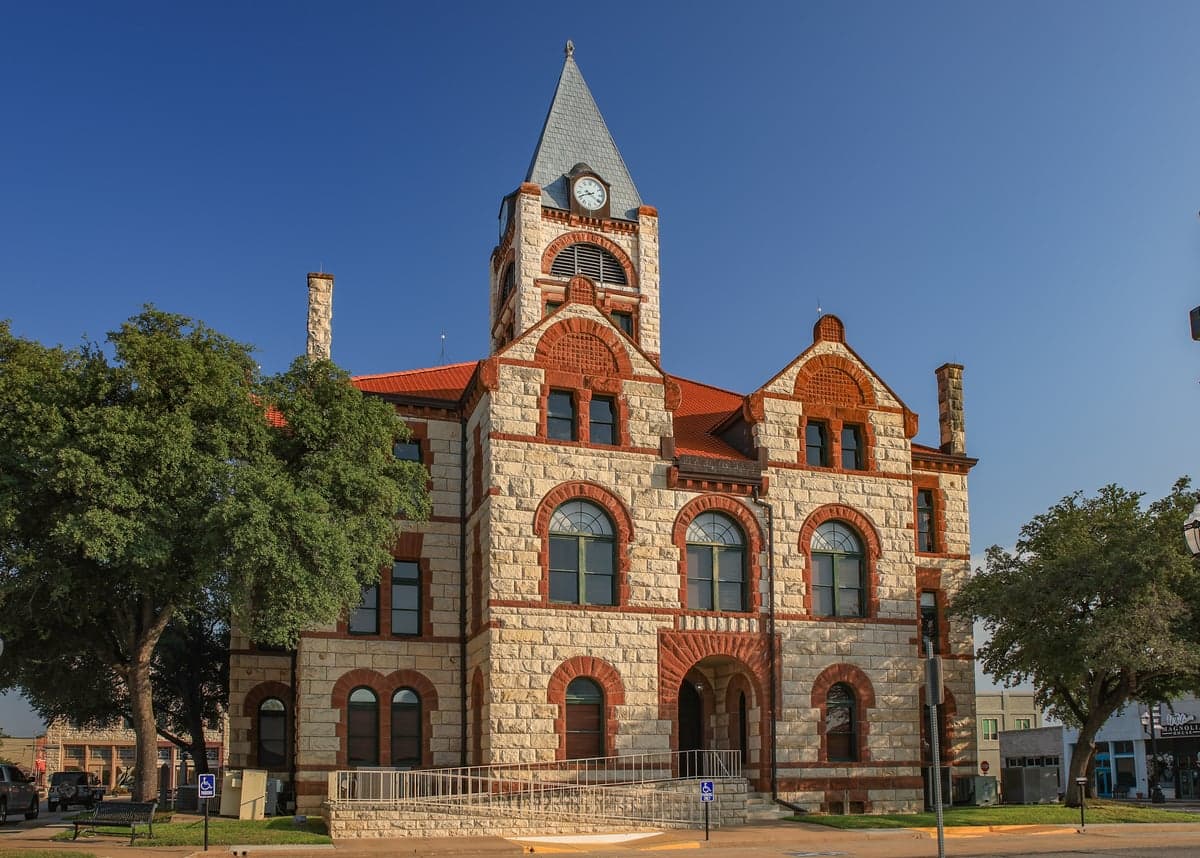
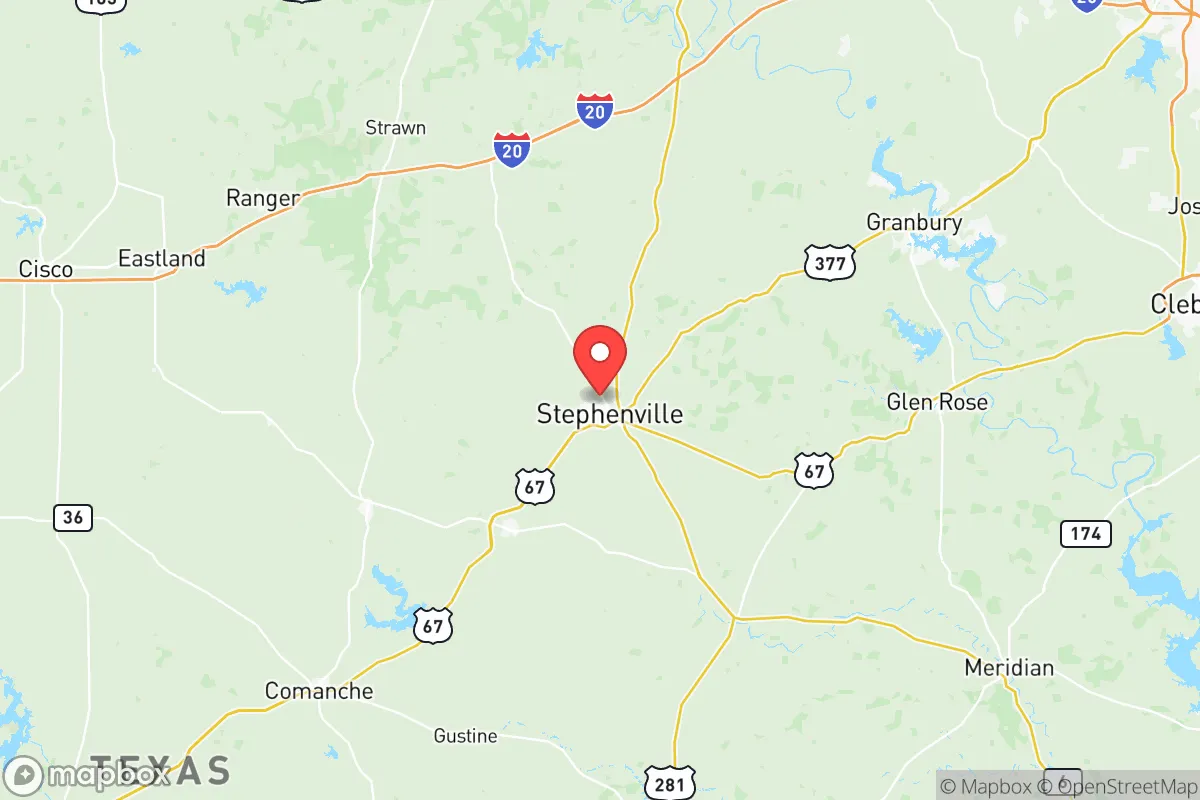
Photo: Wikipedia
Demographics of Erath County
Affluence Level in Erath County
A middle-class area roughly in line with national averages across income, home values, education, and employment.
People of Erath County
Today, Erath County's 43,244 residents form a predominantly white (72.6%) and Hispanic (22.0%) population with a small but growing Asian (0.7%) and Indian (0.3%) presence, concentrated in the county seat of Stephenville and the smaller towns of Dublin and Hico. The county's identity remains deeply rooted in its agricultural and ranching heritage, with Texas A&M University's Tarleton State University campus anchoring a college-educated cohort of 32.5% and a foreign-born share of just 4.5%. This is a place where the legacy of 19th-century Anglo-American settlement still shapes the cultural landscape, even as Hispanic communities have become a substantial and integrated part of the population.
Settlement & growth (pre-1960)
Before Anglo-American settlers arrived, the area now known as Erath County was part of the traditional territory of the Comanche and, to a lesser extent, the Lipan Apache. These nomadic peoples followed the bison herds across the rolling plains and along the Bosque River, but no permanent Native settlements existed within the county's boundaries. Spanish and Mexican authorities claimed the region but never established missions or presidios here; the first non-Native presence came in the 1850s, after Texas statehood and the end of the Mexican-American War.
The county was formally organized in 1856, named for George Bernard Erath, a Texas Revolution veteran and surveyor. The first wave of settlers were overwhelmingly Anglo-Americans from the Upper South—Tennessee, Kentucky, Arkansas, and Missouri—drawn by the promise of cheap, fertile land under the Texas land-grant system. These families were primarily subsistence farmers and ranchers, raising cattle, corn, and cotton. The county seat, Stephenville, was established in 1856 and quickly became the commercial hub, while Dublin (founded 1860) and Hico (founded 1880) grew as agricultural service centers along the Fort Worth and Rio Grande Railway. A smaller settlement, Alexander, briefly served as a trading post before fading.
Unlike much of Central Texas, Erath County saw no significant German or Czech immigration. The population remained almost entirely native-born white Anglo-Americans through the 19th and early 20th centuries. The arrival of the railroad in the 1880s spurred modest growth, but the county's isolation from major urban centers kept it rural. The Dust Bowl and Great Depression of the 1930s hit hard, causing a population decline from a peak of roughly 20,000 in 1910 to about 15,000 by 1940. Many families left for California or Texas cities, but those who stayed doubled down on ranching and dairy farming, which would define the county's economy for decades.
World War II brought a small but lasting change: the establishment of what is now Tarleton State University in Stephenville. Originally a private college founded in 1899, it became a public institution and expanded rapidly after the war, attracting students from across Texas and, gradually, a handful of international students. By 1960, the county's population had rebounded to roughly 17,000, still overwhelmingly white and native-born.
Modern era (post-1965)
The 1965 Hart-Cellar Act had a minimal direct impact on Erath County. Unlike major Texas cities, the county did not become a destination for post-1965 immigration from Asia, Latin America, or Africa. The foreign-born share remains just 4.5% today, far below the national average. Instead, the county's demographic change since 1965 has been driven by two forces: the growth of Tarleton State University and the expansion of the dairy industry.
Tarleton State University, now part of the Texas A&M University system, grew from a small teachers' college into a regional university with over 14,000 students by 2024. This brought a modest influx of faculty and students from outside the county, including a small number of international students from East and Southeast Asia (0.7% of the county population) and the Indian subcontinent (0.3%). These groups are concentrated in Stephenville, particularly in neighborhoods near the campus, and tend to be transient—many leave after graduation. The university also attracted a small number of Black faculty and students, but the county's Black population remains just 1.4%.
The more significant demographic shift has been the growth of the Hispanic population, which rose from roughly 5% in 1980 to 22.0% today. This growth is almost entirely domestic and regional: families from South Texas and the Rio Grande Valley, many of them Mexican-American, moved north for work in the dairy industry. Erath County is now one of the top milk-producing counties in Texas, with dozens of large dairies employing Hispanic workers. These families have settled in Stephenville, Dublin, and the rural areas between them, forming stable, multigenerational communities. Unlike in some parts of Texas, there is no sharp residential segregation; Hispanic families live throughout the county, and intermarriage with the white population is common.
Domestic migration from other parts of Texas and the Sun Belt has been modest. The county's population grew by about 10% between 2010 and 2020, slower than the booming Dallas-Fort Worth metroplex to the northeast. Most newcomers are white retirees or remote workers seeking a lower cost of living and a rural lifestyle, settling in Stephenville's newer subdivisions or on small acreages near Hico and the unincorporated community of Morgan Mill.
The future
Erath County's population is likely to continue growing slowly, reaching perhaps 50,000 by 2040. The Hispanic share will probably rise to 30-35% as younger families have more children and as additional dairy workers arrive from South Texas. This growth is being absorbed into the county's existing cultural identity rather than creating distinct enclaves; Spanish is increasingly heard in Stephenville's schools and businesses, but the county's political and social character remains conservative and rural.
The East/Southeast Asian and Indian populations will likely remain small and concentrated around Tarleton State University, growing only if the university expands its international recruitment. The white population will continue to age, with younger white residents often leaving for urban job markets after college. This could gradually shift the county's median age downward, as Hispanic families tend to be younger.
One wild card is the potential for spillover growth from the Dallas-Fort Worth metroplex. If housing prices in the metroplex continue to rise, Erath County's relative affordability (median home value around $250,000) could attract more white-collar remote workers, accelerating growth and diversifying the economy beyond agriculture and education. However, the county's distance from major employment centers (about 75 miles from Fort Worth) limits this trend for now.
Erath County is becoming a more Hispanic, slightly more diverse version of its historical self—still rural, still conservative, still centered on Stephenville and its university. For a newcomer, this means moving into a community where the Anglo-American ranching culture remains dominant but where Hispanic families are an established and growing presence, and where the pace of change is slow enough that the county's character feels stable. The county is not tribalizing into ethnic enclaves; rather, it is gradually integrating its Hispanic population into the existing social fabric, a process that has been underway for decades and shows no signs of accelerating or reversing.

* Values derived from national, state, county, city and local statistics and may differ in a specific area. Last updated: 2026-05-22T08:29:00.000Z
Narrative content on this page is AI-generated and may contain mistakes. Verify any details that matter before acting on them.
ReloMaps may earn a commission from affiliate links at no extra cost to you.

