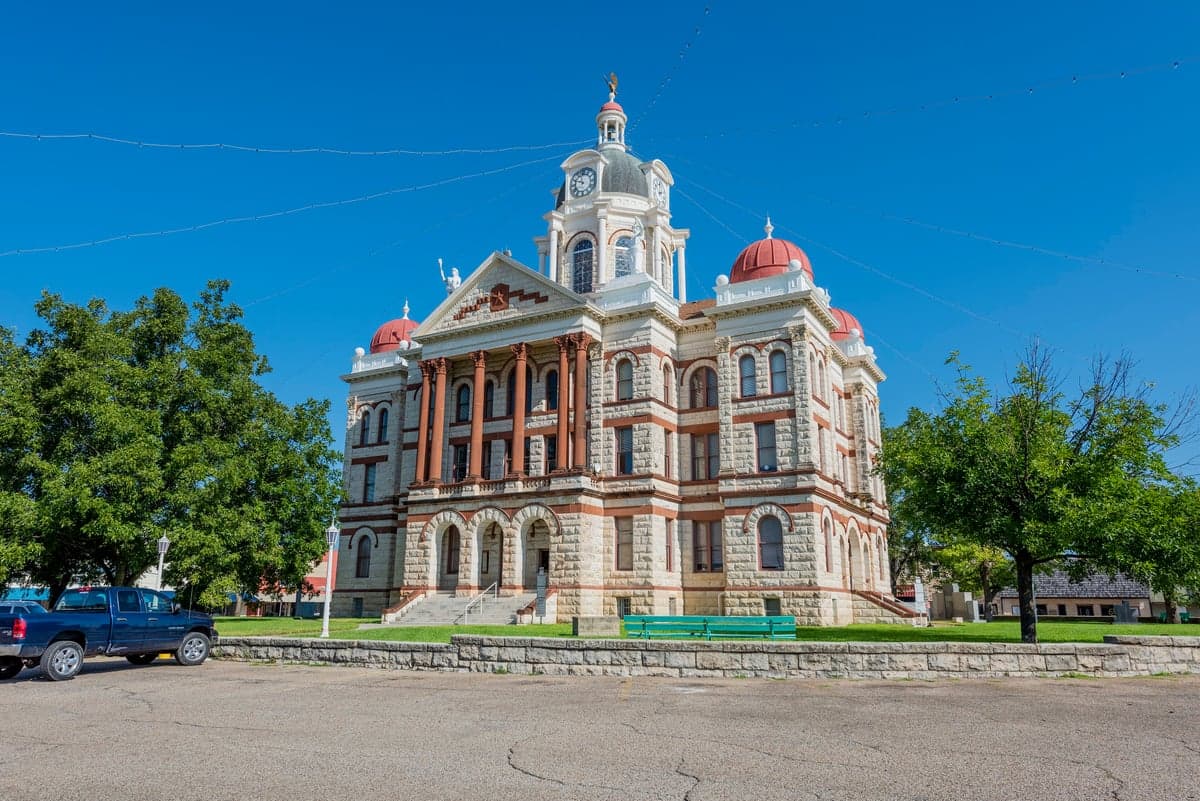
Photo: Wikipedia
Political ClimatePolitical Climate in Coryell County
Showing district-level results — no local-only data available.
Local Political AnalysisPolitical Analysis of Coryell County
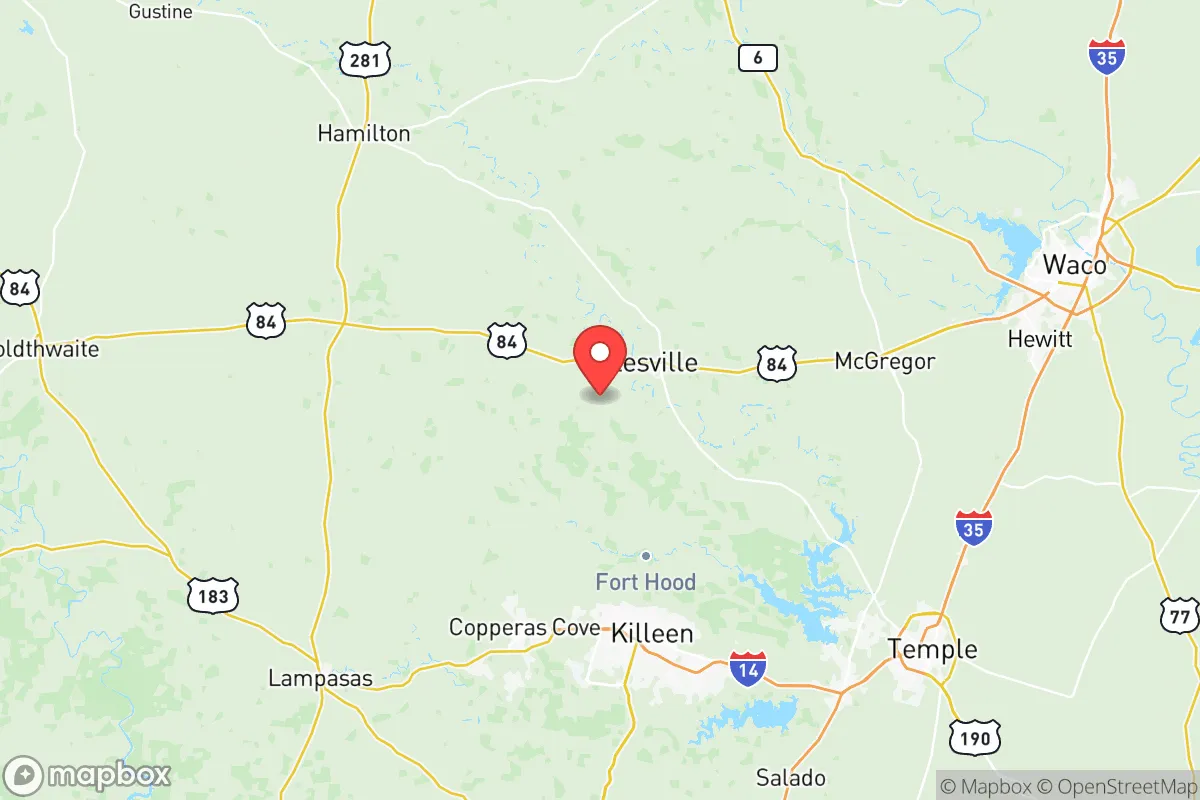
Coryell County, anchored by Fort Cavazos (formerly Fort Hood) and the cities of Gatesville and Copperas Cove, is a reliably Republican stronghold with a Cook PVI of R+11, making it significantly more conservative than Texas as a whole (R+4). The county has voted for the GOP presidential candidate by double-digit margins in every election this century, though the margin has tightened slightly in recent cycles as the military and suburban populations have grown. This isn't a place that flips blue anytime soon, but the political texture is more nuanced than the raw numbers suggest.
How it compares
Coryell County's R+11 rating places it about seven points to the right of the statewide Texas R+4, a gap that reflects the county's rural character and strong military ties. The political geography breaks down predictably: Gatesville, the county seat and home to several state prison facilities, is the most conservative pocket, routinely delivering 75-80% of its vote to Republican candidates. Copperas Cove and Fort Cavazos are reliably red but more moderate, with GOP margins typically in the high 50s to low 60s — the military vote here is conservative but not uniformly so, especially among younger enlisted personnel and officers. The only precincts that lean blue are in the southern part of Oglesby and a small cluster around Pancake, where a mix of working-class families and a few long-time Democratic holdouts keep things competitive. In 2024, the county voted +18 for the GOP presidential candidate, down from +24 in 2020, a shift driven by growing suburbanization around Copperas Cove and a slight uptick in Democratic-leaning military households.
What this means for residents
For conservative residents, the political climate is comfortable and affirming. Local offices — county commissioners, school boards, and the sheriff — are dominated by Republicans, and policy debates tend to center on property taxes, water rights, and support for Fort Cavazos. Conservative voters can expect their values reflected in local governance without much friction. For liberal residents, the reality is more isolating but not hostile. There's no organized progressive infrastructure, but the military community fosters a live-and-let-live culture, and most people keep politics out of daily interactions. The biggest practical impact is on local elections: primaries are where decisions are made, and turnout in Democratic primaries is so low that the party rarely fields candidates for county-level races. That said, the county's growing diversity — especially the rising Hispanic and Asian populations tied to the base — is slowly shifting the conversation, even if the vote totals haven't caught up yet.
Culturally, Coryell County is defined by its military presence and its rural roots. The biggest policy distinction from Texas at large is the outsized influence of Fort Cavazos: local leaders prioritize housing affordability for service members, school funding tied to military families, and infrastructure that supports the base. There's less emphasis on the culture-war issues that dominate state-level politics in Austin, and more focus on practical matters like road maintenance and veterans' services. The county's prisons in Gatesville also create a unique economic and political dynamic, with corrections employees forming a reliable voting bloc that pushes for law-and-order policies. For anyone moving here, the takeaway is simple: it's a conservative place that's getting slightly less so, but the change is slow, and the day-to-day political temperature is much cooler than the state's headline-grabbing battles would suggest.

State Political ClimatePolitical Climate in Texas
State Political AnalysisPolitical Environment in the State
Texas has been a reliably Republican state for the past three decades, with a Cook Partisan Voting Index of R+4, but that label masks a dramatic and ongoing realignment. The dominant coalition remains a mix of rural conservatives, suburban moderates, and business-oriented fiscal conservatives, but the state has been shifting leftward in major metro areas since the early 2000s. Over the last 10-20 years, the GOP’s grip has tightened in rural and exurban counties while Democrats have consolidated power in the big cities, creating a state that is simultaneously more polarized and more competitive at the margins than it was in the 1990s.
Urban vs. rural divide
The political map of Texas is a study in contrasts. The state’s four largest metros — Houston (Harris County), Dallas-Fort Worth (Dallas, Tarrant, Collin, Denton counties), San Antonio (Bexar County), and Austin (Travis County) — now drive the Democratic vote. Harris County, the state’s most populous, has voted Democratic in every presidential election since 2008, and Travis County (Austin) has been a deep blue stronghold since the 1990s. Meanwhile, rural West Texas, the Panhandle, and East Texas remain overwhelmingly Republican. Lubbock County, home to Texas Tech, voted +30 points for Trump in 2024, while El Paso County, on the border, voted +25 for Biden. The most telling shift is in the suburbs: Tarrant County (Fort Worth) flipped from red to blue in 2020 and stayed there in 2024, while Collin County (Plano, Frisco) has moved from +20 R in 2012 to a narrow +4 R in 2024. The Rio Grande Valley, once reliably Democratic, has been trending Republican, with Starr County flipping to Trump in 2024 after decades of Democratic dominance.
Policy environment
Texas’s policy environment is defined by a low-tax, low-regulation posture that has been consistent for decades. There is no state income tax — funded instead by a high property tax system and a 6.25% state sales tax (local add-ons can push it to 8.25%). The regulatory climate is business-friendly, with no state-level minimum wage above the federal $7.25 and a right-to-work law that limits union power. Education policy is a flashpoint: the state funds public schools through a Robin Hood system that redistributes property tax revenue from wealthy districts to poor ones, but per-pupil spending remains below the national average. School choice has expanded, with the 2023 passage of a school voucher-like program (HB 3) that created education savings accounts for special needs students, though broader universal vouchers failed in the 2023 session. Healthcare policy is notably restrictive: Texas has not expanded Medicaid under the Affordable Care Act, leaving roughly 1.5 million uninsured adults in the coverage gap. Abortion is banned from conception under the 2021 trigger law (SB 8), with no exceptions for rape or incest. Election laws have tightened: SB 1 (2021) restricted mail-in voting, added ID requirements, and banned 24-hour and drive-through voting, while also empowering partisan poll watchers.
Recent policy direction
The last five years have seen Texas move decisively in a conservative direction on several fronts, while remaining libertarian on others. On gun rights, the state enacted permitless carry (HB 1927) in 2021, allowing any legal gun owner to carry a handgun without a license. On parental rights and education, the 2023 session passed HB 900, which restricts library materials deemed “sexually explicit” in public schools, and SB 17, which banned diversity, equity, and inclusion offices at public universities. On speech and privacy, the state passed HB 20 in 2021, which prohibits social media platforms from moderating content based on viewpoint (currently tied up in court). On medical and bodily autonomy, the abortion ban is total, but the state also legalized hemp-derived consumable products (like delta-8 THC) in 2019, creating a gray market that remains largely unregulated. Property rights are strong: Texas has no state-level rent control and a homestead exemption that protects primary residences from forced sale to satisfy most debts. On taxation, the 2023 session cut property taxes by roughly $18 billion through a combination of higher homestead exemptions and a compression of school district tax rates. On voting and ballot access, the trend has been toward restriction: SB 1 made it harder to vote by mail and added criminal penalties for election officials who send unsolicited mail-in ballot applications.
Civil unrest & political movements
Texas has seen significant political activism on both sides in recent years. The 2020 Black Lives Matter protests in Austin, Dallas, and Houston were among the largest in the state’s history, with some turning violent in Austin. The 2021 winter storm blackouts sparked protests against the state’s independent power grid (ERCOT) and led to the resignation of several utility commissioners. Immigration politics are a constant flashpoint: Governor Greg Abbott’s Operation Lone Star, launched in 2021, deployed state troopers and National Guard to the border, bused migrants to Democratic-led cities, and installed razor wire and buoys in the Rio Grande. The state has also passed SB 4 (2023), which makes illegal entry a state crime and allows state judges to order deportation — currently blocked by federal courts. Secession rhetoric, while fringe, has a small but vocal following: the Texas Nationalist Movement has pushed for a 2024 primary ballot referendum on secession, though it failed to gain traction. Election integrity controversies have been persistent: the 2020 and 2022 cycles saw lawsuits over mail-in ballot drop boxes and voter roll purges, with the state arguing it was cleaning up rolls and Democrats alleging voter suppression. A new resident would notice the ubiquity of political signage, especially in rural areas, and the frequency of “Keep Texas Red” or “Texas First” bumper stickers.
Projection
Over the next 5-10 years, Texas is likely to become more competitive at the statewide level, but not necessarily more liberal. The key demographic driver is the continued growth of the suburbs around Dallas-Fort Worth, Houston, and San Antonio, which are filling with transplants from California and the Northeast who tend to be moderate Republicans or independents. The Hispanic population, which is growing rapidly, is not monolithic: younger, more secular Hispanics lean Democratic, while older, more religious Hispanics in the Rio Grande Valley are trending Republican. The urban cores will remain deep blue, and rural areas will stay deep red, but the battleground will be the exurbs — places like Comal County (north of San Antonio), which voted +40 R in 2020 but saw a 10-point shift toward Democrats in 2024. The state’s policy direction will likely remain conservative on fiscal and cultural issues, but the margin for further restriction may narrow. A new resident moving in now should expect a state that is still solidly Republican but with a growing Democratic minority that can win statewide office in a wave year. The practical takeaway: if you’re conservative, you’ll find a friendly policy environment and a growing network of like-minded communities; if you’re liberal, you’ll find strongholds in the cities and a state that is slowly, grudgingly becoming more competitive.
For a new resident, the bottom line is that Texas offers a low-tax, high-freedom environment for those who align with its current political direction, but it also requires navigating a polarized landscape where your zip code determines your daily experience. If you move to Austin or Dallas, you’ll live in a blue bubble with progressive city policies; if you move to Lubbock or Tyler, you’ll be in a deep red area where conservative values dominate. The state’s political trajectory suggests that this divide will only deepen, making it essential to choose your community carefully based on your own priorities.
* Values derived from national, state, county, city and local statistics and may differ in a specific area. Last updated: 2026-06-14T17:13:43.000Z
Narrative content on this page is AI-generated and may contain mistakes. Verify any details that matter before acting on them.
ReloMaps may earn a commission from affiliate links at no extra cost to you.

