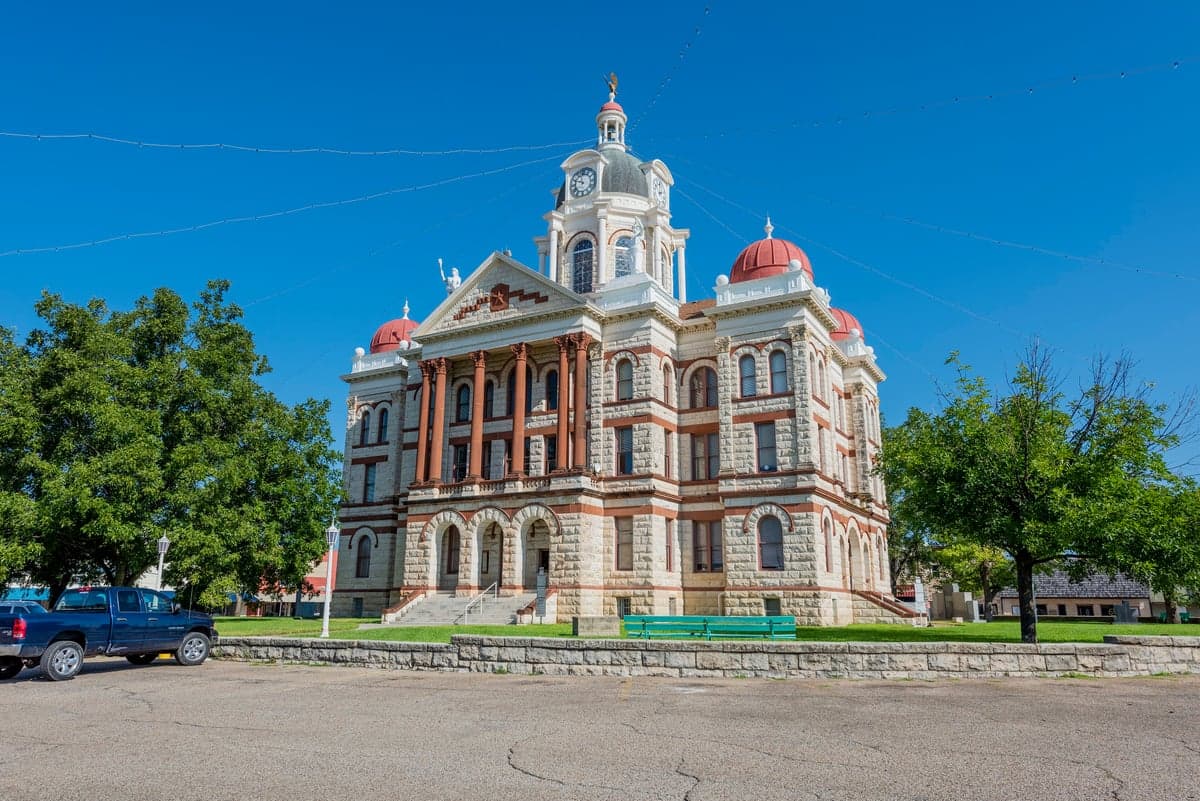
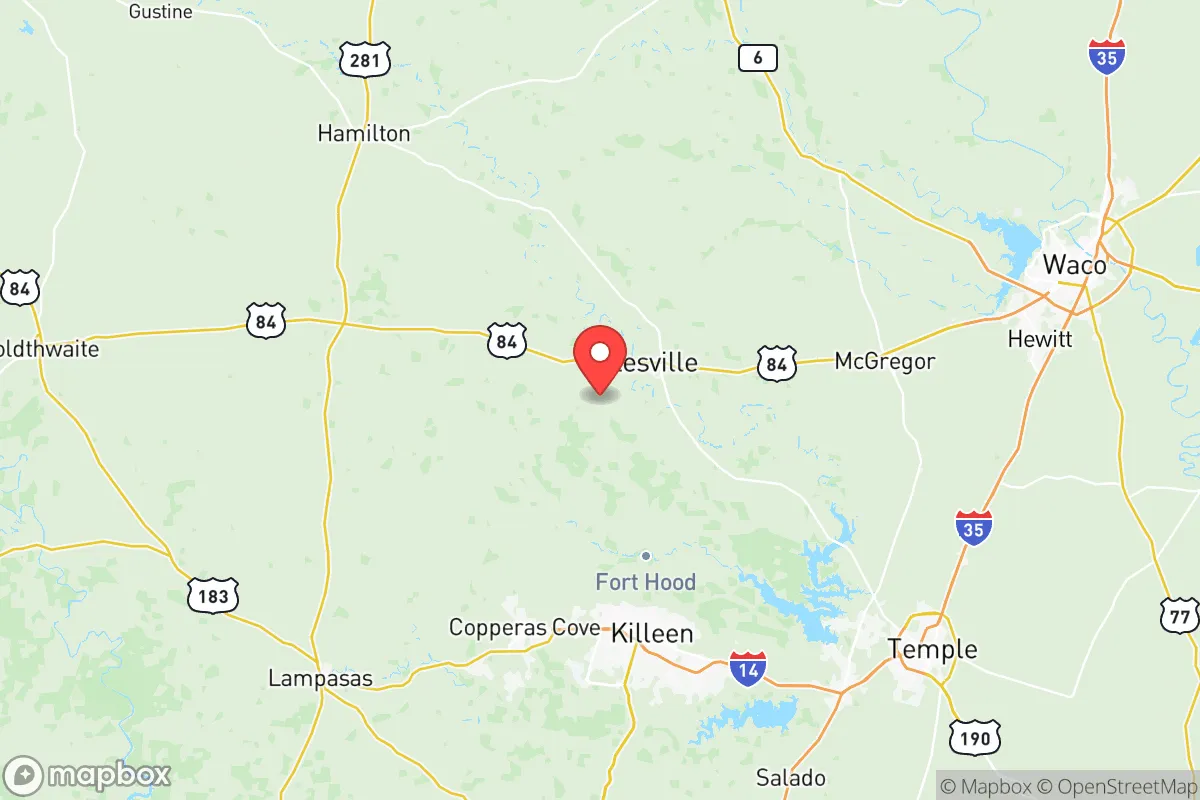
Photo: Wikipedia
Demographics of Coryell County
Affluence Level in Coryell County
A middle-class area roughly in line with national averages across income, home values, education, and employment.
People of Coryell County
Coryell County, with a population of 83,772, is a predominantly rural and small-town community anchored by the Fort Cavazos military installation and the historic town of Gatesville. Its residents are notably less diverse than the state average, with a White population of 55.2% and a Hispanic share of 20.3%, while the foreign-born population stands at just 3.1%. The county’s identity is shaped by a blend of deep-rooted Anglo-Texan heritage, a significant African American community tied to the military and local history, and a growing but still modest Hispanic presence, creating a conservative-leaning, family-oriented environment.
Settlement & growth (pre-1960)
Before American settlement, the area now known as Coryell County was part of the traditional lands of the Tonkawa, Waco, and Comanche peoples. Spanish and Mexican land grants in the early 19th century brought the first European settlers, but large-scale American colonization began after Texas independence in 1836. The Texas legislature created Coryell County in 1854 from parts of Bell and McLennan counties, naming it after James Coryell, a frontiersman killed by Native Americans.
The first major wave of Anglo-American settlers arrived in the 1850s, primarily from the Upper South (Tennessee, Kentucky, Missouri) and the Lower South (Alabama, Mississippi). These were mostly subsistence farmers and cattle ranchers drawn by cheap land grants and the promise of cotton cultivation. They established the county seat of Gatesville in 1854, along with smaller communities like Copperas Cove (founded 1870) and Evant (settled 1870s). The population was overwhelmingly White and native-born, with a small number of enslaved African Americans—by 1860, the county had 1,500 White residents and 400 slaves.
After the Civil War, freed African Americans remained in the county, working as sharecroppers and tenant farmers. They formed distinct rural settlements, such as the Pancake community near Gatesville and the Mound community near Copperas Cove. The arrival of the Gulf, Colorado and Santa Fe Railway in 1882 spurred the growth of Gatesville as a cotton and livestock shipping hub, and the town of Oglesby was platted in 1881. A small wave of German and Czech immigrants arrived in the 1880s and 1890s, settling around Pancake and Mound, but they never formed large ethnic enclaves like those in the Texas Hill Country.
The single most transformative event for Coryell County’s population was the establishment of Camp Hood in 1942 (renamed Fort Hood in 1950, now Fort Cavazos). The U.S. Army selected the area for its vast, sparsely populated terrain, ideal for tank training. The base brought an immediate influx of military personnel and civilian workers from across the country, many of whom were African American and White from the Rust Belt and the South. The town of Copperas Cove exploded from a village of 500 in 1940 to over 10,000 by 1960, becoming the county’s largest city. The base also attracted a small number of Mexican American laborers, who settled in Gatesville and Copperas Cove.
Modern era (post-1965)
The 1965 Hart-Cellar Act had a limited direct impact on Coryell County, as the area never became a primary destination for post-1965 immigrants. The foreign-born share remains just 3.1%, far below the Texas average of 17%. However, the county’s population has been reshaped by domestic migration tied to the military and the broader Sun Belt shift. Fort Cavazos (then Fort Hood) continued to draw African American and White military families from bases closing in the Northeast and Midwest, as well as Hispanic service members from Texas and the Southwest.
The Hispanic population grew from roughly 5% in 1980 to 20.3% today, driven by both military families and civilian workers in construction, services, and agriculture. This growth is concentrated in Copperas Cove and Gatesville, where Hispanic neighborhoods have formed around the downtown areas and near the base’s main gate. The Asian population (East/Southeast Asian) reached 1.9%, largely composed of military spouses and veterans from the Philippines, Vietnam, and Korea, with a small cluster in Copperas Cove near the base. The Indian population (subcontinent) is negligible at 0.1%.
The African American population, at 12.7%, is heavily tied to the military. Many Black families who arrived during the post-World War II era remained after retirement, creating stable communities in Copperas Cove and the Mound area. The White population, now 55.2%, includes both long-time Anglo-Texan families and a large number of military retirees from other states. Suburbanization has been modest compared to major Texas metros, but Copperas Cove has seen steady growth of single-family subdivisions catering to military families, while Gatesville remains more rural and agricultural in character.
The future
Coryell County is projected to become slightly more diverse over the next 10-20 years, but the pace will be slow. The Hispanic share is expected to rise toward 25-28% as younger Hispanic families age into childbearing years and as military recruitment continues to draw Hispanic service members. The Asian and African American shares are likely to remain stable, as the military population is the primary driver and base demographics are relatively constant. The White share will continue to decline gradually, from 55% to perhaps 48-50%, as older Anglo residents pass away and younger White families move to larger metros for jobs.
New growth will concentrate in Copperas Cove and along the I-14 corridor, which connects the county to Bell County and the Killeen-Temple metro area. Gatesville will see slower growth, while rural communities like Evant and Oglesby may continue to lose population. The county’s cultural identity will remain conservative and military-influenced, with a growing Hispanic presence adding bilingual services and cultural festivals, but without the rapid diversification seen in Texas’s urban centers.
For someone moving in now, Coryell County offers a stable, family-oriented community where the military is the dominant employer and cultural touchstone. The population is becoming more Hispanic but remains far less diverse than Texas as a whole, with a strong Anglo-Texan and African American military heritage. The future points toward slow, steady growth in Copperas Cove and Gatesville, with a modest increase in diversity driven by Hispanic families and military recruitment, making it a predictable and safe choice for those seeking a conservative, small-town lifestyle with access to a major military base.

* Values derived from national, state, county, city and local statistics and may differ in a specific area. Last updated: 2026-06-14T17:13:43.000Z
Narrative content on this page is AI-generated and may contain mistakes. Verify any details that matter before acting on them.
ReloMaps may earn a commission from affiliate links at no extra cost to you.

