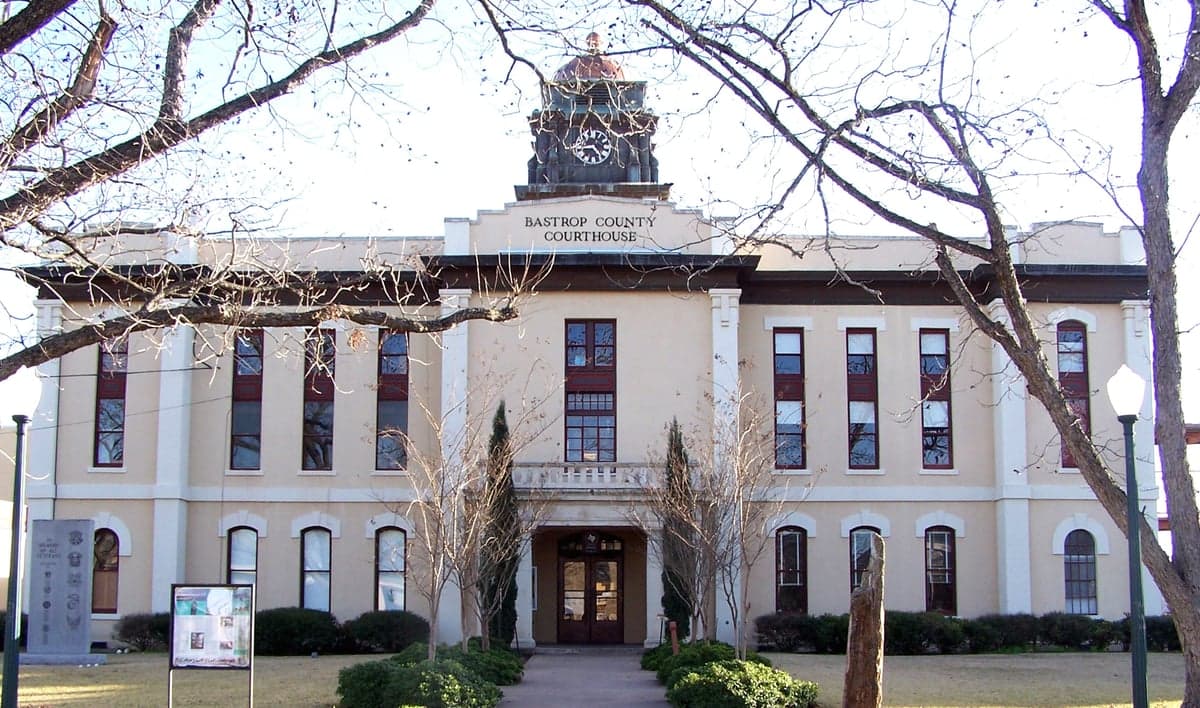
Photo: Wikipedia
Personal Sovereignty in Bastrop County
Strong independent fundamentals that actively favor personal liberty and low regulation.
What does Personal Sovereignty tell us?
Personal Sovereignty measures your capacity for self-reliance and independence with minimal government friction. Higher scores mean fewer barriers between you and the way you want to live... but it assumes you have the space you need and good neighbors.
What does this tell us?
Personal Sovereignty measures your capacity for self-reliance and independence with minimal government friction. Higher scores mean fewer barriers between you and the way you want to live... but it assumes you have the space you need and good neighbors.
State Policy
Energy independence: Net exporter (220% of energy produced in-state)
Personal Liberty
Homesteading

Personal Liberty Analysis
Bastrop County offers a meaningful degree of personal sovereignty relative to the Austin metro area, but it is not a libertarian free zone. The county’s regulatory posture, tax burden, and cultural norms create a middle ground where self-reliance is feasible but not frictionless—especially for those coming from deep-blue states. For single individuals and parents prioritizing autonomy, the key is understanding where the county’s local governance diverges from state-level protections and where it aligns with a prepper or survivalist mindset. The difference between living in Elgin versus Smithville, or on an unincorporated acreage versus inside Bastrop city limits, can be the difference between genuine self-determination and a slow creep of municipal overreach.
Tax burden and regulatory posture: how Bastrop County compares to surrounding areas
Texas has no state income tax, which is a baseline advantage for anyone seeking to keep more of their earnings. Bastrop County’s property tax rate hovers around 2.2% of assessed value, slightly above the state average, but still far below what you’d face in California, New York, or Illinois. The county’s regulatory posture is generally permissive, but with notable local variations. The city of Bastrop itself has adopted stricter building codes and zoning ordinances than the unincorporated areas, particularly regarding short-term rentals and new construction setbacks. In contrast, Smithville and Elgin maintain a lighter regulatory touch, with fewer permitting hurdles for accessory dwellings, workshops, or small-scale agricultural structures. For a prepper or homesteader, the unincorporated areas east of the Colorado River—near Red Rock or Cedar Creek—offer the most freedom from municipal oversight. The county’s appraisal district is aggressive on valuations, so expect annual tax increases tied to rising land values, but there are no county-level income or business taxes beyond the standard property levy. The overall message: Bastrop County is not a tax haven like rural New Mexico or Wyoming, but it is a solid improvement over the Austin city limits, where regulatory costs and fees add 15-20% to any construction or renovation project.
Self-defense and gun law specifics: what the Second Amendment looks like on the ground
Texas is a permitless carry state, and Bastrop County’s sheriff’s office is publicly supportive of the Second Amendment. Open carry of handguns is legal for anyone 21 or older who can legally possess a firearm, and long guns are unrestricted. The county has no local magazine capacity bans, no red flag law enforcement beyond state-level provisions, and no additional waiting periods beyond the federal background check. Bastrop County is a “Second Amendment Sanctuary” county, having passed a resolution in 2021 affirming that local resources will not be used to enforce federal gun laws deemed unconstitutional. This matters for preppers and survivalists because it signals that the sheriff’s office will not cooperate with federal overreach—at least on paper. In practice, the Bastrop Police Department and the county sheriff’s deputies are generally pro-gun, but the city of Bastrop has a more visible law enforcement presence than outlying areas. If you want to minimize interactions with police while exercising your gun rights, the rural areas near Paige or McDade are preferable. There are no county-level restrictions on building a private shooting range on your own property, provided you meet noise and safety common-law standards. For parents, the legal landscape for firearm storage and youth training is favorable: Texas law does not require trigger locks or safe storage, and minors can possess firearms with parental supervision for hunting, target shooting, and self-defense training.
Self-reliance and homesteading viability: lot sizes, zoning, and off-grid feasibility
Bastrop County’s zoning is minimal outside incorporated cities, which makes it one of the more viable areas near Austin for off-grid living. Minimum lot sizes in unincorporated areas are typically one acre for a single-family dwelling, but many subdivisions have deed restrictions that require larger lots—often three to five acres. Smithville and Elgin have the most permissive zoning for homesteading activities, including keeping chickens, goats, and even small livestock within city limits, though with some restrictions on roosters and odor management. The unincorporated areas around Red Rock and Cedar Creek allow for full-scale homesteading: you can keep horses, cattle, pigs, and poultry without special permits, as long as you meet basic animal welfare standards. Off-grid feasibility is high in these areas. There are no county-level bans on rainwater collection, solar panels, or composting toilets. The main hurdle is well and septic permitting, which requires county health department approval and can take 60-90 days. Bastrop County does not require a building permit for structures under 200 square feet in unincorporated areas, which is a significant advantage for building a workshop, tool shed, or small cabin without bureaucratic interference. However, the county does enforce the International Residential Code for any habitable dwelling, so a full off-grid cabin will still need to meet structural and electrical standards. For preppers seeking true autonomy, the areas east of Highway 21—toward the Lee County line—offer the best combination of low population density, minimal regulation, and affordable land prices, often under $10,000 per acre.
Personal liberties: parental rights, medical autonomy, speech, and property
Texas has strong parental rights protections under state law, including the Texas Parental Rights Act, which prohibits government agencies from overriding parental decisions without a court order. Bastrop County’s school districts—Bastrop ISD, Elgin ISD, and Smithville ISD—generally defer to parents on medical decisions, vaccination choices, and curriculum objections, though the districts are not uniformly conservative. Smithville ISD and Elgin ISD have a reputation for being more responsive to parental concerns than Bastrop ISD, which has a larger student population and more bureaucratic inertia. Medical autonomy is protected by state law: there is no state-level vaccine mandate for adults, and the Texas Medical Board has limited authority to compel treatment. Bastrop County has no local health ordinances that override these protections, unlike some urban counties that attempted mask or vaccine mandates during the pandemic. Speech and property rights are robust. The county has no sign ordinances in unincorporated areas, so you can post political or religious signage without permit fees. There are no county-level noise ordinances that would prevent you from running a generator or power tools at night, though common-law nuisance claims could still apply. Property rights are further protected by Texas’s strong eminent domain laws, which require full compensation and public necessity. Bastrop County has not pursued any controversial land-use condemnations in recent years, unlike Travis County’s aggressive use of eminent domain for transportation projects. For parents, the ability to homeschool without state interference is a major plus: Texas requires no notification, no standardized testing, and no curriculum approval for homeschoolers.
Overall, Bastrop County offers a level of personal sovereignty that is rare within commuting distance of a major Texas city. It is not a prepper paradise like the Texas Panhandle or the Hill Country west of Kerrville, but it is a practical compromise for those who need access to Austin’s job market while maintaining a self-reliant lifestyle. The county’s tax burden is moderate, its gun culture is strong, its homesteading potential is real, and its respect for parental and property rights is above average. For single individuals and parents who prioritize autonomy over convenience, Bastrop County—especially the unincorporated areas around Smithville, Elgin, Red Rock, and McDade—represents a solid strategic relocation choice in a state that is increasingly divided between urban overreach and rural freedom.

* Values derived from national, state, county, city and local statistics and may differ in a specific area. Last updated: 2026-05-12T20:57:05.000Z
Narrative content on this page is AI-generated and may contain mistakes. Verify any details that matter before acting on them.
ReloMaps may earn a commission from affiliate links at no extra cost to you.

