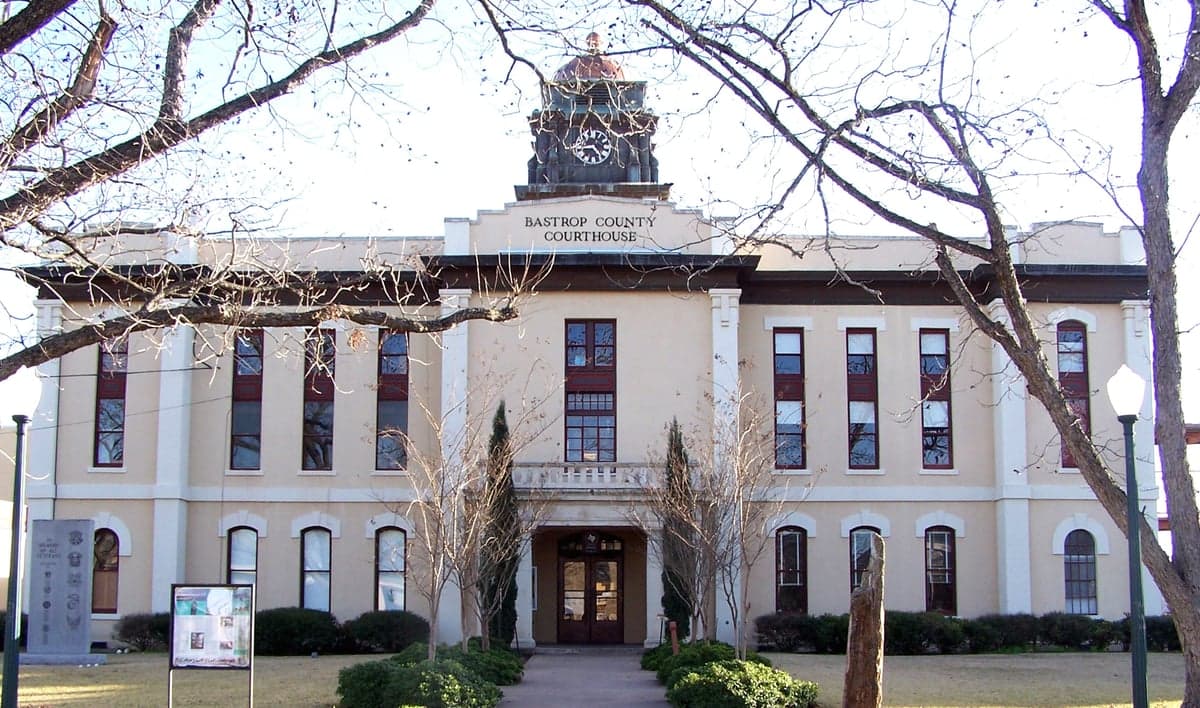
Photo: Wikipedia
Demographics of Bastrop County
Affluence Level in Bastrop County
A middle-class area roughly in line with national averages across income, home values, education, and employment.
People of Bastrop County
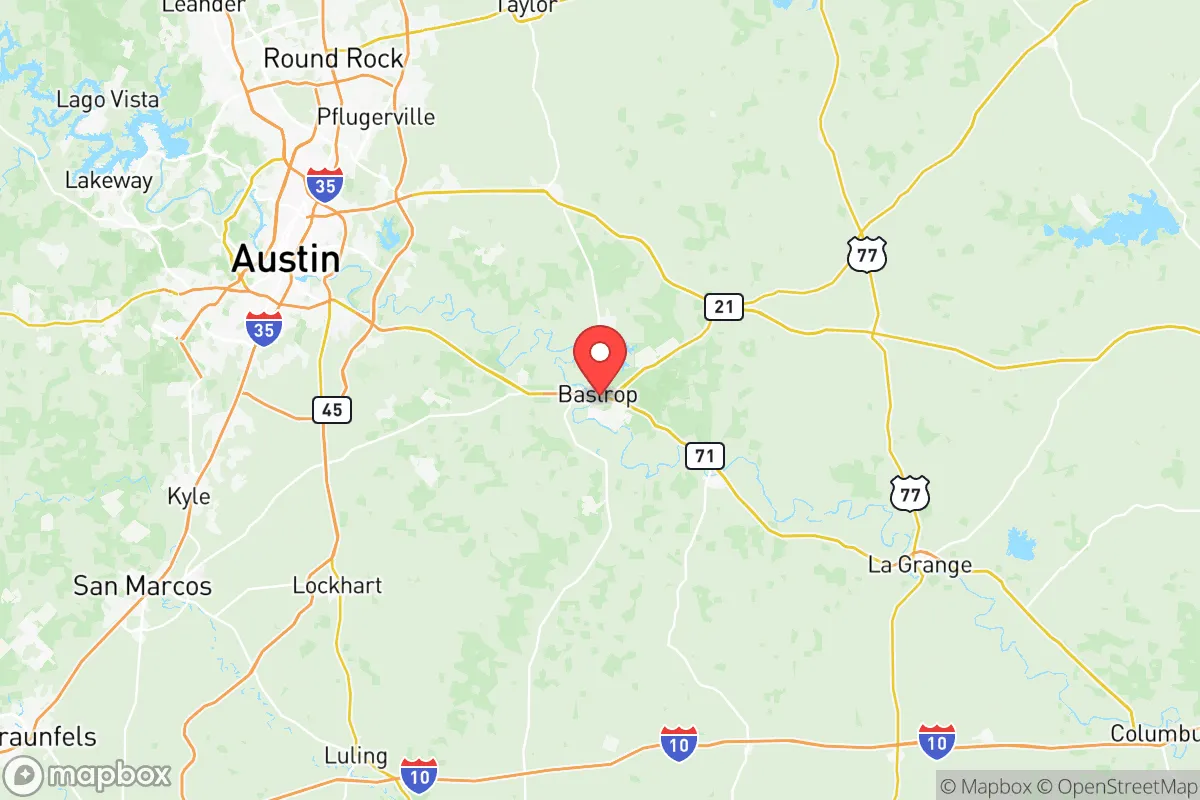
Bastrop County, Texas is home to 102,370 residents, a population shaped by centuries of layered migration that has produced a near-even split between White (45.7%) and Hispanic (44.0%) communities, with a smaller Black population of 5.7% and a foreign-born share of 9.7%. The county’s character is defined by its position as a rural-to-suburban transition zone east of Austin, where historic German and Czech farming settlements meet newer subdivisions drawing families and commuters from the state capital. Distinctive identity markers include a strong ranching and timber heritage, a growing conservative-leaning exurban base, and a deep-rooted Hispanic presence that predates Texas statehood.
Settlement & growth (pre-1960)
The earliest inhabitants of what is now Bastrop County were the Tonkawa and Coahuiltecan peoples, semi-nomadic hunter-gatherers who occupied the Colorado River bottomlands for millennia before European contact. Spanish expeditions passed through the area as early as the 1690s, but no permanent Spanish settlement took hold; the region remained a sparsely populated frontier under Mexican rule after 1821. The first Anglo-American colonists arrived in the 1830s under Stephen F. Austin’s Old Three Hundred land grants, settling along the Colorado River at present-day Bastrop (founded as Mina in 1832) and Elgin. These early settlers were primarily from the U.S. South—Tennessee, Kentucky, and Mississippi—and brought enslaved African Americans with them, establishing cotton plantations on the fertile river bottoms.
After Texas statehood in 1845, a second wave of European immigrants arrived, most notably German and Czech farmers who purchased land in the county’s central and eastern sections. Towns like Smithville and McDade became centers of German-speaking communities, while Czech families concentrated around Rosanky and Red Rock. These groups brought Lutheran and Catholic traditions, family farming practices, and a strong work ethic that defined the county’s agricultural economy through the early 1900s. The arrival of the railroad in the 1870s—connecting Bastrop, Elgin, and Smithville to the Houston and Texas Central line—spurred population growth and turned Elgin into a cotton-ginning hub known for its brickmaking industry.
Emancipation in 1865 freed the county’s enslaved population, which numbered roughly 2,000 at the time. Freedmen established several rural communities, including St. Mary’s Colony near Bastrop and Kellogg’s Settlement in the county’s southeast, where they farmed small plots and built churches and schools. The Black population remained significant through the early 20th century, but the Great Migration (1910–1970) drew many African Americans to Houston and other industrial cities, reducing the county’s Black share from roughly 30% in 1900 to under 10% by 1970. Meanwhile, the Dust Bowl of the 1930s brought a small number of white migrants from Oklahoma and Arkansas, though Bastrop County’s agricultural economy was less devastated than the Texas Panhandle, limiting this influx.
By 1960, Bastrop County’s population stood at about 16,000—overwhelmingly rural, with a majority-white population, a substantial Hispanic minority (descended from Mexican-American families who had lived in the region since the 19th century), and a declining Black community. The county’s economy remained tied to cotton, cattle, and timber, with sawmills operating in Bastrop and Smithville.
Modern era (post-1965)
The 1965 Hart-Cellar Act had a limited direct impact on Bastrop County, as the area did not attract large numbers of post-1965 immigrants. Instead, the county’s modern demographic transformation has been driven by domestic migration from the Austin metropolitan area. Beginning in the 1980s and accelerating after 2000, families and workers seeking lower housing costs and larger lots began moving east from Travis County into Bastrop County. This suburbanization concentrated in Bastrop (the county seat), Elgin, and the unincorporated area around Wyldwood, where new subdivisions replaced farmland. The county’s population more than doubled between 1990 and 2020, from 38,000 to over 100,000.
The Hispanic population grew from roughly 25% in 1990 to 44% today, driven by both natural increase and continued migration from Mexico and Central America. Hispanic residents are spread throughout the county, with notable concentrations in Bastrop’s historic east side, in Elgin, and in rural colonia-style settlements near Cedar Creek. This community is predominantly Mexican-American, with smaller numbers of Salvadoran and Guatemalan families. The foreign-born share of 9.7% is lower than the Texas average (17%), reflecting the county’s relatively modest direct immigration.
The White population, while declining as a share from over 70% in 1980 to 45.7% today, has grown in absolute numbers due to in-migration from Austin and other parts of Texas. These newer white residents tend to be more educated and politically moderate-to-conservative, working in tech, construction, and professional services in Austin while living in Bastrop County for its lower taxes and larger properties. The Black population has stabilized at 5.7%, with small communities in Bastrop and Elgin, and a newer influx of African Americans from Houston and Dallas seeking affordable housing. East/Southeast Asian residents (0.6%) and Indian-subcontinent residents (0.1%) are present in very small numbers, mostly professionals employed in Austin’s tech sector who commute from subdivisions near the Travis County line.
Suburbanization has reshaped the county’s geography. The Bastrop city limits have expanded westward along State Highway 71, while Elgin has grown northward toward Manor. Smithville and McDade have seen slower growth, retaining their small-town character. The county’s college-educated share of 23.3% is below the Texas average (31%), reflecting the area’s mix of blue-collar trades, service work, and agriculture alongside white-collar commuters.
The future
Bastrop County’s population is projected to reach 130,000–150,000 by 2040, driven by continued spillover from Austin and by the development of new master-planned communities such as the ColoVista development near Bastrop. The Hispanic share is likely to continue rising slowly, approaching 50% by 2040, as younger Hispanic families have higher birth rates and continued migration from Mexico and Central America. The White share will decline further in percentage terms but grow in absolute numbers, creating a more ethnically balanced county than the heavily white exurbs north of Austin.
The county is not tribalizing into distinct enclaves; rather, it is becoming more integrated geographically, with newer subdivisions drawing a mix of white, Hispanic, and Black residents. The historic German and Czech communities are largely assimilated, with their cultural markers surviving in place names and annual festivals (e.g., Elgin’s Poultry Festival, Smithville’s Jamboree) rather than in distinct ethnic neighborhoods. The immigrant community is growing slowly and is primarily Hispanic, with little new Asian or African immigration. In-migration from Austin is gradually raising the county’s educational attainment and income levels, but Bastrop County remains more working-class and conservative than Travis County, a dynamic that is likely to persist.
For someone moving in now, Bastrop County offers a middle ground: a place where historic rural communities coexist with new suburban development, where Hispanic and Anglo cultures have coexisted for generations, and where the cost of living remains lower than Austin while the commute to the city is manageable. The county is becoming more diverse, more suburban, and more connected to the Austin economy, but it retains a distinct identity shaped by its German-Czech farming roots, its Southern plantation history, and its long-standing Mexican-American presence.

* Values derived from national, state, county, city and local statistics and may differ in a specific area. Last updated: 2026-05-12T20:57:05.000Z
Narrative content on this page is AI-generated and may contain mistakes. Verify any details that matter before acting on them.
ReloMaps may earn a commission from affiliate links at no extra cost to you.

