Photo: Wikipedia
Demographics of Jefferson County
Affluence Level in Jefferson County
A middle-class area roughly in line with national averages across income, home values, education, and employment.
People of Jefferson County
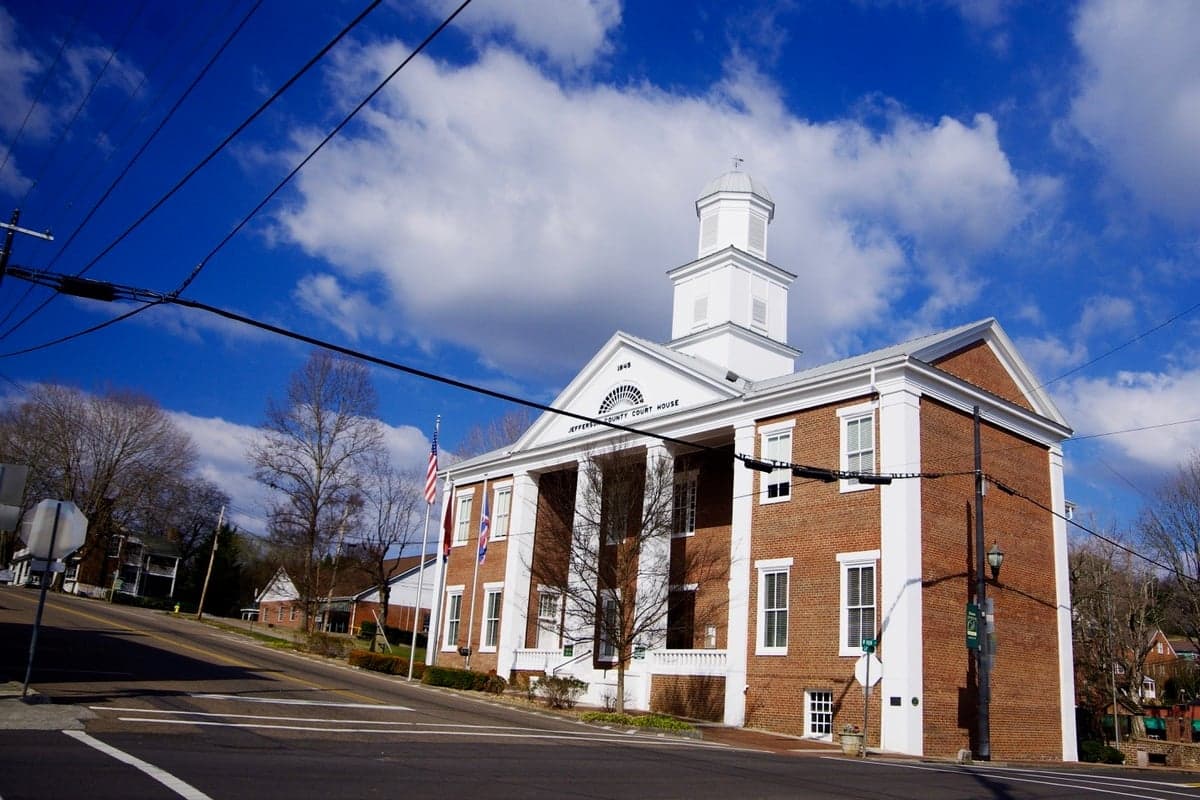
Jefferson County, Tennessee, is a predominantly white, rural-to-suburban community of 55,835 residents where 90.3% of the population identifies as white, 4.5% as Hispanic, and 1.5% as Black. The county’s character is shaped by its Appalachian foothill geography, a strong sense of local independence, and a population that is older and less diverse than the national average, with only 1.3% foreign-born residents. Distinctive markers include a deep-rooted Scots-Irish heritage, a growing bedroom-community identity for Knoxville commuters, and a cultural conservatism reflected in its voting patterns and religious participation.
Settlement & growth (pre-1960)
Long before European settlement, the land that is now Jefferson County was part of the hunting grounds of the Cherokee Nation, who maintained villages along the French Broad and Holston Rivers. The Cherokee were forcibly removed through the 1830s, with the last major cession occurring in 1819, opening the area to white settlement. The first permanent European settlers were predominantly Scots-Irish and English migrants moving west from Virginia and North Carolina in the late 18th and early 19th centuries, drawn by the promise of fertile bottomland and the availability of land grants for Revolutionary War service. These early families established the county’s oldest settlements, including Dandridge (the county seat, founded 1793), Jefferson City (originally Mossy Creek), and New Market. The Scots-Irish influence remains the dominant cultural thread, visible in the county’s many Presbyterian and Baptist churches, its family-centered social structure, and its historical resistance to centralized authority.
During the 19th century, the population grew slowly but steadily, driven by subsistence farming, small-scale milling, and the establishment of Mossy Creek Academy (later Carson-Newman College) in 1851. The Civil War divided the county, with Union and Confederate sympathies roughly equal, but the post-war period saw little in-migration from outside the region. Unlike the Deep South, Jefferson County did not experience a large influx of freed slaves; the Black population has always been small, hovering around 1-2% since the late 1800s. The arrival of the railroad in the 1850s and later the development of the Tennessee Valley Authority in the 1930s brought modest economic diversification, but the county remained overwhelmingly agricultural and rural through the 1950s. The population in 1960 was roughly 23,000, almost entirely white and native-born, with a handful of families of German and Irish descent who had arrived in the mid-1800s.
Modern era (post-1965)
The 1965 Hart-Cellar Act had almost no direct impact on Jefferson County. With only 1.3% of the population foreign-born, the county has not experienced the immigration-driven diversification seen in urban Tennessee. The small Hispanic population (4.5%) is a recent phenomenon, largely arriving after 2000, drawn by agricultural work in nurseries and Christmas tree farms around Strawberry Plains and White Pine, as well as construction and service jobs in the Knoxville metro area. These families are predominantly Mexican and Central American, and they have concentrated in mobile home parks and rental housing in the more affordable southern and western parts of the county. The Black population (1.5%) has remained stable, with most African American residents living in Jefferson City and Dandridge, often descendants of families who have been in the county for generations. The East/Southeast Asian population (0.3%) and Indian subcontinent population (0.2%) are negligible, consisting mostly of a few faculty families at Carson-Newman University and medical professionals at the county’s hospitals.
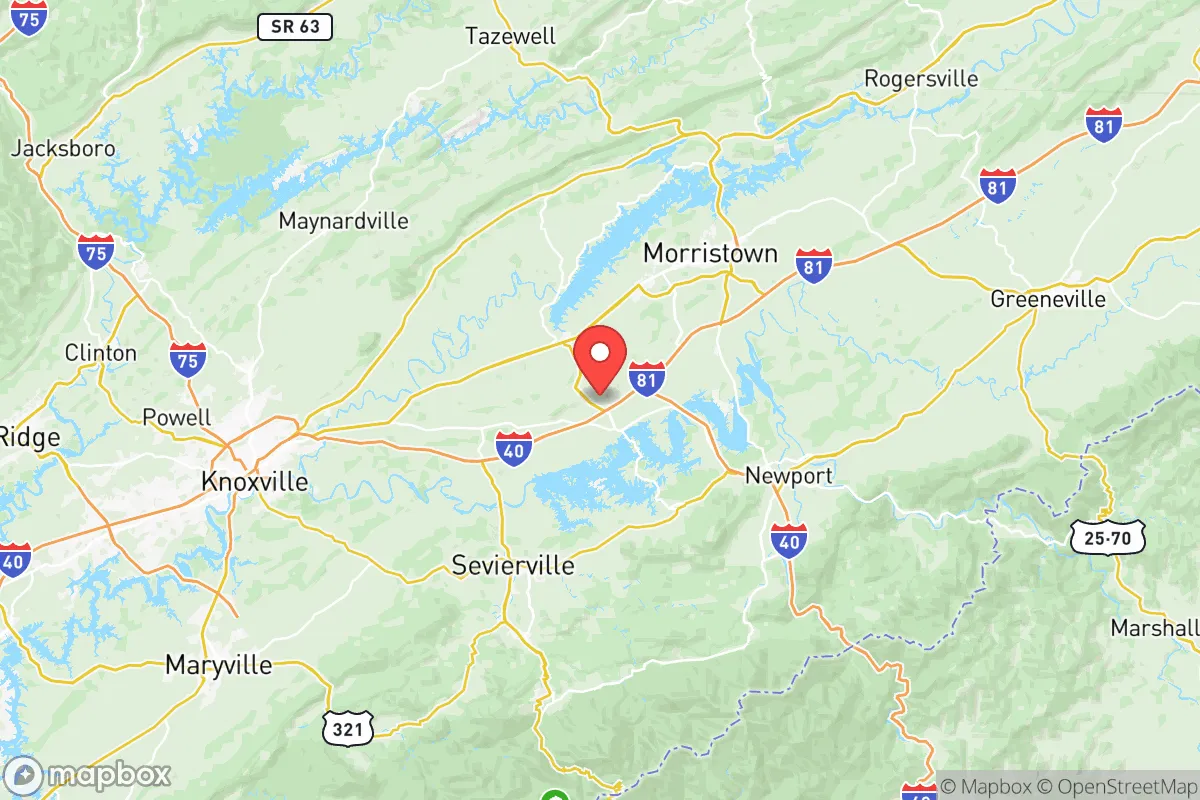
The most significant demographic shift since 1965 has been domestic migration: the gradual suburbanization of Jefferson County as a bedroom community for Knoxville, located about 30 miles to the west. The completion of Interstate 40 in the 1970s and the expansion of State Route 92 and State Route 66 made commuting feasible, and the county’s population grew from 24,000 in 1970 to over 55,000 today. This growth has been overwhelmingly white and native-born, with new residents coming from Knox County, other parts of East Tennessee, and, increasingly, from Rust Belt states like Ohio, Michigan, and Illinois. These newcomers are often retirees seeking lower taxes and a slower pace, or families looking for affordable housing and good schools. The growth has concentrated in the western part of the county, particularly around Strawberry Plains and the I-40 corridor, and in the expanding subdivisions near Dandridge and Jefferson City. The county’s college-educated population is only 21.0%, well below the national average, reflecting the area’s reliance on manufacturing, logistics, and service-sector employment.
The future
Jefferson County is projected to continue growing slowly, driven by domestic migration from higher-cost areas, but it is unlikely to become significantly more diverse. The Hispanic population may increase modestly as families already in the county grow and as agricultural and construction labor demand persists, but the foreign-born share is expected to remain below 3% for the foreseeable future. The white population will remain the overwhelming majority, though it may decline slightly as a share due to aging and out-migration of younger adults to urban centers. The county’s cultural identity is evolving from a purely rural, agricultural community to a hybrid rural-suburban one, with new subdivisions and strip malls along the I-40 corridor contrasting with the historic downtowns of Dandridge and Jefferson City. This tension between preservation and growth is the defining local issue, with long-time residents wary of the changes brought by Knoxville commuters and newcomers.
For someone moving in now, Jefferson County offers a stable, low-crime, and affordable environment with strong community ties and a conservative social fabric. The population is homogeneous, family-oriented, and rooted in a Scots-Irish tradition of self-reliance and local governance. The county is not becoming a melting pot, but it is becoming a more connected part of the Knoxville metro area, which will bring gradual changes in housing, retail, and commuting patterns. The bottom line: Jefferson County is a place where the past is still very present, and where the future will look much like the present, only a little busier and a little more suburban.

* Values derived from national, state, county, city and local statistics and may differ in a specific area. Last updated: 2026-09-08T08:09:18.000Z
Narrative content on this page is AI-generated and may contain mistakes. Verify any details that matter before acting on them.
ReloMaps may earn a commission from affiliate links at no extra cost to you.

