Photo: Wikipedia
Political ClimatePolitical Climate in Jefferson County
Showing district-level results — no local-only data available.
Local Political AnalysisPolitical Analysis of Jefferson County
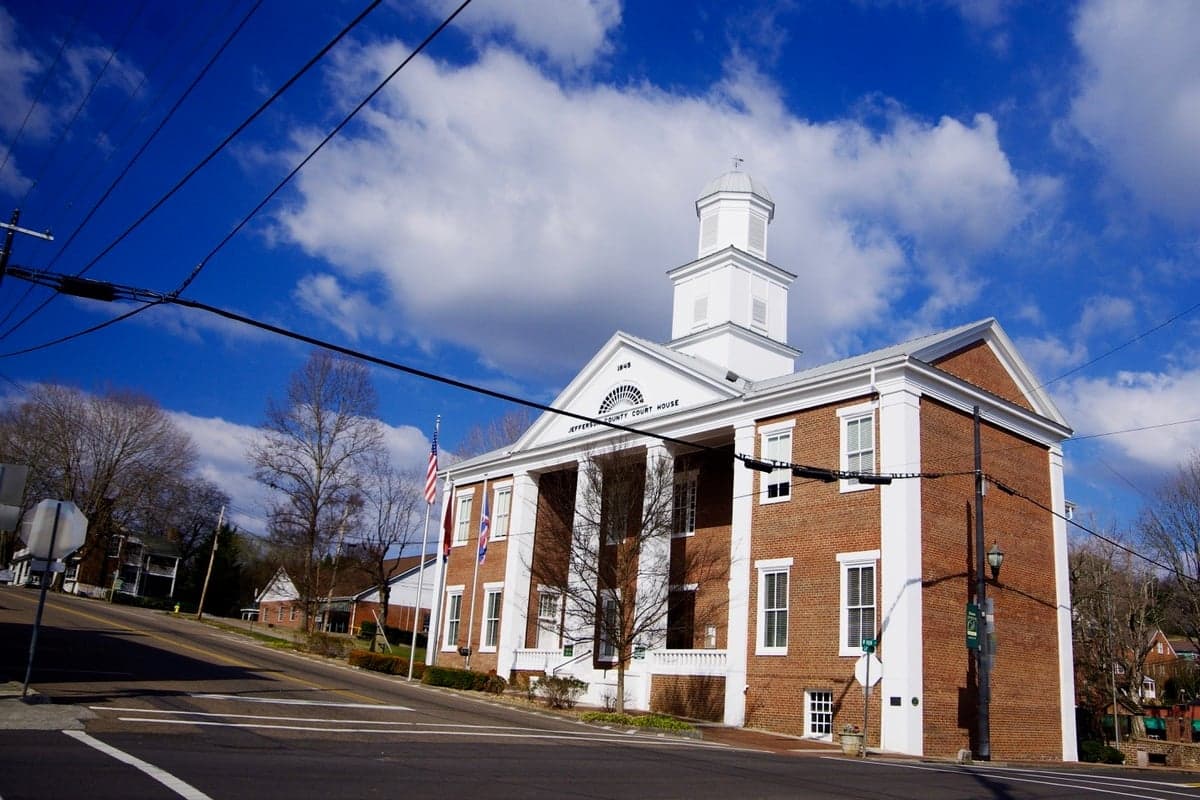
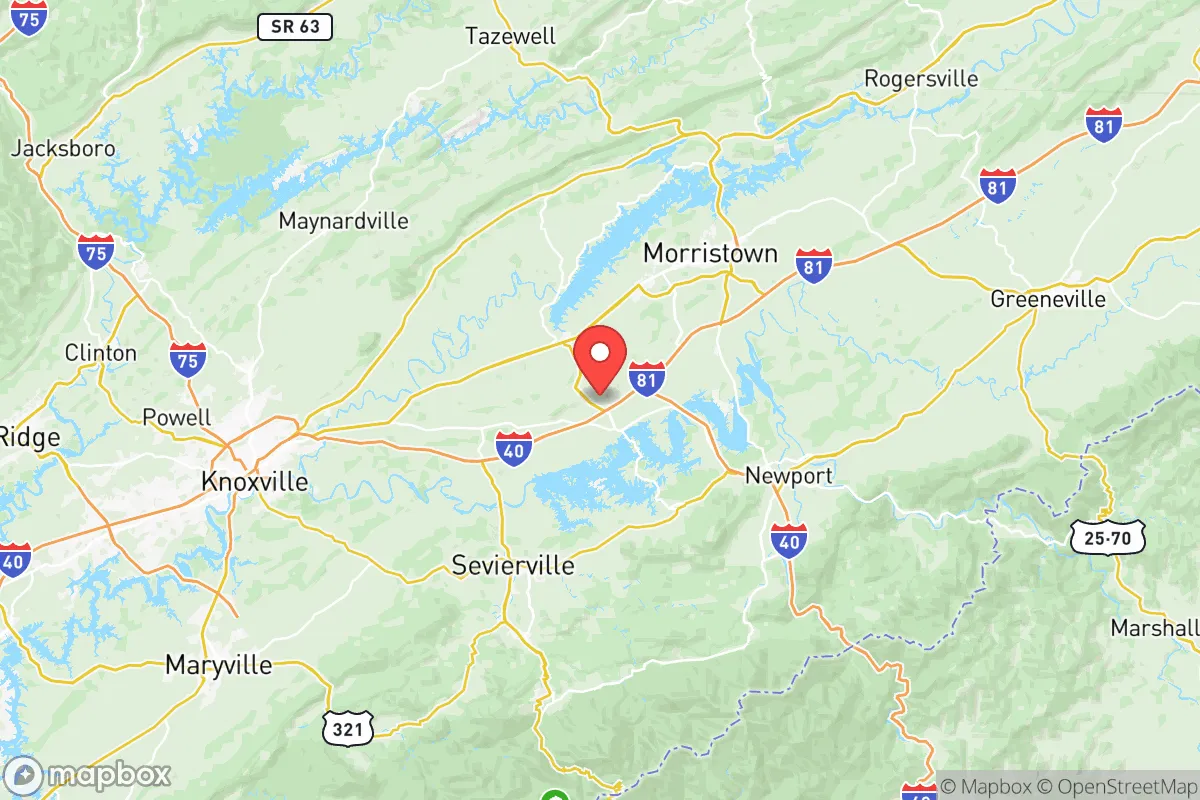
Jefferson County, Tennessee, is one of the most reliably Republican areas in the entire state, with a Cook Partisan Voting Index (PVI) of R+29 — more than twice as red as Tennessee’s statewide R+13 rating. That’s not a recent shift; the county has been a GOP stronghold for decades, and if anything, the margins have only widened since 2020. You’ll see Trump signs on every other lawn in places like Dandridge and Jefferson City, but the picture isn’t entirely uniform. The county seat, Dandridge, is the heart of deep-red sentiment, while the college town of Jefferson City — home to Carson-Newman University — shows a slightly more moderate streak, with a handful of precincts that occasionally vote within 10 points of the statewide average. The rural pockets around White Pine and New Market lean hard right, while the area around the Douglas Lake resort communities can swing a bit more, especially with second-home owners from Knoxville.
How it compares
Compared to Tennessee as a whole, Jefferson County is a full 16 points more conservative on the PVI scale. That’s a massive gap. Statewide, Tennessee’s R+13 rating already puts it in the top tier of red states, but Jefferson County sits in a league with places like Grundy County or the far northeastern corner of the state. The practical effect: while Tennessee’s statewide races are rarely competitive, Jefferson County is a place where a Republican primary win is essentially the general election win. In the 2024 presidential race, the county delivered roughly 78% of its vote to Donald Trump, compared to about 65% statewide. The county’s GOP base is so solid that Democratic candidates often skip it entirely, focusing resources on the Nashville and Memphis corridors. That said, the county’s politics are more about cultural conservatism than economic populism — you’ll hear more about Second Amendment rights and school choice than about trade tariffs or manufacturing jobs.
What this means for residents
For conservative residents, Jefferson County is a comfortable place to live politically. Local offices — from county commission to school board — are overwhelmingly held by Republicans, and policy debates tend to revolve around how conservative, not whether. The county commission’s recent fights over library book policies and a proposed property tax freeze are good examples of the local political temperature. For liberal residents, the reality is more isolating. There’s no organized Democratic Party presence to speak of, and progressive viewpoints are rarely represented in public forums. That said, Jefferson City’s college influence provides a small bubble where more moderate or left-leaning views can be expressed without the same social friction you’d find in Dandridge or rural White Pine. The county’s politics are stable, not volatile — you won’t see the kind of rapid demographic shifts that are reshaping Williamson County or Rutherford County. The trajectory is toward even deeper red, driven by an aging population and the out-migration of younger, more moderate voters to Knoxville or Nashville.
Culturally, the county’s political identity is tied to its rural character and strong evangelical presence. You’ll find more churches per capita than coffee shops, and the local Republican Party’s monthly meetings often feature prayer and a focus on family values. The county’s relationship with the state government is generally cooperative — Jefferson County reliably sends conservative representatives to Nashville, and there’s little of the friction you see between deep-blue cities and the state capitol. For anyone moving here, the political climate is straightforward: if you’re conservative, you’ll feel at home; if you’re not, you’ll need to find your community in the quieter corners of Jefferson City or among the lakefront transplants who bring a slightly more diverse set of views. Either way, the politics here are a constant, not a surprise.

State Political ClimatePolitical Climate in Tennessee
State Political AnalysisPolitical Environment in the State
Tennessee is a solidly Republican state with a Cook PVI of R+13, meaning it votes about 13 points more Republican than the national average in presidential elections. The state has shifted rightward over the past 20 years, driven by the exodus of conservative-leaning residents from blue states and the continued growth of its reliably red suburbs and exurbs. While Democrats once held a competitive edge in state and local races through the 1990s, the GOP now holds supermajorities in both chambers of the General Assembly and controls every statewide office, making Tennessee one of the most reliably conservative states in the country for the foreseeable future.
Urban vs. rural divide
The political map of Tennessee breaks down along a classic urban-rural split, but with a few distinct wrinkles. The state's two major metros—Nashville (Davidson County) and Memphis (Shelby County)—are deep blue, with Nashville voting roughly 65% Democratic in 2024 and Memphis closer to 70%. These cities anchor the state's Democratic base, but they are surrounded by heavily Republican suburbs and exurbs. For example, Williamson County, just south of Nashville, is one of the wealthiest and most Republican counties in the nation, voting about 70% for Trump in 2024. Similarly, the suburbs of Memphis—like Collierville and Germantown—are reliably red, though they have shown slight shifts toward the center in recent local elections. The rest of the state is overwhelmingly Republican: rural West Tennessee, the Cumberland Plateau, and East Tennessee (outside of Knoxville) are all deep red. Knoxville itself is a purple city, with a Republican lean but a growing Democratic presence, especially among younger residents and university faculty. The only other notable blue dot is Chattanooga, which has a Democratic-leaning core but is surrounded by a sea of red in Hamilton County's rural precincts.
Policy environment
Tennessee's policy environment is defined by a low-tax, limited-government philosophy that appeals strongly to conservative relocators. The state has no personal income tax—only a flat 6.5% corporate income tax and a 7% sales tax on most goods, with food taxed at 4%. Property taxes are low by national standards, with an effective rate around 0.7% of home value. The regulatory posture is business-friendly, with a right-to-work law and no state-level minimum wage above the federal $7.25. Education policy is a mixed bag: the state has a robust school choice program, including charter schools and a new Education Savings Account (ESA) program for low-income families in certain counties, but public school funding per pupil remains below the national average. Healthcare is a notable weak spot—Tennessee has not expanded Medicaid under the Affordable Care Act, leaving roughly 300,000 residents in the coverage gap. Election laws are restrictive: the state requires a photo ID to vote, has no same-day registration, and recently passed a law making it a felony to hand out water or food to voters waiting in line within 100 feet of a polling place. Gun laws are among the most permissive in the nation: permitless carry for adults 21 and older was enacted in 2021, and the state has a strong "stand your ground" law.
Recent policy direction
Recent legislation in Tennessee has pushed the state further to the right on a broad range of issues. On gun rights, the 2021 permitless carry law (SB 765) eliminated the requirement for a permit to carry a handgun, though a background check is still required for purchases from licensed dealers. In 2023, the legislature passed a law allowing teachers to carry firearms on school grounds with approval from local law enforcement. On parental rights and education, the state passed a "Don't Say Gay" law (HB 0800) in 2023 that restricts classroom discussion of sexual orientation and gender identity in grades K-8, and a 2022 law (SB 2296) that bans transgender girls from participating in girls' sports. On speech and privacy, the state enacted a law in 2023 requiring social media platforms to verify the age of users and restrict minors' access to "harmful" content. On medical and bodily autonomy, Tennessee has one of the most restrictive abortion bans in the country, with no exceptions for rape or incest and a narrow exception for the life of the mother. The state also passed a law in 2023 (SB 1) that bans gender-affirming care for minors, including puberty blockers and hormone therapy. On property rights, the state has a strong eminent domain law that favors private development, but also a robust "right to farm" law that protects agricultural operations from nuisance lawsuits. On voting and ballot access, the state has tightened rules: a 2023 law (SB 1540) made it a crime for election officials to send unsolicited absentee ballot applications, and a 2024 law (HB 2104) requires voters to provide proof of citizenship when registering, though this has been challenged in court.
Civil unrest & political movements
Tennessee has seen its share of political flashpoints in recent years. The most visible was the 2023 Nashville school shooting at The Covenant School, which sparked massive protests at the state capitol for gun control measures, including a sit-in by Democratic lawmakers that led to the expulsion of two Black representatives. The protests were met with a heavy police presence and counter-protests from gun rights groups, but no widespread unrest. On the right, the state has a strong Second Amendment sanctuary movement, with dozens of counties passing resolutions declaring themselves "sanctuaries" for gun rights. Immigration politics are less heated than in border states, but the legislature passed a law in 2024 (HB 2120) requiring local law enforcement to cooperate with federal immigration authorities and penalizing "sanctuary city" policies, though no Tennessee city has formally adopted such a policy. Election integrity controversies have been relatively muted, but the state's 2020 election audit found no evidence of widespread fraud, despite some Republican activists pushing for further restrictions. A new resident would notice the presence of "Don't Tread on Me" flags and "Thin Blue Line" decals on vehicles in rural areas, and occasional protests at the capitol on issues like abortion and gun rights, but these are generally orderly and small-scale.
Projection
Over the next 5-10 years, Tennessee's political trajectory is likely to remain solidly Republican, but with some subtle shifts. In-migration from blue states—especially California, Illinois, and New York—is bringing a wave of new residents who tend to be more moderate on social issues but still fiscally conservative. This is already visible in places like Williamson County, where the GOP primary has become more competitive between establishment conservatives and populist firebrands. The Nashville metro area will continue to grow and become more Democratic, but the state's rural and exurban areas will remain deeply red, and the GOP's supermajority in the legislature is unlikely to be threatened. The biggest wildcard is the state's abortion ban: if public opinion continues to shift toward supporting exceptions for rape and incest, the legislature may face pressure to loosen the law, but the current leadership shows no appetite for that. A new resident moving in now should expect a state that remains reliably conservative on taxes, guns, and education, but with a growing urban-liberal counterweight that will keep cultural battles alive in the legislature for years to come.
For a new resident, the bottom line is that Tennessee offers a low-tax, business-friendly environment with strong gun rights and a conservative cultural tilt, but with a vibrant blue urban core in Nashville and Memphis that provides a counterbalance. If you're a conservative, you'll find a state government that largely aligns with your values on taxes, education, and personal liberty. If you're a liberal, you'll find a welcoming community in the cities, but you'll need to accept that state policy will often run counter to your preferences, especially on healthcare, abortion, and voting access. Either way, the state's political climate is stable, predictable, and unlikely to surprise you in the near term.
* Values derived from national, state, county, city and local statistics and may differ in a specific area. Last updated: 2026-09-08T08:09:18.000Z
Narrative content on this page is AI-generated and may contain mistakes. Verify any details that matter before acting on them.
ReloMaps may earn a commission from affiliate links at no extra cost to you.

