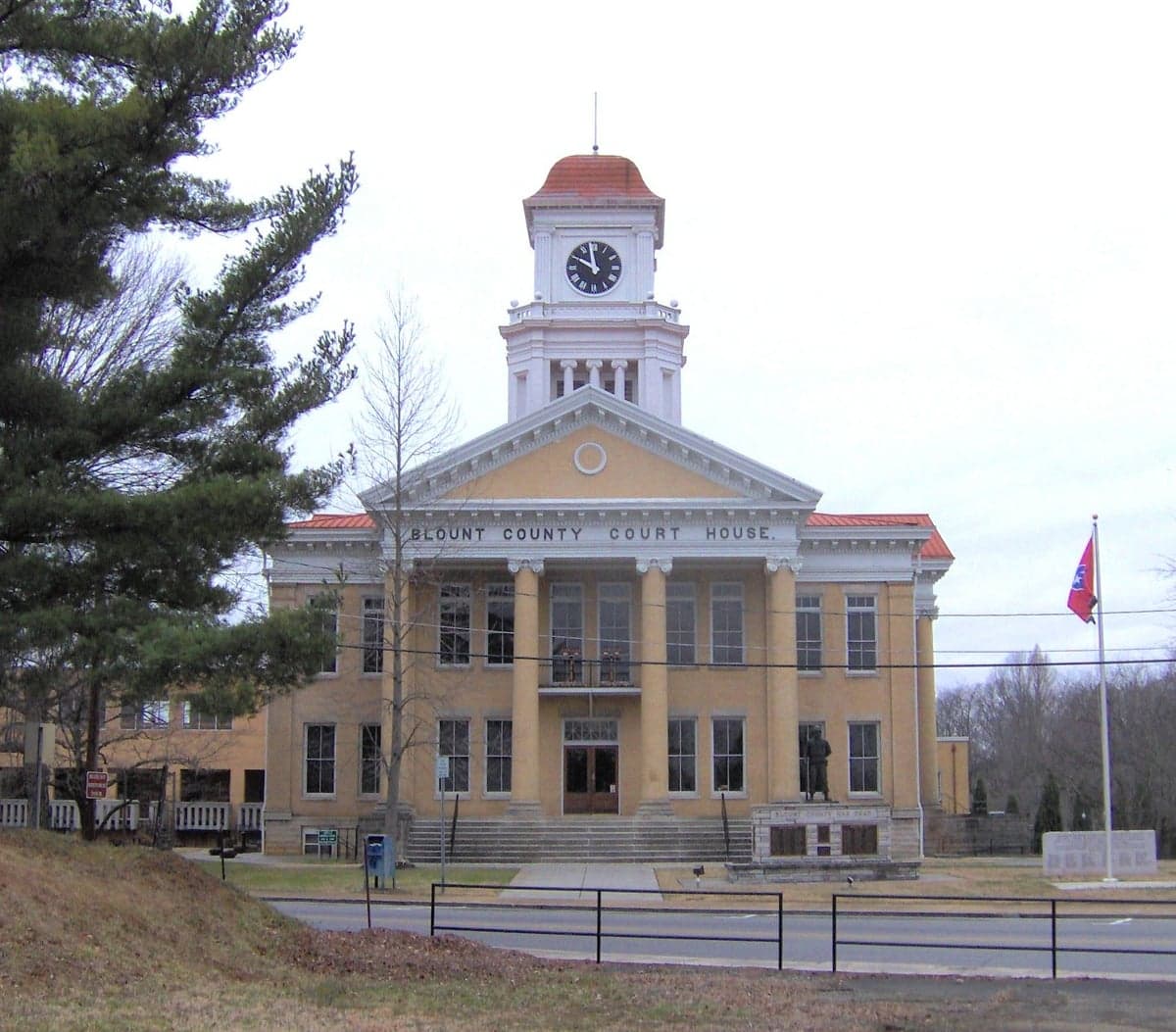
Photo: Wikipedia
Political ClimatePolitical Climate in Blount County
Showing district-level results — no local-only data available.
Local Political AnalysisPolitical Analysis of Blount County
Blount County, Tennessee, is a reliably conservative stronghold, carrying a Cook Partisan Voting Index (PVI) of R+17, which places it four points to the right of Tennessee’s overall R+13 rating. This isn’t a new development—the county has voted Republican in every presidential election since 2000, often by margins exceeding 30 points. However, the political landscape isn’t monolithic; subtle shifts are visible in specific precincts, particularly around the city of Maryville and the college town of Alcoa, where younger and more educated voters occasionally nudge results toward the center. The broader trajectory remains solidly red, but the local dynamics are worth understanding for anyone considering a move here.
How it compares
Blount County’s R+17 PVI is a full four points more conservative than Tennessee’s statewide R+13, placing it among the most Republican counties in East Tennessee. To put that in perspective, while Tennessee as a whole leans reliably red, Blount County is a deeper shade of that color—comparable to neighboring Sevier County (R+18) but notably more conservative than Knox County (R+12) to the north. Within the county, the political variation is real: the city of Maryville tends to be the most moderate area, with precincts near the downtown and the University of Tennessee’s satellite campus occasionally swinging within 5-10 points of the county average. In contrast, Alcoa—home to a large industrial base and a significant number of union workers—has historically shown a slight Democratic lean in local races, though it still votes Republican in national elections. The rural precincts, such as those around Friendsville and Rockford, are the most deeply conservative, often delivering 70-80% Republican margins. The swing precincts are few, but they exist: the Eagleton area, a mix of suburban and exurban development, has seen a slow drift toward the center as new residents from Knoxville move in.
What this means for residents
For conservative residents, Blount County’s political climate means local governance that aligns closely with their values—low taxes, limited regulation, and a strong emphasis on Second Amendment rights and religious freedom. The county commission and school board are consistently Republican-dominated, and policy debates rarely stray far from fiscal conservatism and traditional social positions. For liberal or moderate residents, the reality is more nuanced. While you won’t face hostility in daily life—Blount County is known for its Southern politeness—you’ll find few elected officials who share your views. Local Democratic candidates rarely win above the county level, and progressive policy proposals (e.g., expanded public transit or affordable housing initiatives) face an uphill battle. That said, the presence of Maryville College and the proximity to Knoxville’s more diverse political scene provide a counterbalance. Many liberal-leaning residents find community in local advocacy groups or simply accept that their vote is a minority voice, focusing instead on the area’s natural beauty and low cost of living.
Culturally, Blount County stands apart from Tennessee’s urban centers like Nashville or Memphis. The county’s politics are deeply intertwined with its Appalachian heritage and strong evangelical Christian presence, which shapes everything from Sunday blue laws (most retail stores don’t open until noon) to local zoning debates. One notable policy distinction: Blount County is a “dry” county for alcohol sales in unincorporated areas, though Maryville and Alcoa have voted to allow beer and wine sales within city limits. This patchwork of local control reflects a broader preference for limited government at the county level, even as state and federal policies lean conservative. For newcomers, the key takeaway is that Blount County offers a stable, predictable political environment—one where the pace of change is slow, and the community’s values are deeply rooted. Whether that feels like a comfort or a constraint depends entirely on your perspective.

State Political ClimatePolitical Climate in Tennessee
State Political AnalysisPolitical Environment in the State
Tennessee is a solidly Republican state with a Cook PVI of R+13, meaning it votes about 13 points more Republican than the national average in presidential elections. Over the past 20 years, the state has shifted from a competitive purple state—where Democrats still held statewide offices as recently as 2006—to a deep red stronghold, driven by the realignment of rural and suburban voters and the near-total collapse of the Democratic Party outside of Memphis and Nashville. The dominant coalition is a mix of rural conservatives, suburban evangelicals, and a growing number of transplants from blue states seeking lower taxes and a more conservative policy environment.
Urban vs. rural divide
The political map of Tennessee is starkly divided. The three major urban centers—Nashville (Davidson County), Memphis (Shelby County), and Chattanooga (Hamilton County)—are Democratic-leaning islands in a sea of red. Nashville and Memphis are reliably blue, with Davidson County voting +28 D in 2024 and Shelby County +22 D. Chattanooga is more competitive but has trended left in recent cycles, with Hamilton County flipping to Biden in 2020 and staying blue in 2024. The rest of the state is overwhelmingly Republican. Knoxville (Knox County) is a conservative stronghold, voting +18 R in 2024, while Franklin and Brentwood in Williamson County are among the most affluent and Republican suburbs in the nation, with Williamson County voting +35 R. The rural counties of Middle and West Tennessee—like Dickson, Lawrence, and Weakley—routinely vote +40 to +50 R. The divide is not just urban vs. rural; it's also cultural. The fast-growing exurbs of Murfreesboro (Rutherford County) and Clarksville (Montgomery County) are reliably red but have seen some Democratic inroads as they diversify and grow.
Policy environment
Tennessee's policy environment is among the most conservative in the nation. The state has no income tax on wages, relying instead on a high sales tax (7% state rate, plus local add-ons that can push it over 9.75%) and a flat 6.5% tax on business income. Property taxes are low by national standards, with a median effective rate of about 0.67%. The regulatory posture is business-friendly: Tennessee is a right-to-work state, has no state-level minimum wage (the federal $7.25 applies), and has aggressively recruited companies like Ford, Oracle, and LG with tax incentives. Education policy is dominated by school choice: the state has a robust charter school law, a voucher program (the Education Savings Account pilot in Nashville and Shelby County), and a growing number of private school options. Healthcare is a mixed bag: Tennessee did not expand Medicaid under the ACA, leaving roughly 300,000 residents in the coverage gap, but the state has a relatively competitive private insurance market. Election laws are restrictive: voter ID is required, early voting is available but limited, and the state purged over 100,000 voters from the rolls between 2019 and 2021. Abortion is effectively banned after six weeks (the "Heartbeat Bill"), with no exceptions for rape or incest, following the 2022 Dobbs decision. Gun laws are permissive: permitless carry was enacted in 2021, and the state has a "stand your ground" law.
Recent policy direction
Over the past five years, Tennessee has moved decisively to the right on nearly every front. In 2023, the legislature passed a law banning gender-affirming care for minors, which was upheld by the Sixth Circuit. The same year, the state enacted a near-total abortion ban with no exceptions for rape or incest, and a law allowing teachers to carry firearms in schools. On education, the state passed a law requiring schools to notify parents of "sexually explicit" materials, leading to book bans in several districts. On speech and privacy, the state passed a law in 2024 requiring social media platforms to verify the age of users and restrict minors' access. On property rights, the legislature has resisted zoning reform in Nashville, but has passed laws limiting local governments' ability to regulate short-term rentals. On taxation, the state has cut the sales tax on groceries from 4% to 2% and eliminated the professional privilege tax. On voting, the state has tightened absentee ballot rules and shortened the early voting window. The overall direction is toward a more libertarian-leaning conservative model: low taxes, minimal regulation, and strong protections for gun rights and religious liberty, but with significant restrictions on abortion and transgender rights.
Civil unrest & political movements
Tennessee has seen its share of political flashpoints. In 2020, protests over the killing of George Floyd in Nashville turned violent, with the city's downtown damaged by looting and arson. The state's response was swift: the legislature passed a law in 2021 increasing penalties for rioting and blocking efforts to defund the police. In 2023, the expulsion of two Black Democratic lawmakers from the state House for protesting gun control on the floor drew national attention and sparked protests at the Capitol. Immigration politics are heated but not as visible as in border states: Tennessee has no sanctuary cities, and the legislature passed a law in 2024 requiring local law enforcement to cooperate with ICE. There is a small but vocal secessionist movement in East Tennessee, where some rural counties have passed symbolic resolutions asserting local sovereignty over federal land management. Election integrity remains a live issue: the state's Republican Party has pushed for stricter voter ID laws and has investigated a handful of cases of non-citizen voting, though no widespread fraud has been found. A new resident would notice the prevalence of "thin blue line" flags and "Don't Tread on Me" bumper stickers in rural areas, and the occasional political rally on the Capitol steps in Nashville.
Projection
Over the next 5-10 years, Tennessee is likely to remain solidly Republican, but the margins may narrow slightly as the state's urban and suburban areas continue to grow. The influx of transplants from California, New York, and Illinois—drawn by low taxes and housing costs—is a double-edged sword for conservatives. Many of these newcomers are themselves conservative, but they are also bringing more moderate views on social issues like marijuana legalization and LGBTQ rights. The state's Democratic Party is weak but not dead: it holds the mayoralties of Nashville and Memphis, and could become competitive in the 5th Congressional District (Nashville suburbs) as it diversifies. The biggest wildcard is the state's growing Hispanic population, which is concentrated in Nashville and Memphis and could shift the state's politics if it becomes more politically engaged. For now, expect the legislature to continue passing conservative bills on abortion, guns, and education, while the state's economy remains strong. A new resident moving in now should expect to find a state that is deeply conservative in its rural and suburban areas, with pockets of progressive activism in the cities, and a political culture that prizes individual liberty and low taxes above all else.
For a new resident, the bottom line is this: Tennessee offers a low-tax, low-regulation environment with strong protections for gun rights and religious liberty, but with significant restrictions on abortion and transgender rights. If you are a conservative, you will find a welcoming political culture and a government that shares your values. If you are a liberal, you will find a state where your vote is largely irrelevant outside of Nashville and Memphis, and where your social views are out of step with the majority. The state's politics are stable and predictable, but the growing urban-rural divide means that your experience will vary dramatically depending on where you live. Choose your county carefully.
* Values derived from national, state, county, city and local statistics and may differ in a specific area. Last updated: 2026-06-24T05:25:29.000Z
Narrative content on this page is AI-generated and may contain mistakes. Verify any details that matter before acting on them.
ReloMaps may earn a commission from affiliate links at no extra cost to you.

