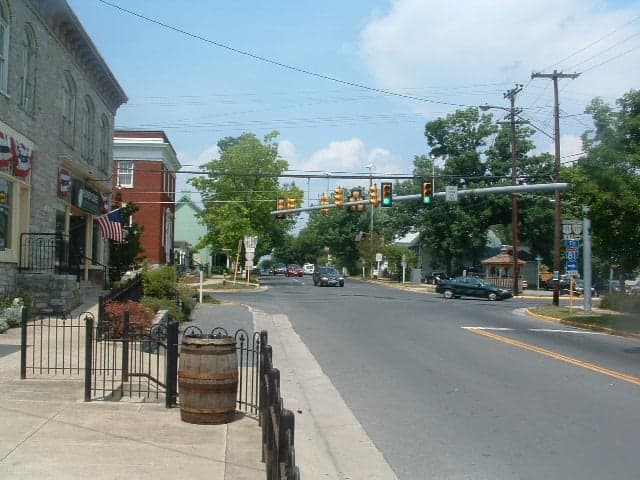

Photo: Wikipedia
Political ClimatePolitical Climate in Stephens City, VA
District shown is the primary district for this city’s centroid. Cities may span multiple districts.
Inherited from parent state — no local data available.
Local Political AnalysisPolitical Analysis of Stephens City, VA
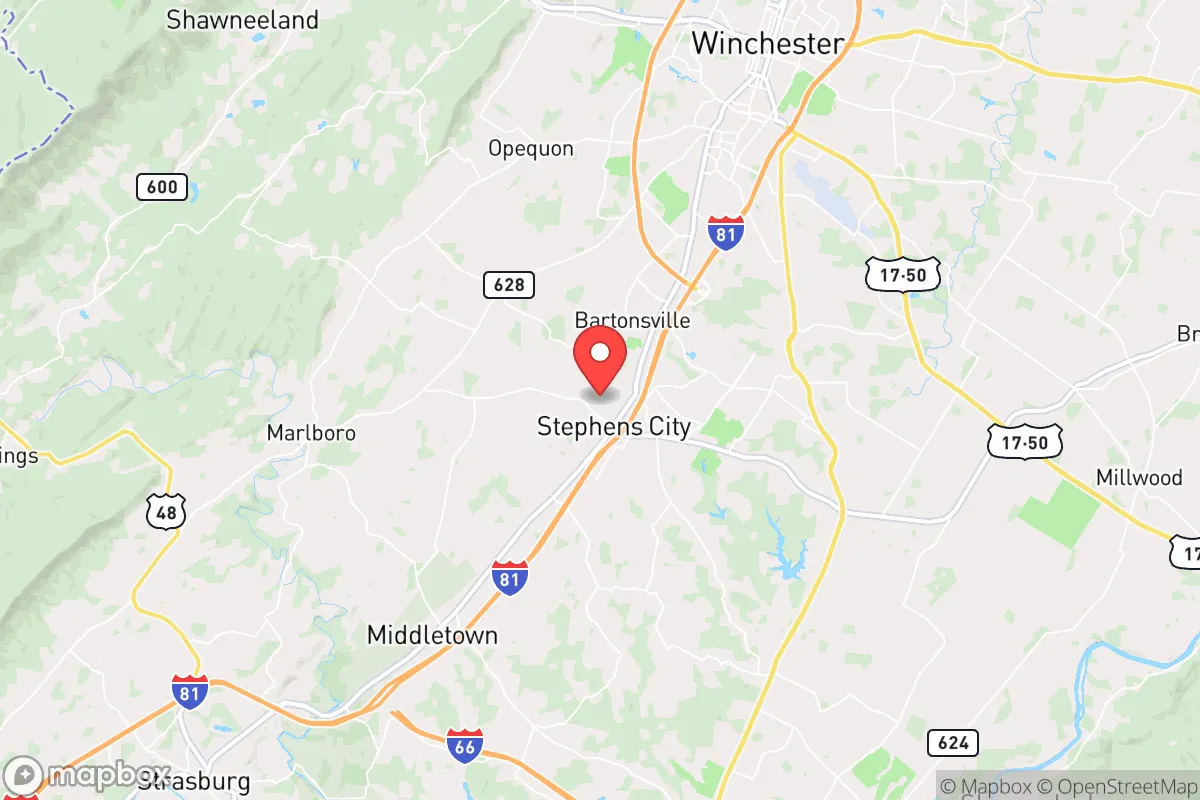
Stephens City is a reliably conservative pocket in Virginia’s northern Shenandoah Valley, with a Cook Partisan Voting Index of R+12 that puts it about 16 points to the right of the state as a whole (D+4). That gap isn’t just a number on a map—it’s something you feel driving into town from the east. Over the past decade, the area has held steady in its Republican lean, even as the rest of Virginia has shifted blue in presidential races. The 2024 election saw Frederick County, which wraps around Stephens City, go for the GOP ticket by a solid margin, while nearby Winchester—just 10 minutes north—flipped back to the Democrats. That contrast is the story of this region: Stephens City stays red, but it’s surrounded by a state that’s increasingly purple trending blue.
How it compares
Stephens City’s R+12 rating is a world away from Virginia’s D+4 statewide index. To put it in perspective, the town votes more like rural Southwest Virginia than the suburbs of Northern Virginia or Richmond. Drive 20 miles east to the town of Front Royal, and you’ll find a similar R+10 vibe, but head 30 miles north to Leesburg in Loudoun County, and you’re suddenly in D+7 territory—a stark reminder of how fast the political landscape changes once you cross the Blue Ridge. Within Frederick County itself, Stephens City is more conservative than the county’s average, which sits around R+8, thanks to the moderating influence of Winchester’s college-educated population and its historic district. The town’s trajectory has been stable: no dramatic swings left or right, just a steady Republican majority that’s held for decades, even as the state legislature in Richmond has flipped between parties.
What this means for residents
For conservative residents, Stephens City feels like home base. Local elections are dominated by Republicans, and the county board of supervisors tends to lean pro-business and skeptical of new regulations. You’ll find gun rights respected, lower property taxes than in blue-leaning counties like Fairfax, and a general sense that your vote counts in the direction you want. For liberal residents, it’s a different story. You’re not going to be ostracized—Stephens City is a small, neighborly place—but you’ll be in the minority. Progressive candidates rarely win local races, and issues like zoning reform or public transit expansion often stall out. That said, the proximity to Winchester (15 minutes north) gives liberals an outlet: that city has a Democratic mayor, a more diverse economy, and a cultural scene that leans left. Many liberals in Stephens City commute to Winchester for work or social life, then come home to quieter streets and lower housing costs.
Culturally, the biggest distinction is how the town handles growth. Stephens City has resisted the rapid suburbanization that’s swallowed parts of Loudoun and Prince William counties. There’s no big-box sprawl here—just a historic main street, a few churches, and a lot of farmland. That’s a deliberate choice, driven by a conservative preference for limited government and local control. But it also means fewer amenities: no Whole Foods, no co-working spaces, and limited public transportation. For the long term, I see Stephens City staying R+12 for the next decade. The valley’s population is growing slowly, and the newcomers tend to be retirees or remote workers who value the low taxes and quiet life—not the kind of demographic shift that flips a district blue. If you’re moving here, know that the politics are baked into the landscape, and they’re not changing anytime soon.

State Political ClimatePolitical Climate in Virginia
State Political AnalysisPolitical Environment in the State
Virginia is a classic swing state that has shifted decisively blue over the past two decades, now carrying a Cook PVI of D+4, but the reality on the ground is far more divided than that single number suggests. The state’s political center of gravity has moved from the conservative-leaning rural south and west to the densely populated, increasingly progressive suburbs of Northern Virginia and the Richmond-Hampton Roads corridor. Over the last 20 years, Democrats have won every presidential election here since 2008, and they control both chambers of the General Assembly and the governorship as of 2026, but the margins are razor-thin — the 2021 governor’s race was decided by just two points, and the state House flipped back to Democrats by a single seat in 2023.
Urban vs. rural divide
The political map of Virginia is a study in stark contrasts. The blue strongholds are unmistakable: Fairfax County (population 1.1 million) alone delivers a Democratic margin of roughly 200,000 votes, more than enough to offset the entire rest of the state’s rural red vote. Arlington and Alexandria are even more lopsided, routinely voting 75-80% Democratic. Richmond and Norfolk are solidly blue, while Virginia Beach is a perennial swing city that has trended left in recent cycles. Meanwhile, the reddest parts of the state are the rural Southside and Southwest Virginia — places like Lynchburg, Danville, and Bristol — where Trump won by 30-40 points in 2024. The real battlegrounds are the exurban counties that ring the DC suburbs: Loudoun County flipped from red to blue in the 2010s and is now a Democratic stronghold, while Prince William County and Stafford County are more competitive but trending blue. The 2024 presidential race saw Henrico County (suburban Richmond) flip to Democrats for the first time, a sign that the suburban shift is still in motion.
Policy environment
Virginia’s policy landscape reflects its purple-to-blue status, with a mix of moderate and progressive policies that can surprise newcomers. The state income tax is a flat 5.75% (one of the highest flat rates in the South), and the sales tax is 5.3% (higher in some localities). Property taxes are set at the local level and vary widely — Loudoun County has some of the highest rates in the state, while Pittsylvania County in Southside is much lower. Education policy is a flashpoint: Virginia has a statewide school choice program (the Education Improvement Scholarships Tax Credit) but no universal voucher system, and the state Board of Education has been locked in a years-long battle over transgender student policies. Healthcare is dominated by the expansion of Medicaid under the Affordable Care Act, which Virginia adopted in 2019 under a Democratic governor — a move that covered 400,000 new enrollees but remains controversial among conservatives. Election laws are relatively accessible: Virginia has no-excuse absentee voting, same-day voter registration, and early voting starting 45 days before an election, all of which were expanded under Democratic control in 2020.
Recent policy direction
The last five years have seen a rapid leftward shift on several fronts, but with significant pushback. On gun and self-defense law, Democrats passed a package in 2020 that included universal background checks, a one-handgun-per-month limit, and a “red flag” law allowing temporary confiscation of firearms from individuals deemed a threat — but a 2024 court ruling struck down the handgun limit as unconstitutional, and the red flag law has been used sparingly. On parental and education rights, the state has been a national battleground: Governor Glenn Youngkin (R) signed a 2022 executive order banning “inherently divisive concepts” in schools, but a court blocked it, and the issue remains unresolved. On speech and privacy, Virginia passed the Consumer Data Protection Act in 2021, one of the strongest state privacy laws in the country, but it has no private right of action. On medical and bodily autonomy, the state has protected abortion access up to 26 weeks (with a 24-hour waiting period) since 2020, and a 2024 law removed the requirement for parental notification for minors seeking abortion — a major point of contention. On property rights, Virginia has no statewide rent control, but localities can impose it under certain conditions, and the state’s “right to farm” law protects agricultural operations from nuisance lawsuits. On taxation, the state has not passed a broad tax cut since 2022, when the standard deduction was doubled and the grocery tax was eliminated. On voting and ballot access, the 2020 reforms were largely preserved, but a 2024 law requiring photo ID for absentee ballots was struck down by a federal court.
Civil unrest & political movements
Virginia has been a flashpoint for political activism on both sides. The 2017 “Unite the Right” rally in Charlottesville — which turned violent and left one counter-protester dead — remains a defining scar on the state’s political identity, and it galvanized both the left’s anti-racism movements and the right’s free-speech defenses. More recently, the 2021 “Parents Matter” movement, which started in Loudoun County over school mask mandates and critical race theory, became a national template for conservative school board activism and helped elect Youngkin. Immigration politics are less visible here than in border states, but Prince William County has a “sanctuary” policy limiting local police cooperation with ICE, while Fredericksburg and Harrisonburg have seen tensions over refugee resettlement. Election integrity remains a live issue: the 2020 election in Virginia was certified without major controversy, but a 2024 audit of the state’s voter rolls found 3,000 non-citizens registered (out of 6 million voters), fueling ongoing Republican calls for stricter verification. You’ll see “Don’t Tread on Me” flags in rural areas and “Black Lives Matter” signs in the suburbs — the divide is visible in everyday life.
Projection
Over the next 5-10 years, Virginia is likely to continue its slow but steady drift leftward, driven by demographic trends that are hard to reverse. The DC suburbs are growing faster than the rest of the state — Loudoun County added 100,000 residents between 2010 and 2020, and it’s now the richest county in the country by median income — and those newcomers tend to be younger, more diverse, and more Democratic. The rural areas, meanwhile, are aging and losing population; Southwest Virginia has seen a net outflow of working-age residents for decades. That said, the margins are close enough that a single bad cycle for Democrats — say, a recession or a national Republican wave — could flip the governorship or the legislature back. A relocator moving in now should expect a state where the policy pendulum swings every 2-4 years, but the long-term arc is blue. The practical effect is that conservative residents will find themselves in a state where their votes matter less in statewide races but where local control in red counties remains strong, while liberal residents will enjoy a generally friendly policy environment but may face occasional reversals.
For a new resident, the bottom line is that Virginia offers a genuine political battleground experience — you’ll see competitive races, active grassroots movements, and a policy environment that can change dramatically with each election. If you’re a conservative, you’ll find like-minded communities in the rural areas and exurbs, but you’ll be living under a state government that is increasingly progressive on taxes, education, and social issues. If you’re a liberal, you’ll find a state that mostly aligns with your values, but you’ll need to be prepared for the occasional conservative governor who can block legislation. Either way, Virginia rewards political engagement — your vote really does matter here, and the state’s future will be shaped by the choices of the people moving in right now.
* Values derived from national, state, county, city and local statistics and may differ in a specific area. Last updated: 2026-08-24T01:49:08.000Z
Narrative content on this page is AI-generated and may contain mistakes. Verify any details that matter before acting on them.
ReloMaps may earn a commission from affiliate links at no extra cost to you.

