Photo: Wikipedia
Demographics of Springfield, MA
Affluence Level in Springfield, MA
A below-average socioeconomic profile. Incomes, home values, and educational attainment trail the U.S., with higher poverty and unemployment.
People of Springfield, MA
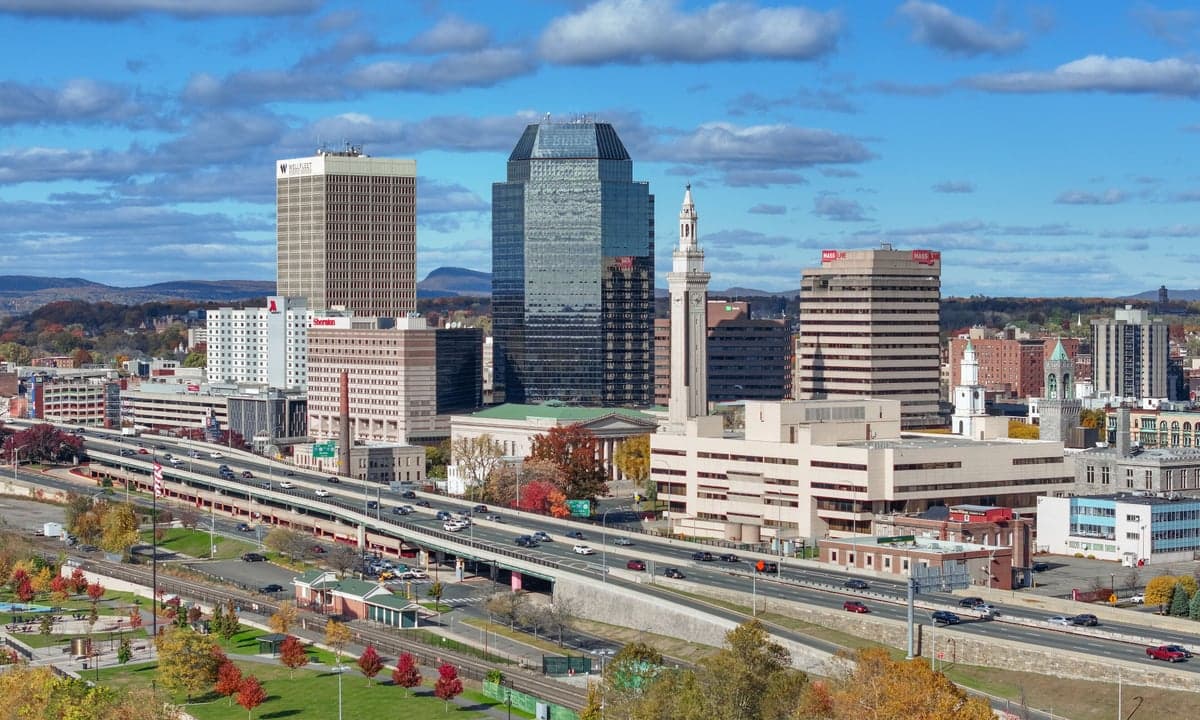
The people of Springfield, Massachusetts, in 2026 form a predominantly Hispanic and Black city of 154,751 residents, marked by a young median age and a notably low college attainment rate of 19.7%. The city is a majority-minority urban center where Hispanic residents (47.4%) and Black residents (17.7%) together make up nearly two-thirds of the population, while non-Hispanic White residents have fallen to 29.3%. With only 4.5% foreign-born, Springfield is not a classic immigrant gateway but a city shaped by domestic migration, industrial decline, and the movement of Puerto Rican and African American families from the Northeast corridor. The city’s identity is one of resilience and economic struggle, with a population density of roughly 4,800 people per square mile concentrated in historic neighborhoods that still bear the imprint of earlier waves of European immigration.
How the city was settled and grew
Springfield was founded in 1636 by English Puritan settlers led by William Pynchon, who established a trading post at the confluence of the Connecticut and Chicopee Rivers. The original population was English and Congregationalist, drawn by fertile river valley land and the promise of fur trade with Native Americans. The city’s industrial takeoff came in the 19th century with the Springfield Armory (1794), which attracted skilled machinists and laborers, and later with the rise of precision manufacturing, toolmaking, and the Indian Motocycle Company. The first major immigrant wave was Irish, arriving in the 1840s and 1850s to build railroads and work in factories, settling in the Old Hill and Six Corners neighborhoods. French Canadians followed in the 1870s and 1880s, drawn by textile mills, and concentrated in Hungry Hill and Indian Orchard. Italian and Polish immigrants arrived between 1890 and 1920, filling the Armory and machine-tool shops, and established themselves in South End and Forest Park. By 1950, Springfield was a heavily ethnic, working-class city of roughly 170,000, with a population that was overwhelmingly White and European-origin.
Modern era (post-1965)
The post-1965 period brought a dramatic demographic transformation. The Hart-Cellar Act of 1965 opened immigration from Asia and Latin America, but Springfield’s foreign-born share remained low (4.5% today) because the city’s growth came primarily from domestic migration. The largest shift was the arrival of Puerto Rican families, who began moving to Springfield in the 1950s and accelerated through the 1970s and 1980s, fleeing economic hardship on the island and drawn by manufacturing jobs that were already disappearing. They settled heavily in the North End and Memorial Square neighborhoods, which today are overwhelmingly Hispanic. Simultaneously, African American families moved north from the South during the Great Migration and later from other Rust Belt cities, concentrating in Mason Square and the Old Hill area. White flight accelerated after the 1960s, with many Italian, Irish, and Polish families moving to suburbs like East Longmeadow, Wilbraham, and Ludlow. By 2020, the White population had dropped from over 90% in 1950 to 29.3%, while the Hispanic share rose to 47.4% and the Black share to 17.7%. East and Southeast Asian communities (1.9%) are small and concentrated near the Baystate Medical Center area, while Indian-subcontinent residents (0.8%) are a tiny, dispersed group. The city’s low college attainment rate (19.7%) reflects the loss of middle-class professional families to the suburbs and the concentration of poverty in the urban core.
The future
Springfield’s population is likely to continue its gradual decline or stagnation, as it has since peaking at 174,000 in 1970. The Hispanic share is projected to grow further, potentially reaching 55-60% by 2040, driven by higher birth rates and continued migration from Puerto Rico and other parts of Latin America. The non-Hispanic White population will continue to shrink, falling below 25% within a decade. The Black population is stable but may decline slightly as younger families move to more affordable suburbs in Hampden County. The city is not homogenizing into a single culture; rather, it is tribalizing into distinct enclaves: the North End and Memorial Square are heavily Puerto Rican and Dominican; Mason Square and Old Hill remain predominantly Black; and Forest Park and the East Forest Park area retain a small but aging White middle-class presence. East and Southeast Asian and Indian communities are too small to form visible enclaves and are likely to remain dispersed. The foreign-born share (4.5%) is low and not rising fast, meaning Springfield will not become a new immigrant gateway. The next 10-20 years will likely see a continued concentration of poverty, a young population with low educational attainment, and a political landscape dominated by Hispanic and Black voters. For someone moving in now, Springfield offers low housing costs and a strong sense of community in its ethnic neighborhoods, but limited economic opportunity and a public school system that struggles with funding and performance.
Springfield is becoming a smaller, poorer, and more heavily Hispanic city, with a Black minority and a shrinking White population. It is a place where the working-class industrial past has given way to a service-and-government economy, and where the population is increasingly young, non-white, and locally rooted rather than immigrant-driven. For a conservative-leaning individual or family, Springfield offers affordability and a dense urban environment, but requires careful neighborhood selection and realistic expectations about schools, taxes, and economic mobility.

* Values derived from national, state, county, city and local statistics and may differ in a specific area. Last updated: 2026-05-01T21:25:33.000Z
Narrative content on this page is AI-generated and may contain mistakes. Verify any details that matter before acting on them.
ReloMaps may earn a commission from affiliate links at no extra cost to you.

