
Photo: Wikipedia
Political ClimatePolitical Climate in Beadle County
Showing state-level results — no local-only data available.
Local Political AnalysisPolitical Analysis of Beadle County
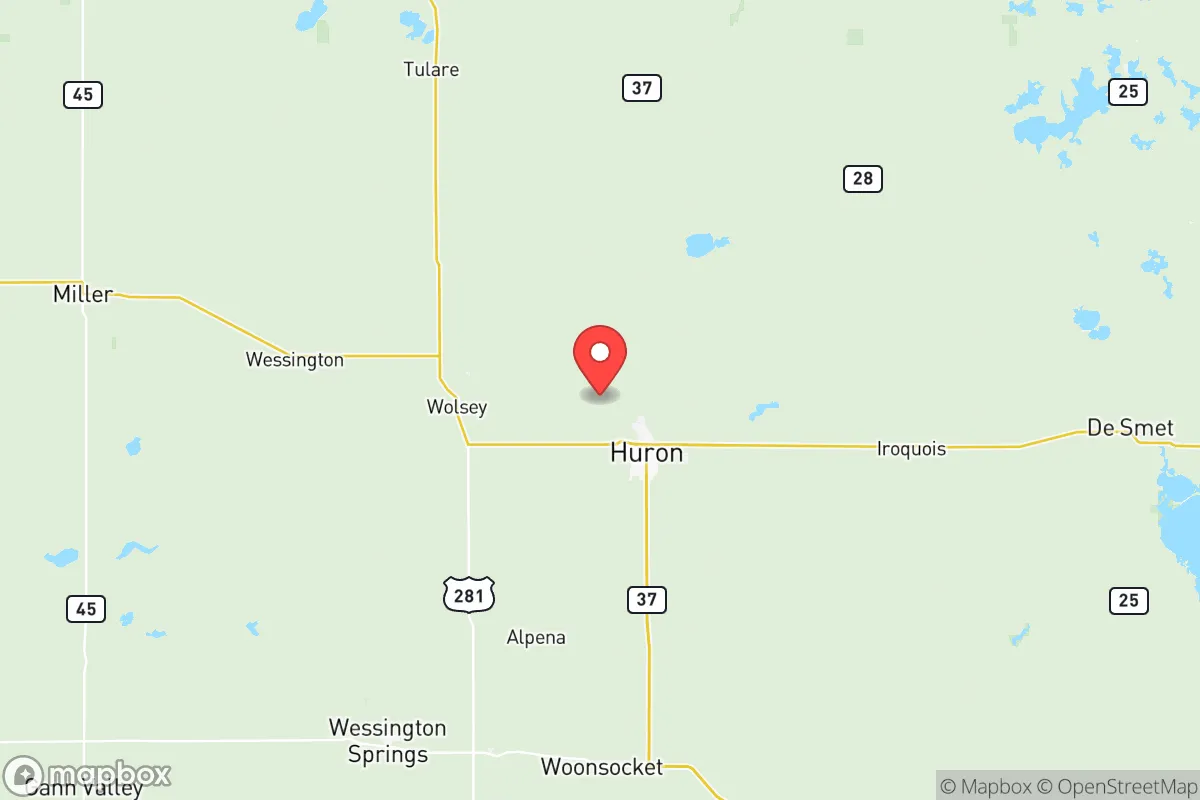
Beadle County, anchored by the city of Huron, is a solidly Republican area with a Cook Partisan Voting Index (PVI) of R+15, meaning it votes about 15 points more Republican than the national average. This isn't a recent shift; the county has been a GOP stronghold for decades, though the margin has widened since the early 2000s. In the 2024 presidential election, Donald Trump carried Beadle County with roughly 68% of the vote, a slight increase from his 2020 performance, reflecting a broader rural trend in South Dakota. The real story, though, isn't just the red numbers—it's the subtle but real variation between the county's small towns and its agricultural precincts.
How it compares
Compared to the rest of South Dakota, Beadle County sits squarely in the conservative mainstream. The state as a whole is deeply Republican, with no recent Democratic presidential candidate winning it since 1964. However, Beadle County is actually a bit more moderate than the state's most conservative western counties, like Pennington or Lawrence, which often push R+20 or higher. The county's political geography breaks down like this: Huron itself is the most politically diverse area, with a few precincts near the city's core and around the state hospital campus occasionally voting within 5 points of a Democrat, especially in local races. The towns of Wolsey and Cavour lean reliably Republican, but not as overwhelmingly as the open-country precincts. The real red heart of the county is the rural precincts around Iroquois and Yale, where Republican candidates routinely pull 80% or more of the vote. Swing precincts are rare, but the Huron 2nd and 3rd wards can be competitive in county commission races, especially when a well-known local Democrat runs.
What this means for residents
For conservative residents, the political climate is comfortable and affirming. Local government, from the county commission to the school board, is dominated by Republicans, and policy debates tend to focus on tax rates, agricultural regulations, and infrastructure—issues where conservative viewpoints hold sway. For liberal residents, life is more about finding community than winning elections. There's a small but active Democratic group in Huron that focuses on local issues like affordable housing and public school funding, and they often find common ground with moderate Republicans on those topics. Socially, the county is traditional but not insular; the presence of the state's largest hospital and a growing immigrant workforce in Huron's meatpacking plants has brought a quiet diversity that tempers the area's politics. You won't see many yard signs for progressive candidates, but you also won't see much open hostility—most folks here just want to get along and keep the roads paved.
Culturally, Beadle County stands apart from the more libertarian-leaning parts of western South Dakota. There's a stronger sense of community obligation here, reflected in higher voter turnout for local bond issues and a willingness to fund the public library and parks. The county's political trajectory seems stable: expect continued Republican dominance, but with a slight softening in Huron as the city grows more diverse. For anyone moving here, the key takeaway is that politics is a backdrop, not a battleground—people judge you more by your work ethic and neighborliness than your party registration.

State Political ClimatePolitical Climate in South Dakota
State Political AnalysisPolitical Environment in the State
South Dakota has been a reliably Republican state for decades, with a partisan lean that has only deepened in recent cycles. The state voted for Donald Trump by over 30 points in both 2020 and 2024, and Republicans hold every statewide office and supermajorities in both legislative chambers. Over the past 10-20 years, the dominant coalition has shifted from a more pragmatic, rural conservatism focused on agriculture and small government to a harder-edged, culturally conservative posture driven by the state’s growing population of retirees, remote workers, and out-of-state transplants—particularly in the Black Hills and along the I-29 corridor. While Democrats once held competitive races in the 2000s (Tim Johnson’s Senate seat, for example), the party has effectively collapsed outside of a few tribal areas and the city of Sioux Falls.
Urban vs. rural divide
The political map of South Dakota is starkly divided between a handful of urban centers and the vast rural expanse. Sioux Falls, the state’s largest city and economic engine, is the only real blue dot—Minnehaha County went for Joe Biden in 2020 by about 5 points, and it’s the only county that consistently elects Democrats to the legislature. Rapid City and the surrounding Pennington County lean Republican but are more moderate than the rest of the state, often splitting tickets on local races. Brookings, home to South Dakota State University, is a swing area that can go either way depending on the candidate. The rural counties—especially in the west (e.g., Butte County, Meade County) and the central plains (e.g., Hanson County, Jerauld County)—routinely deliver 80-90% Republican margins. The nine tribal reservations, including Pine Ridge and Rosebud, vote overwhelmingly Democratic, but their populations are small and turnout is low, so they have little impact on statewide outcomes.
Policy environment
South Dakota’s policy environment is defined by a low-tax, low-regulation posture that appeals to conservative relocators. There is no state income tax, no corporate income tax, and no personal property tax on vehicles or business inventory. The state sales tax is 4.5%, with local add-ons pushing it to 6-7% in some cities. Property taxes are moderate, though they vary significantly by county—Lincoln County (suburban Sioux Falls) has seen rapid increases due to new construction. The regulatory climate is business-friendly: no occupational licensing for many trades, no state-level minimum wage above the federal $7.25, and a right-to-work law. Education policy is a mixed bag: the state has a school choice program (the “South Dakota Opportunity Scholarship”) but no voucher system, and public schools are funded primarily through local property taxes, leading to disparities between wealthy suburbs and rural districts. Healthcare is a perennial issue—the state did not expand Medicaid until 2023, and rural hospital closures remain a concern. Election laws are among the most restrictive in the nation: no early voting, no no-excuse absentee voting, and voter ID is required. The state also has a strict photo ID law for voting, which has been challenged but upheld.
Recent policy direction
Over the past five years, South Dakota has moved aggressively on cultural and liberty issues. In 2023, the legislature passed a near-total ban on abortion (HB 1025), with exceptions only for rape, incest, and life of the mother—effectively ending access in the state. Gun laws have been loosened: permitless carry was enacted in 2019, and in 2021 the state passed a “Second Amendment Preservation Act” (SB 46) that purports to nullify federal gun laws, though it has not been tested in court. On education, the state passed a “Parents’ Bill of Rights” (HB 1057) in 2022, requiring schools to notify parents of curriculum changes and allowing them to opt children out of certain materials. Medical marijuana was legalized by ballot initiative in 2020, but the legislature has since tightened regulations, limiting dispensary locations and requiring a doctor’s recommendation. Recreational marijuana remains illegal, and a 2022 ballot measure to legalize it failed. Property rights are strong: the state has no inheritance tax and no estate tax, and it has a “right to farm” constitutional amendment protecting agricultural operations from nuisance lawsuits. On privacy and surveillance, the state has been cautious—no statewide facial recognition ban, but no widespread police surveillance programs either. Voting access has been tightened: in 2021, the legislature passed a law requiring absentee ballots to be notarized or witnessed, and limiting ballot drop boxes.
Civil unrest & political movements
South Dakota is not a hotbed of civil unrest, but there have been notable flashpoints. The Standing Rock protests in 2016-2017 (the Dakota Access Pipeline) drew thousands of activists and resulted in clashes with law enforcement, but that was primarily on the reservation and in neighboring North Dakota. Within the state, the most visible political movements are on the right: the “Constitutional Sheriffs” movement has a strong presence in western counties, and there have been periodic calls for “nullification” of federal laws, particularly on gun control and land use. The Black Hills region has seen tensions over federal land management, with some ranchers and activists pushing for transfer of federal lands to state control. On the left, the South Dakota Democratic Party is nearly moribund, but grassroots groups like Rural Organizing Project and Dakota Rural Action work on issues like Medicaid expansion and environmental protection. Immigration politics are muted—the state has a small foreign-born population (about 4%), and there are no sanctuary cities. Election integrity controversies have been minimal, though the 2020 election saw some local GOP officials question results in Minnehaha County, where Biden’s win was narrow. A new resident would notice that political activism is low-key compared to coastal states—most people keep their politics private, and the culture is one of live-and-let-live, at least on the surface.
Projection
Over the next 5-10 years, South Dakota’s political trajectory is likely to remain solidly Republican, but with some internal shifts. The state is growing—population increased by about 9% between 2010 and 2020, driven by in-migration to Sioux Falls, Rapid City, and the Black Hills. These new residents tend to be more culturally conservative than the native population, often moving from blue states for lower taxes and fewer regulations. This will likely push the state further right on cultural issues (abortion, guns, education) while maintaining its pro-business posture. However, the growth of Sioux Falls could eventually make the state more competitive at the local level—Minnehaha County is already a swing county, and if it continues to grow faster than the rest of the state, Democrats might become viable in a few legislative districts. The tribal vote could also become more influential if turnout increases, but that’s a long shot. The biggest wildcard is the state’s aging population—South Dakota has one of the oldest median ages in the country, and older voters tend to be more conservative, but they also care about healthcare and property taxes, which could create pressure for policy changes. A new resident moving in now should expect a state that is deeply conservative but not uniformly so—pockets of moderation exist in the cities, and the culture is generally polite and non-confrontational.
For a new resident, the bottom line is this: South Dakota offers a low-tax, low-regulation environment that is ideal for those who prioritize economic freedom and cultural conservatism. If you lean left, you’ll find a small but active community in Sioux Falls and on the reservations, but you’ll be politically isolated in most of the state. If you lean right, you’ll feel at home almost everywhere, but you should be aware that the state’s politics are not static—the influx of out-of-state transplants is slowly changing the character of places like Rapid City and Brookings. The key takeaway is that South Dakota is a place where your vote matters less at the state level (it’s already decided) but can have real impact in local races, especially in the growing suburbs. The culture is one of independence and self-reliance, and the state’s policies reflect that—for better or worse, depending on your perspective.
* Values derived from national, state, county, city and local statistics and may differ in a specific area. Last updated: 2026-07-30T12:12:42.000Z
Narrative content on this page is AI-generated and may contain mistakes. Verify any details that matter before acting on them.
ReloMaps may earn a commission from affiliate links at no extra cost to you.

