Photo: Wikipedia
Demographics of Orangeburg County
Affluence Level in Orangeburg County
A below-average socioeconomic profile. Incomes, home values, and educational attainment trail the U.S., with higher poverty and unemployment.
People of Orangeburg County
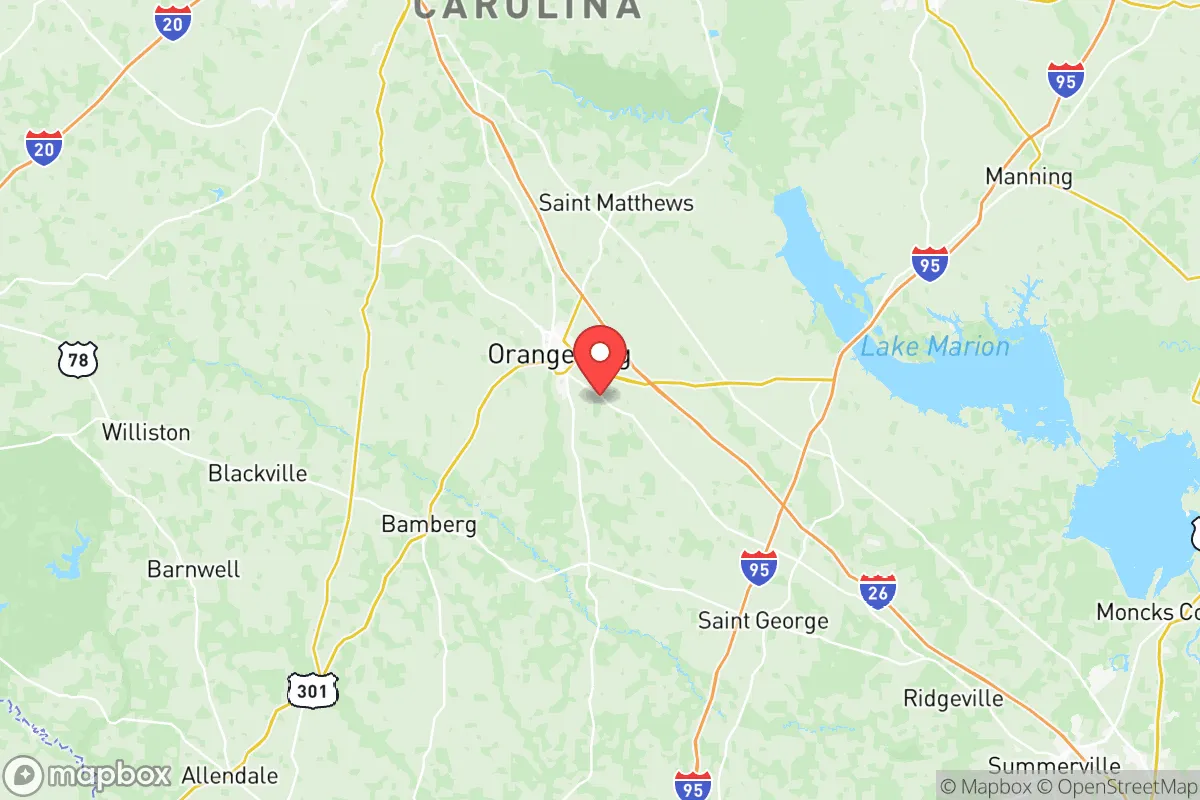
Orangeburg County, South Carolina, is home to 83,531 residents, making it a predominantly rural and small-town community with a distinctive demographic profile: 61.5% Black or African American, 33.1% White, and a very small foreign-born population of just 0.9%. The county's population is concentrated in the city of Orangeburg, the county seat, along with the towns of Bowman, Holly Hill, North, Norway, Rowesville, Santee, Springfield, Vance, and Woodford. With a college-educated rate of 19.4%, the county's identity is deeply rooted in its agricultural history, its historically Black colleges and universities (HBCUs), and a slow-growth, family-oriented character that sets it apart from the booming coastal and upstate regions of South Carolina.
Settlement & growth (pre-1960)
The land that is now Orangeburg County was originally inhabited by the Edisto and Congaree Native American tribes, who lived along the Edisto River and its tributaries. European contact began with Spanish explorers in the 16th century, but permanent settlement did not take hold until the British colonial era. In 1704, the colonial government established a township called Orangeburg (named for William III, Prince of Orange) as a buffer settlement along the Edisto River to protect Charleston from Native American raids and Spanish incursions from Florida.
The earliest European settlers were primarily German, Swiss, and Scots-Irish immigrants, recruited by the colonial government with promises of land grants. These groups arrived in the 1730s and 1740s, establishing small farms and trading posts. The German-speaking settlers were particularly concentrated in the area around Orangeburg and Rowesville, where their descendants remain today. The town of North, founded later, also became a center for the German-descended population. By the time of the American Revolution, Orangeburg County had a mixed population of small farmers, many of whom were Loyalists during the conflict.
The 19th century brought the cotton boom, which transformed the county's economy and demographics. Large plantations were established along the Edisto River and its tributaries, worked by enslaved African Americans. By 1860, the county's population was majority Black, a pattern that has persisted to the present day. After the Civil War and Reconstruction, many freedmen became sharecroppers and tenant farmers, remaining in the rural areas and small towns. The town of Holly Hill became a center for the Black farming community, while Bowman and Vance also developed significant African American populations.
The late 19th and early 20th centuries saw the founding of South Carolina State University (1896) and Claflin University (1869) in Orangeburg, both HBCUs that drew Black students and faculty from across the South. These institutions became anchors for the county's Black middle class and intellectual community. The Great Migration (1910-1970) saw many Black residents leave Orangeburg County for Northern industrial cities, but the county's Black population remained the majority due to a relatively low out-migration rate compared to other Deep South counties.
White settlement in the early 20th century was supplemented by a small number of Italian and Greek immigrants who opened businesses in Orangeburg and Santee, though these communities remained tiny. The county's economy diversified somewhat with the arrival of the railroad and the timber industry, but agriculture—cotton, soybeans, and later tobacco—remained dominant through the 1950s.
Modern era (post-1965)
The post-1965 era brought significant changes to Orangeburg County, though not through the large-scale immigration that reshaped other parts of the United States. The county's foreign-born population remains extremely low at 0.9%, far below the national average. The small Hispanic population (2.5%) began to grow in the 1990s and 2000s, primarily as Mexican and Central American laborers arrived to work in agriculture, poultry processing, and construction. These workers are concentrated in Orangeburg and Santee, where they form small but visible communities.
The East/Southeast Asian population (0.4%) and Indian subcontinent population (0.4%) are tiny and consist mainly of professionals working at South Carolina State University, Claflin University, and the regional medical center in Orangeburg. No significant ethnic enclaves have formed for these groups.
The most significant demographic shift since 1965 has been domestic migration. The county has experienced a slow but steady out-migration of younger, college-educated residents—both Black and White—to larger metropolitan areas like Charleston, Columbia, and Charlotte. This "brain drain" has contributed to the county's low college attainment rate (19.4%). At the same time, the county has attracted some retirees and second-home buyers to the Santee area, drawn by Lake Marion and the Santee Cooper lakes system. This has created a small but growing population of older, mostly White residents in the southern part of the county.
Suburbanization has been limited. The city of Orangeburg has seen some sprawl along the US 601 and US 21 corridors, but the county remains predominantly rural. The town of North has experienced population decline, while Santee has seen modest growth due to tourism and retirement migration.
The future
Orangeburg County's population is projected to remain stable or decline slightly over the next 10-20 years, as out-migration of young adults continues to offset any natural increase. The county is becoming slightly more diverse, driven by the slow growth of the Hispanic population, but it will remain overwhelmingly Black and White for the foreseeable future. The foreign-born share is unlikely to rise significantly given the county's lack of major employment centers or immigrant networks.
The county's cultural identity is likely to remain rooted in its HBCU legacy, its agricultural heritage, and its rural character. The biggest demographic wild card is the potential for industrial recruitment—if the county successfully attracts large manufacturing or logistics employers (as some nearby counties have done), it could reverse the brain drain and attract new domestic and international migrants. The Santee area may continue to grow as a retirement and recreation destination, while the smaller towns like Bowman and Holly Hill will likely continue to lose population.
For someone moving in now, Orangeburg County offers a low-cost, slow-paced, family-oriented environment with strong community institutions, particularly around its HBCUs and churches. The trade-off is limited economic opportunity, low ethnic diversity, and a population that is aging and slowly shrinking. It is a place for those seeking stability and tradition rather than growth and change.

* Values derived from national, state, county, city and local statistics and may differ in a specific area. Last updated: 2026-08-08T12:01:26.000Z
Narrative content on this page is AI-generated and may contain mistakes. Verify any details that matter before acting on them.
ReloMaps may earn a commission from affiliate links at no extra cost to you.

