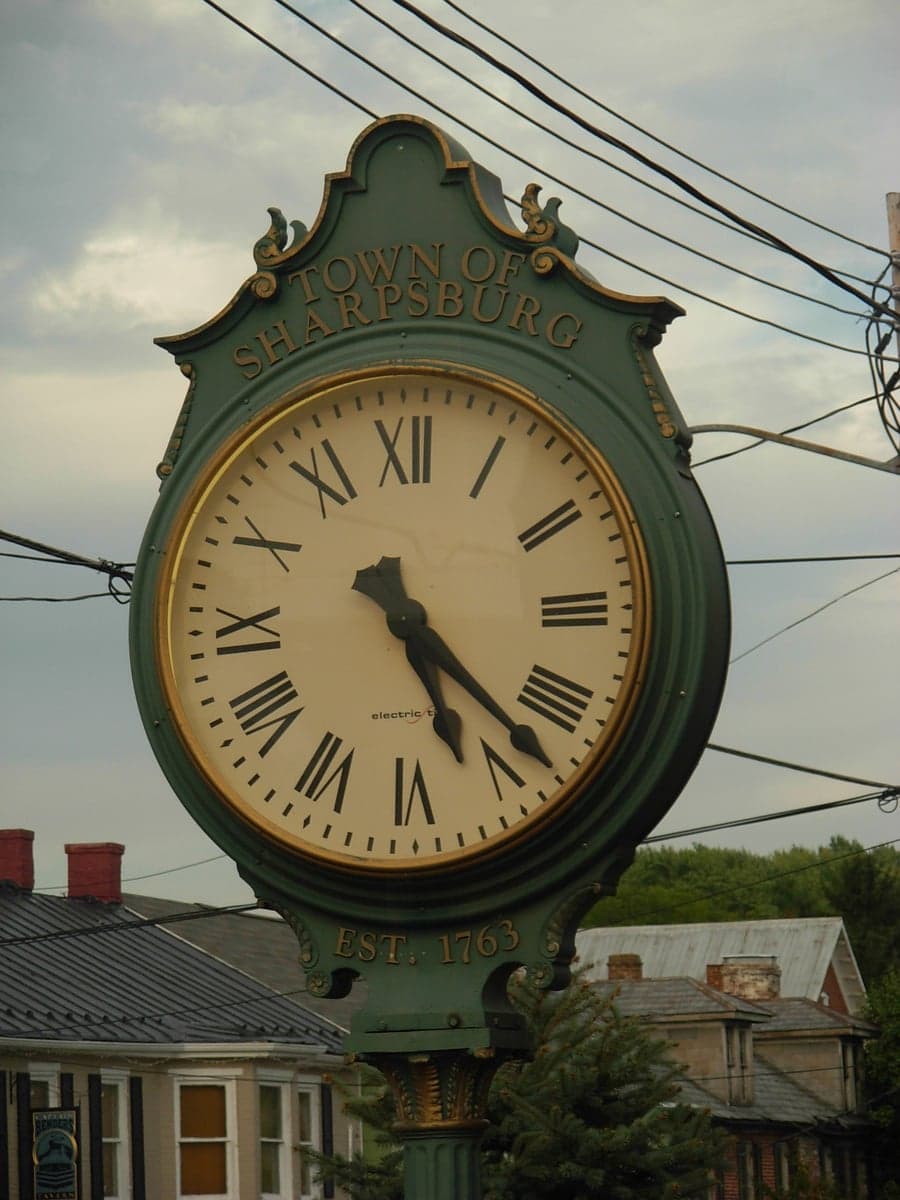
Photo: Wikipedia
Personal Sovereignty in Sharpsburg, MD
Viable for self-reliance. Generally workable, though some barriers may limit total independence.
What does Personal Sovereignty tell us?
Personal Sovereignty measures your capacity for self-reliance and independence with minimal government friction. Higher scores mean fewer barriers between you and the way you want to live... but it assumes you have the space you need and good neighbors.
What does this tell us?
Personal Sovereignty measures your capacity for self-reliance and independence with minimal government friction. Higher scores mean fewer barriers between you and the way you want to live... but it assumes you have the space you need and good neighbors.
State Policy
Energy independence: Importer (18% of energy produced in-state)
Personal Liberty
Homesteading

Personal Liberty Analysis
Sharpsburg, Maryland, offers a nuanced personal sovereignty environment that balances the state's progressive regulatory framework with the practical realities of a small, rural Washington County community. For individuals and families who prioritize autonomy, the town provides a moderate-to-restrictive baseline on taxes and gun laws, but opens meaningful opportunities for self-reliance through land use, homesteading, and a culture that largely respects personal liberties. The key is understanding where Maryland's state-level policies set the floor and where Sharpsburg's local character allows you to build your own ceiling.
Tax burden and regulatory posture in Washington County
Maryland is a high-tax state overall, and Sharpsburg residents feel that directly. The state income tax ranges from 2% to 5.75%, and Washington County adds a local income tax of 2.8% — bringing the combined top marginal rate to roughly 8.55%. Property taxes are levied at the county level, with Washington County's rate at approximately $1.06 per $100 of assessed value, plus a small Sharpsburg town tax. For a $300,000 home, expect an annual property tax bill around $3,300. Sales tax is 6%, applied to most goods and services. The regulatory posture is mixed: Maryland has a strong state-level permitting apparatus for construction, environmental review, and business licensing, but Washington County is generally more pragmatic and less bureaucratic than the D.C. suburbs. Zoning in Sharpsburg is primarily residential and agricultural, with the town's historic district overlay adding design review for exterior changes to older homes. This means any new construction or major renovation requires both county and town approval, which can add time and cost. However, for a small town, the permitting process is straightforward if you follow the rules — there is no hostility to development, just a paper-heavy process. Business licensing is similarly moderate: a county business license is required, and home-based businesses are allowed with a conditional use permit in most residential zones. Overall, the tax burden is high by national standards, but the regulatory environment is manageable for those willing to navigate the paperwork.
Self-defense and gun law specifics in Maryland
Maryland's gun laws are among the most restrictive in the nation, and Sharpsburg residents must comply with state statutes. Maryland requires a permit to purchase a handgun (the Handgun Qualification License, or HQL), which involves a background check, fingerprinting, and a four-hour training course. Long guns (rifles and shotguns) can be purchased with a standard background check and a seven-day waiting period. The state has a "may issue" concealed carry regime, but in practice, since the Supreme Court's Bruen decision in 2022, Maryland has moved toward "shall issue" — meaning if you meet the statutory criteria (background check, training, and no disqualifying factors), the state must issue the permit. However, the process is still lengthy and expensive: expect a 90-day wait and costs exceeding $300 for training, fingerprints, and application fees. Maryland bans "assault weapons" by name and feature, including AR-15s and many semi-automatic rifles with certain cosmetic features. Magazine capacity is limited to 10 rounds for both handguns and long guns. There is no state preemption on firearms laws, meaning local jurisdictions can pass their own restrictions — but Washington County is generally gun-friendly, and Sharpsburg itself has no additional local ordinances beyond state law. Stand-your-ground laws do not exist in Maryland; the state imposes a duty to retreat in public places before using deadly force, unless you are in your home (the Castle Doctrine applies). For a reader prioritizing self-defense, this means owning a firearm for home defense is straightforward, but carrying concealed is expensive and time-consuming, and the types of firearms available are limited compared to states like West Virginia or Pennsylvania.
Self-reliance and homesteading viability: lot sizes, zoning, and off-grid feasibility
Sharpsburg's rural character makes it a viable location for homesteading and self-reliance, but with important caveats. The town itself is compact, with most residential lots ranging from 0.25 to 1 acre. However, the surrounding unincorporated areas of Washington County offer larger parcels — 5- to 20-acre lots are common within a 10-minute drive of town, and agricultural zoning allows for farming, livestock, and accessory structures like barns and greenhouses. Zoning in the county's agricultural zones (AR and AC) permits a wide range of agricultural activities without special permits: raising chickens, goats, sheep, and cattle is allowed, as is beekeeping and market gardening. The county health department requires a septic system permit for any dwelling not connected to public sewer, and well permits are issued by the Maryland Department of the Environment — both processes are routine but involve fees and inspections. Off-grid living is legally challenging in Maryland. The state requires all dwellings to be connected to an approved water supply and sewage disposal system, and the building code mandates compliance with the International Residential Code, which effectively prohibits true off-grid structures without a septic system and a well or public water. Solar panels are allowed and encouraged, but net metering is available only through the grid — you cannot legally disconnect from the utility entirely. Rainwater collection is permitted for non-potable uses (irrigation, livestock) but not for drinking without a treatment system. For a family seeking a self-reliant lifestyle, Sharpsburg offers excellent land availability and permissive agricultural zoning, but full off-grid independence is not feasible under current state law. The practical workaround is to buy a few acres, install solar and a well, and remain grid-tied — achieving 80% self-sufficiency while complying with regulations.
Personal liberties: parental rights, medical autonomy, speech, and property
Maryland's posture on personal liberties is generally protective of individual rights in some areas and restrictive in others. Parental rights are strong in practice: Maryland law recognizes parents as the primary decision-makers for their children's education, healthcare, and upbringing. Homeschooling is legal and regulated by the local school system — parents must submit a letter of intent and an annual portfolio review, but the curriculum is largely parent-directed. Maryland does not require vaccines for homeschooled children, and medical exemptions for school-required vaccines are available for both religious and medical reasons. Medical autonomy is more constrained. Maryland has a state-run health insurance exchange and mandates coverage for certain procedures, but there is no state-level protection for alternative or complementary medicine — practitioners must be licensed, and unlicensed practice is illegal. The state has legalized medical cannabis but not recreational use, and possession of small amounts of marijuana is decriminalized (a civil fine, not a criminal offense). Free speech is fully protected under the First Amendment, and Maryland has no state-level laws that significantly restrict political speech, though the state does have a "false statement" law regarding election advertising. Property rights are generally respected, but Maryland's strong environmental regulations can limit what you do with your land — the Chesapeake Bay Critical Area law restricts development within 1,000 feet of tidal waters, and the Forest Conservation Act requires reforestation for certain developments. Eminent domain is used sparingly in Washington County, and property taxes are predictable. For a conservative-leaning reader, the key takeaway is that parental rights and property rights are solid, but medical autonomy is limited by state licensing and insurance mandates.
Overall, Sharpsburg's personal sovereignty profile is a study in trade-offs. The tax burden is high, gun laws are restrictive, and full off-grid living is not legally possible. But the town's rural setting, large-lot availability, permissive agricultural zoning, and strong parental rights create a workable environment for self-reliance. Compared to deep-blue areas like Montgomery County or Baltimore, Sharpsburg feels significantly freer — the local culture is live-and-let-live, and the county government is not hostile to individual autonomy. Compared to West Virginia or Pennsylvania, however, the regulatory overhead is heavier and the legal constraints on firearms and off-grid living are real. For a family willing to navigate Maryland's state-level rules, Sharpsburg offers a solid middle ground: enough freedom to build a self-reliant life, with enough structure to keep the peace.

* Values derived from national, state, county, city and local statistics and may differ in a specific area. Last updated: 2026-11-20T12:52:13.000Z
Narrative content on this page is AI-generated and may contain mistakes. Verify any details that matter before acting on them.
ReloMaps may earn a commission from affiliate links at no extra cost to you.

