Photo: Wikipedia
Political ClimatePolitical Climate in Santa Rosa, CA
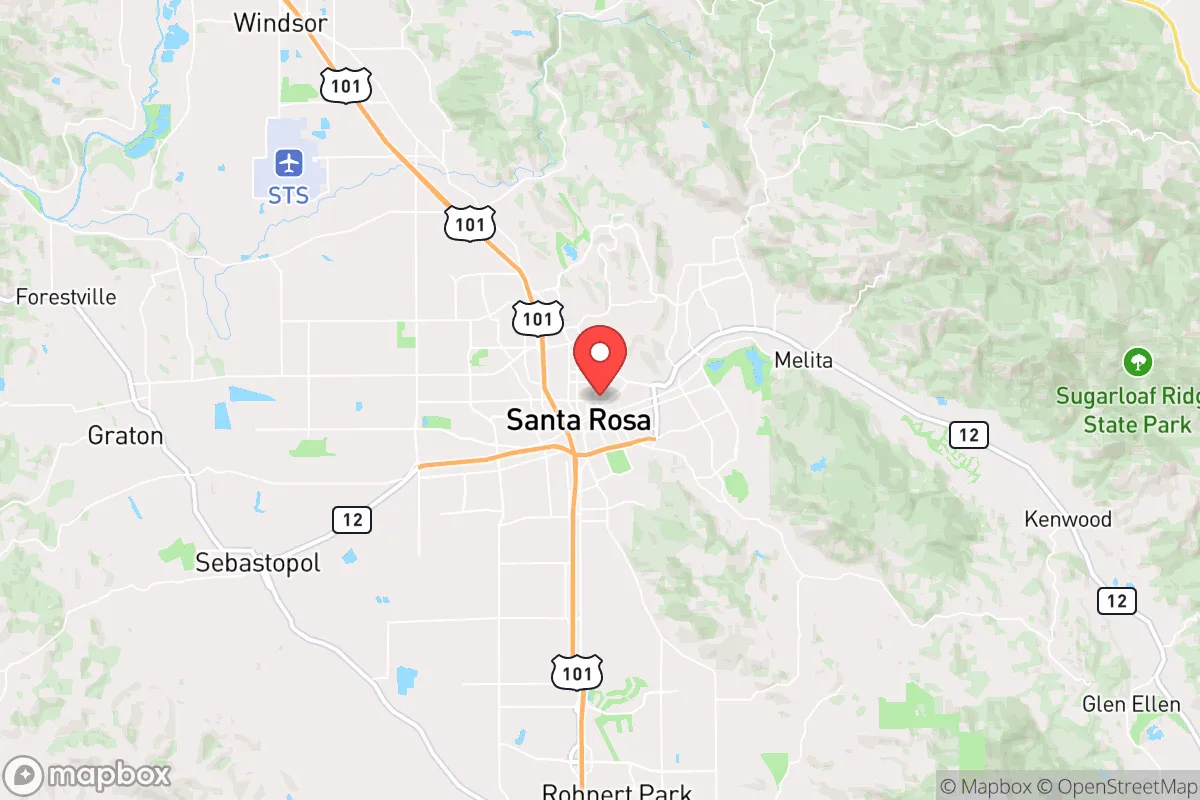
District shown is the primary district for this city’s centroid. Cities may span multiple districts.
Local Political AnalysisPolitical Analysis of Santa Rosa, CA
Santa Rosa, California, leans heavily Democratic, with a Cook PVI of D+17, meaning the city votes about 17 points more Democratic than the national average. That’s a pretty stark shift from what I remember growing up here in the 90s, when Sonoma County was more of a purple patch—you’d see Reagan Democrats and independent ranchers alongside the hippies. Now, the city council and county board are almost uniformly progressive, and the local political conversation has moved noticeably left, especially on housing, policing, and land use. If you’re coming from a more balanced area, the uniformity of the politics here can feel a bit suffocating, like there’s only one acceptable way to think in public.
How it compares
Santa Rosa is the progressive anchor of the North Bay, but it’s not the whole story. Drive 20 minutes east to Windsor or Healdsburg, and you’ll find more moderate-leaning pockets, especially among the wine-country families and small-business owners. Head north to Cloverdale or east into Lake County, and the political vibe flips hard—those areas vote reliably red, and you’ll hear a lot more talk about property rights and limited government. Even within Sonoma County, Rohnert Park and Cotati tend to be less ideologically rigid than Santa Rosa proper. The contrast is sharp: in Santa Rosa, you can’t swing a cat without hitting a “Coexist” bumper sticker, while in Cloverdale, the local diner crowd is grumbling about water regulations and state mandates. That split tells you a lot about how insulated Santa Rosa’s political class can be from the concerns of the rest of the county.
What this means for residents
For a conservative or even a moderate, living in Santa Rosa means constantly navigating policies that feel like government overreach. The city has embraced rent control and just-cause eviction ordinances, which sound nice in theory but have made it harder for small landlords to operate and have driven up costs for renters in the long run. The county’s tight building regulations and high impact fees make new housing construction slow and expensive, which is a big reason why a modest three-bedroom house now runs well over $700,000. You’ll also see progressive policing reforms that have reduced the police force’s presence in some neighborhoods, leading to a noticeable uptick in property crime and homeless encampments in areas like the Roseland and Southwest Santa Rosa corridors. If you value personal freedom—like the right to use your property as you see fit, or to keep your family safe without relying on a stretched-thin sheriff’s office—these trends are genuinely concerning.
Cultural and policy distinctions
One thing that stands out is how environmental regulation is treated almost as a religion here. The city’s Climate Action Plan pushes aggressive emissions targets, which translates into mandates on everything from gas stoves in new builds to landscaping water use. It’s well-intentioned, but it can feel like the government is in your backyard, telling you how to live. There’s also a strong anti-growth sentiment among the local activist base, which has blocked or delayed several housing projects over the years, even as the population grows and traffic on Highway 101 gets worse. Culturally, Santa Rosa is a place where farmers’ markets, craft breweries, and LGBTQ+ pride flags are everywhere, and that’s fine if it’s your scene. But if you’re a gun owner, a churchgoer, or someone who just wants the government to leave you alone, you’ll find yourself increasingly out of step with the local political machine. The long-term trajectory here is more of the same—more regulation, more progressive orthodoxy, and less room for dissent. If that doesn’t sit well with you, you might want to look at Windsor or even Petaluma for a slightly more balanced vibe.

State Political ClimatePolitical Climate in California
State Political AnalysisPolitical Environment in the State
California is a one-party Democratic state where registered Democrats outnumber Republicans by nearly 2-to-1, and the last Republican presidential candidate to carry it was George W. Bush in 2004. Over the past 20 years, the state has shifted dramatically leftward, driven by massive population growth in coastal metros and a steady exodus of conservative-leaning residents to states like Texas and Idaho. For a conservative considering relocation, the political climate here is best understood as a progressive supermajority that has consolidated power through demographic change, restrictive election laws, and a tax-and-regulate policy machine that shows no signs of reversing course.
Urban vs. rural divide
The political map of California is a tale of two worlds. The entire coast from San Diego up through Los Angeles, the Bay Area, and Sacramento is solidly blue, with Los Angeles County alone casting more votes than 40 states. San Francisco and Oakland are among the most progressive cities in the nation, routinely passing measures that go far beyond state law — like San Francisco’s 2022 ban on new gas stations and its push for reparations for Black residents. Inland, the story flips: the Central Valley, the Sierra foothills, and most of the far north are deep red. Bakersfield (Kern County) is a conservative stronghold, voting +20 points for Trump in 2020, while Redding (Shasta County) has become a hub of anti-government activism, with its board of supervisors openly defying state mask mandates and election rules. The Inland Empire — Riverside and San Bernardino counties — is the key battleground: once reliably red, these areas have shifted purple as Los Angeles refugees move in, though they still lean right in local races. The divide isn’t just urban vs. rural; it’s coastal vs. interior, and the interior is losing ground demographically.
Policy environment
California’s policy environment is a case study in progressive governance. The state has the highest personal income tax rate in the nation (13.3% for top earners), a 7.25% sales tax floor that local governments pile onto (often exceeding 10%), and some of the strictest property tax limits in the country thanks to Prop 13 — though a 2020 ballot measure (Prop 15) to weaken it for commercial property failed. Regulatory costs are staggering: the California Environmental Quality Act (CEQA) is routinely weaponized by NIMBY groups to block housing, solar farms, and even bike lanes. Education policy is dominated by the California Teachers Association, the state’s most powerful union, which successfully blocked a 2022 bill requiring schools to notify parents of their child’s gender identity changes. Healthcare is heavily regulated, with the state running its own insurance exchange (Covered California) and moving toward a single-payer system that has stalled due to cost. Election laws are among the most liberal: universal mail-in ballots were made permanent in 2021, same-day registration is available, and ballot harvesting is legal. For a conservative, the policy environment feels like a wall of mandates, taxes, and union-driven rules that leave little room for local autonomy.
Trajectory & freedom
California is becoming less free by nearly every measure, and recent legislation confirms the trend. Gun rights have been systematically eroded: the state banned assault weapons in 1989, added a “may-issue” concealed carry regime in 2023 (SB 2) that effectively makes it impossible to carry in most urban areas, and passed a 2024 law requiring microstamping on all new handguns — a technology that doesn’t exist, effectively banning new models. Parental rights took a major hit in 2024 when Governor Newsom signed AB 1955, which prohibits school districts from requiring staff to notify parents if a child changes their gender identity or pronouns. Medical freedom is under pressure: California was one of the first states to mandate COVID-19 vaccines for schoolchildren (though the mandate was paused), and it maintains some of the strictest vaccine requirements in the nation. Property rights are constrained by rent control (the 2019 Costa-Hawkins repeal via AB 1482) and by CEQA, which gives any citizen the power to sue to stop development. On the positive side, California did pass a 2024 law (SB 43) that loosened some occupational licensing requirements, a rare deregulatory move. But the overall trajectory is toward more government control over daily life, not less.
Civil unrest & political movements
California has been a flashpoint for political unrest for decades. The 2020 George Floyd protests in Los Angeles and Oakland were among the most destructive in the nation, with looting and arson causing over $1 billion in damage. San Francisco’s Tenderloin district has become a symbol of failed progressive policies, with open-air drug markets and homelessness that the city has struggled to address despite spending billions. On the right, the “State of Jefferson” movement — which seeks to carve a new state out of rural Northern California and Southern Oregon — has gained traction in counties like Siskiyou and Modoc, though it remains a symbolic protest. Immigration politics are a constant flashpoint: California is a “sanctuary state” (SB 54, 2017), prohibiting local law enforcement from cooperating with federal immigration authorities, and the border crisis has led to busloads of migrants being sent to Sacramento and Los Angeles by Texas and Arizona governors. Election integrity remains a hot-button issue: the 2020 recall election of Governor Newsom saw widespread use of ballot drop boxes, and conservative groups have sued over the state’s universal mail-in system, though courts have upheld it. A new resident will notice the political tension most acutely in the contrast between wealthy coastal liberals and working-class inland conservatives, a divide that plays out in everything from school board meetings to county fair protests.
Projection
Over the next 5-10 years, California will likely become even more progressive, but the pace may slow as the state’s population decline (first in 2020, then again in 2021-2023) forces some reckoning. The biggest wildcard is housing: if the state fails to build enough units, the exodus of middle-class families — many of them conservative-leaning — will continue, further concentrating political power in the coastal urban core. The 2024 election results showed that Orange County, once a Republican bastion, is now solidly blue, and the Central Valley’s red counties are losing population relative to the coast. Demographic trends favor Democrats: Latino voters, who make up 40% of the population, are shifting left, and Asian American voters in the Bay Area are increasingly progressive. However, there are signs of a conservative backlash: the 2024 recall of San Francisco District Attorney Chesa Boudin (though he was later re-elected) and the rise of “parental rights” school board candidates in suburbs like San Diego’s East County and Placer County (Roseville) suggest that the leftward march is not uncontested. A conservative moving in now should expect a decade of continued tax increases, regulatory expansion, and cultural battles over schools and public safety, with the possibility of a moderate correction if the state’s fiscal situation worsens.
For a conservative considering California, the bottom line is this: you will be living in a state where your vote for president or Senate is effectively meaningless, where your tax dollars fund policies you likely oppose, and where your children’s schools will teach a worldview that contradicts your values. The trade-off is access to the state’s natural beauty, economic opportunity in certain sectors (tech, entertainment, agriculture), and a climate that many find unbeatable. If you choose to move here, target inland counties like El Dorado, Placer, or San Luis Obispo, where local governments are more conservative and you can find communities of like-minded people. But be prepared for a constant political fight — from school board meetings to county supervisor races — and understand that the state-level levers of power are firmly in progressive hands for the foreseeable future.
* Values derived from national, state, county, city and local statistics and may differ in a specific area. Last updated: 2026-04-24T11:35:09.000Z
Narrative content on this page is AI-generated and may contain mistakes. Verify any details that matter before acting on them.
ReloMaps may earn a commission from affiliate links at no extra cost to you.

