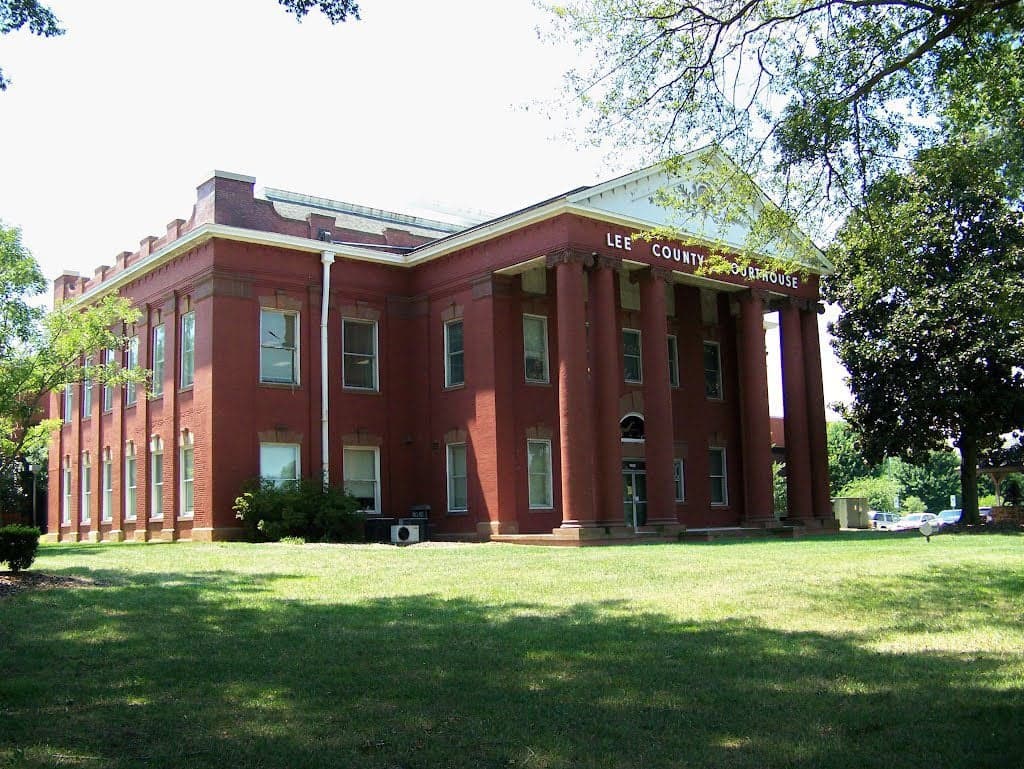
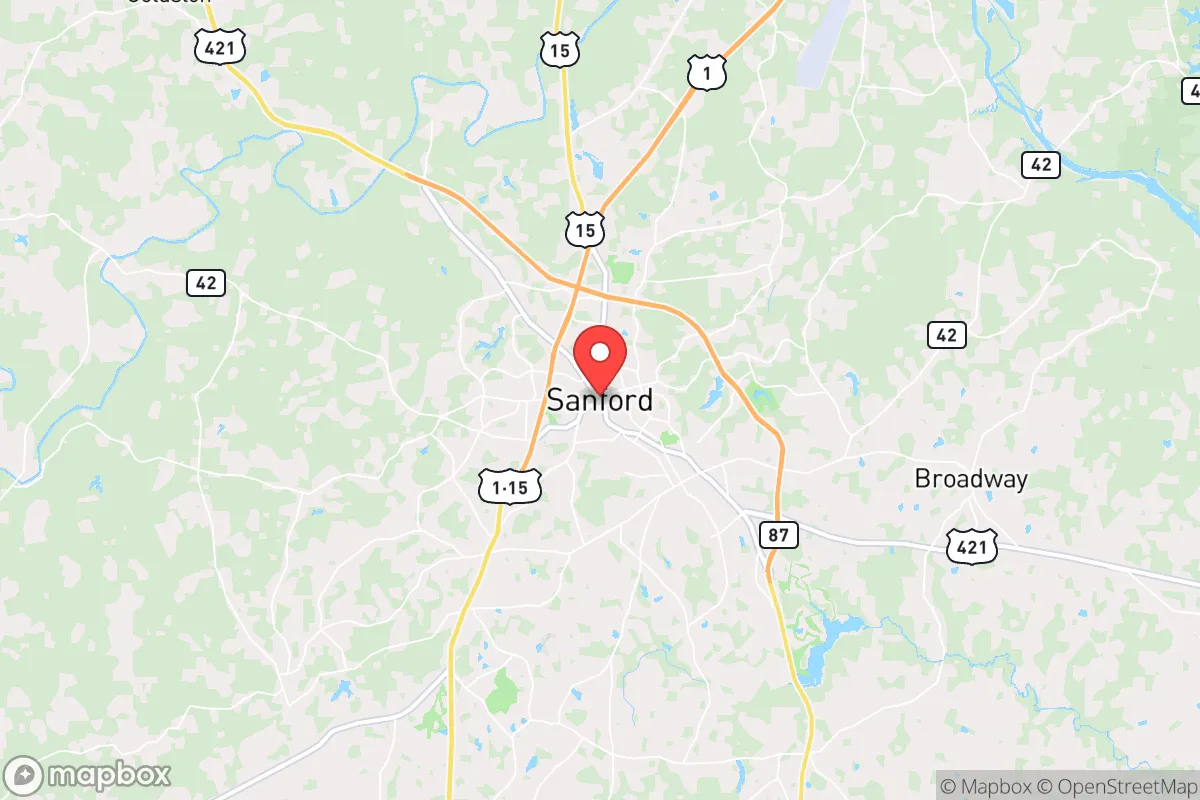
Photo: Wikipedia
Demographics of Sanford, NC
Affluence Level in Sanford, NC
A below-average socioeconomic profile. Incomes, home values, and educational attainment trail the U.S., with higher poverty and unemployment.
People of Sanford, NC
Sanford, North Carolina, is a city of 30,833 residents defined by its working-class roots and a tri-ethnic balance that is unusual for the Piedmont: 41.2% White, 30.9% Hispanic, and 22.7% Black. The city’s population density is moderate, and its character is distinctly blue-collar, shaped by brick-making, textiles, and now a growing logistics and manufacturing base. Sanford’s identity is less about a single dominant culture and more about the layered arrival of distinct groups who built separate neighborhoods and, increasingly, overlapping economic lives.
How the city was settled and grew
Sanford was founded in the 1870s as a railroad junction, not a colonial-era settlement. The original population was drawn by the intersection of the Raleigh and Augusta Air-Line Railroad and the Chatham Railroad, which turned the area into a shipping hub for timber and naval stores. By the early 1900s, the discovery of deep clay deposits sparked a brick-making boom, and Sanford became known as the "Brick Capital of the U.S.A." The first major wave of White settlers, largely of English and Scots-Irish descent, built homes in the Downtown Historic District and along Hawkins Avenue, where the brick mansions of factory owners still stand. A second wave of Black workers, many from nearby Lee County farms, arrived between 1910 and 1940 to work the brickyards and textile mills. They established the West End neighborhood, centered around the intersection of Horner Boulevard and Carthage Street, which became the city’s historic Black commercial and residential core. A smaller wave of Italian and Irish immigrants came for railroad construction work in the 1880s, settling near the rail yards in what is now the Brick District, but their numbers were never large enough to create lasting ethnic enclaves.
Modern era (post-1965)
The post-1965 immigration reforms reshaped Sanford more dramatically than the original railroad boom. The city’s Hispanic population, now 30.9%, began arriving in the 1990s, initially as migrant farmworkers in Lee County’s tobacco and poultry industries. By the 2000s, they had settled permanently, concentrating in the South Sanford area along U.S. 421 and around Wicker Street, where a cluster of Mexican grocery stores, taquerias, and Pentecostal churches now anchors a growing Latino commercial corridor. This wave was overwhelmingly Mexican, with smaller numbers from Central America. Meanwhile, the Black population, which had been stable at roughly 25% since the 1970s, began a slow decline as younger families moved to Raleigh or Fayetteville for better jobs. The White population, once over 70% in 1980, dropped to 41.2% as older residents aged in place and few new White families moved in. East/Southeast Asian communities (1.0%) and Indian-subcontinent residents (0.4%) are very small and dispersed, with no distinct neighborhood concentration; most are professionals employed at the Central Carolina Hospital or at the expanding Sanford-Lee County Industrial Park near the airport. The college-educated share is just 22.4%, reflecting a workforce that still relies heavily on manufacturing, warehousing, and construction rather than white-collar sectors.
The future
Sanford’s population is heading toward a Hispanic-plurality future, likely within the next decade. The Hispanic share has grown from roughly 15% in 2000 to 30.9% today, driven by both births and continued immigration from Mexico and Central America. This growth is not homogenizing the city; rather, it is creating distinct enclaves. South Sanford and Wicker Street are becoming more uniformly Hispanic, while West End remains predominantly Black, and the Downtown Historic District and northern neighborhoods like Quail Ridge are still majority White. The immigrant community is growing, not plateauing, and assimilation is partial: second-generation Hispanic residents are increasingly bilingual and moving into local government and small business ownership, but the foreign-born share (11.5%) remains high enough to sustain Spanish-language institutions. The Black population is likely to continue a slow decline as outmigration to the Triangle suburbs persists. The White population is aging and shrinking, but a small inflow of retirees from the Northeast is buying renovated brick homes downtown, adding a gentrifying element to the historic core. The next 10-20 years will likely see Sanford become a majority-Hispanic city with a stable Black minority and a shrinking White minority, divided geographically by class and ethnicity rather than fully integrated.
For someone moving in now, Sanford is a city in demographic transition: still affordable, still industrial, but increasingly Latino in its public face and daily rhythm. The neighborhoods are distinct, and newcomers should expect to live in an area where ethnic identity is closely tied to geography. The city’s future is not one of melting-pot assimilation but of parallel communities sharing a single tax base and school system.

* Values derived from national, state, county, city and local statistics and may differ in a specific area. Last updated: 2026-05-03T20:26:32.000Z
Narrative content on this page is AI-generated and may contain mistakes. Verify any details that matter before acting on them.
ReloMaps may earn a commission from affiliate links at no extra cost to you.

