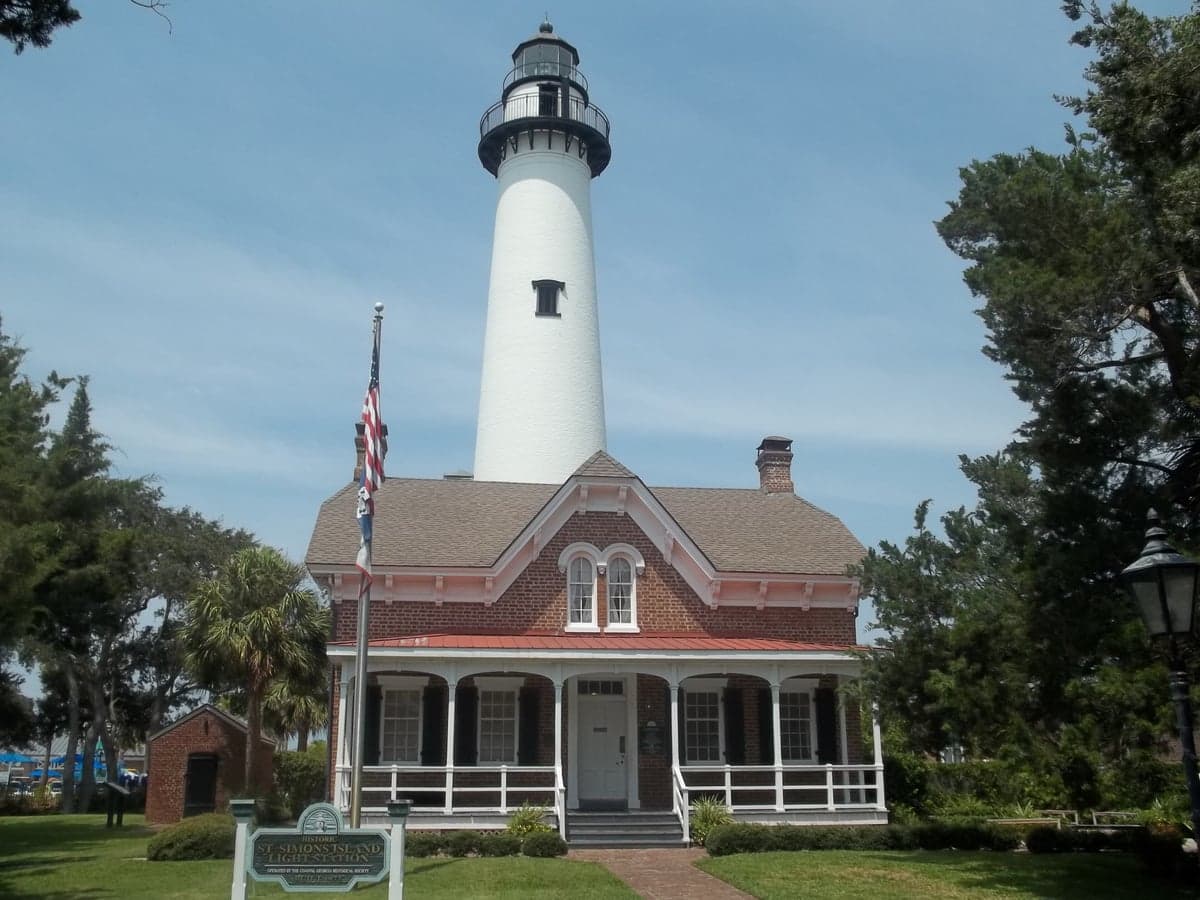
Photo: Wikipedia
Personal Sovereignty in Saint Simons Island, GA
Viable for self-reliance. Generally workable, though some barriers may limit total independence.
What does Personal Sovereignty tell us?
Personal Sovereignty measures your capacity for self-reliance and independence with minimal government friction. Higher scores mean fewer barriers between you and the way you want to live... but it assumes you have the space you need and good neighbors.
What does this tell us?
Personal Sovereignty measures your capacity for self-reliance and independence with minimal government friction. Higher scores mean fewer barriers between you and the way you want to live... but it assumes you have the space you need and good neighbors.
State Policy
Energy independence: Importer (12% of energy produced in-state)
Personal Liberty
Homesteading

Personal Liberty Analysis
Saint Simons Island, Georgia, offers a personal sovereignty environment shaped by Georgia’s generally light-touch state governance, but with important local nuances that matter for autonomy-minded relocators. The island’s regulatory posture is moderate—less permissive than rural South Georgia but far less restrictive than coastal peers like Savannah or Charleston—and the tax burden is among the lowest in the Southeast for both income and property. For single individuals and families prioritizing self-reliance, the key trade-off is between Georgia’s strong state-level protections (gun rights, parental rights, property rights) and the island’s local zoning and HOA-driven constraints that can limit off-grid or high-autonomy living.
Tax burden and regulatory posture: how Georgia’s light-touch state policy applies on the island
Georgia is a right-to-work state with no state-level income tax on a progressive scale—instead, it levies a flat 5.49% individual income tax rate as of 2026, with a standard deduction of $6,200 for single filers and $12,400 for married couples. For Saint Simons Island residents, this means a family of four earning $100,000 pays roughly $4,800 in state income tax, compared to over $7,000 in neighboring Florida (which has no income tax but higher property taxes) or over $9,000 in South Carolina. Property taxes in Glynn County, which includes Saint Simons, are moderate: the millage rate for unincorporated areas is about 12.5 mills, translating to roughly $3,125 annually on a $250,000 home (after the $2,000 homestead exemption). Georgia’s state-level regulatory burden ranks 8th-lowest nationally according to the Mercatus Center’s 2024 regulatory freedom index, but Saint Simons Island itself imposes additional local rules. The island’s zoning code restricts short-term rentals (STRs) to specific overlay districts, and new construction must comply with the Glynn County Unified Development Ordinance, which mandates minimum lot sizes of 10,000 square feet in most residential zones. For businesses, Georgia’s occupational licensing requirements are below the national average, but Glynn County requires a business tax certificate ($150–$300 annually) and a food service permit for any commercial kitchen. Overall, the island’s regulatory posture is best described as “state-light, local-moderate”—you get Georgia’s low business and property tax burden, but you must navigate local zoning and HOA covenants that can feel heavy-handed for those accustomed to rural autonomy.
Self-defense and gun law specifics: what Georgia’s permitless carry means on Saint Simons
Georgia is a permitless carry state as of 2022, meaning any legal resident 21 or older can carry a concealed or open handgun without a license. No background check is required for private firearm sales (though licensed dealers must run a NICS check), and there is no state-level registry or waiting period. For Saint Simons Island residents, this means you can legally carry a firearm in your vehicle, on your property, and in most public spaces—including parks and sidewalks—without a permit. However, there are important local restrictions: firearms are prohibited in all Glynn County school zones (including the island’s public schools and the College of Coastal Georgia campus), in government buildings (the Glynn County Courthouse, the Saint Simons Island post office), and in any establishment that derives 51% or more of its revenue from alcohol sales (bars and restaurants with a liquor license). Georgia’s “Stand Your Ground” law applies statewide, with no duty to retreat in any place where you are lawfully present. Castle doctrine protections extend to your vehicle and place of business, not just your home. For self-defense-minded relocators, the practical takeaway is that Saint Simons Island offers strong state-level protections, but the island’s dense residential character means you’re more likely to encounter posted “no firearms” signs at private businesses (which carry force of law in Georgia) than you would in rural areas. The Glynn County Sheriff’s Office reports a violent crime rate of 3.2 per 1,000 residents (2024 data), below the national average of 4.0, so the need for defensive firearm use is statistically lower than in metro Atlanta or Savannah.
Self-reliance and homesteading viability: lot sizes, zoning, and off-grid feasibility on the island
Saint Simons Island is not a homesteading destination. The island’s zoning code mandates minimum lot sizes of 10,000 square feet in most residential districts (R-1 and R-2), with some areas requiring 15,000 square feet for single-family homes. No agricultural zoning exists on the island—the Glynn County zoning map designates the entire island as either residential, commercial, or conservation. This means raising livestock (chickens, goats, pigs) is prohibited in all residential zones unless you obtain a special use permit, which is rarely granted. For off-grid living, the island’s building code requires connection to municipal water and sewer in most areas; private wells are allowed only on lots of 2 acres or more, and only about 5% of island parcels meet that threshold. Solar panels are permitted but must comply with HOA design guidelines in many subdivisions (e.g., no ground-mounted arrays, no panels visible from the street). Rainwater collection is legal but limited to 500 gallons per property without a permit. For families seeking self-reliance through gardening, the island’s sandy, acidic soil (pH 5.0–5.5) requires significant amendment for vegetables, and the coastal humidity makes pest management challenging. Community garden space is available at the Saint Simons Island Community Garden (10 plots, $50/year), but waiting lists are common. The practical reality is that Saint Simons Island is a suburban-coastal environment where self-reliance means growing herbs in raised beds, installing a backup generator, and maintaining a pantry—not homesteading. For serious off-grid or agricultural autonomy, relocators should look inland to Glynn County’s rural areas (e.g., Sterling or Dock Junction), where 5-acre minimums and agricultural zoning allow livestock, wells, and septic systems.
Personal liberties: parental rights, medical autonomy, speech, and property protections
Georgia is a strong parental-rights state. Georgia Code § 20-2-142 requires school districts to notify parents of any “sexually explicit” instructional materials and allows parents to opt their children out of such content. The state’s “Parents’ Bill of Rights” (HB 1178, 2022) affirms that parents have the fundamental right to direct their child’s education, healthcare, and religious upbringing. For medical autonomy, Georgia does not have a state-level vaccine mandate for adults, but schools require standard immunizations for enrollment (with medical and religious exemptions available). Georgia is one of 12 states with a “Right to Try” law allowing terminally ill patients to access experimental treatments without FDA approval. For speech, Georgia has no state-level hate speech law, and the state constitution’s free speech clause has been interpreted broadly by Georgia courts. Property rights are protected by Georgia’s “Property Rights Protection Act” (2016), which requires the government to prove a “compelling public interest” before taking private property via eminent domain, and to pay 110% of fair market value. Saint Simons Island has no local rent control (prohibited by state law), and short-term rental regulations are limited to the overlay districts. For families, the island’s school system (Glynn County Schools) allows open enrollment within the district, so parents can choose between Saint Simons Elementary (rated 8/10 on GreatSchools) and alternative schools in Brunswick. The overall personal liberties environment is conservative-leaning but not libertarian: you have strong parental and property rights, but local HOA covenants and zoning can restrict how you use your land and home.
Compared to other coastal Georgia communities, Saint Simons Island offers a middle-ground sovereignty profile. It is more restrictive than rural Glynn County or Camden County (where 5-acre minimums and no HOA rules allow greater self-reliance), but significantly less restrictive than Savannah (which has rent control, stricter STR rules, and a higher property tax rate) or Hilton Head, South Carolina (which has a 2% local sales tax and stricter building codes). For the autonomy-minded relocator, the island works best if you value strong state-level protections (gun rights, parental rights, low taxes) and are willing to accept local zoning and HOA constraints. If your priority is maximum self-reliance—off-grid living, livestock, minimal regulation—look inland. If you want a coastal lifestyle with strong personal liberties and a light tax burden, Saint Simons Island is a solid choice, provided you vet your HOA covenants and lot size before buying.

* Values derived from national, state, county, city and local statistics and may differ in a specific area. Last updated: 2026-09-17T20:21:40.000Z
Narrative content on this page is AI-generated and may contain mistakes. Verify any details that matter before acting on them.
ReloMaps may earn a commission from affiliate links at no extra cost to you.

