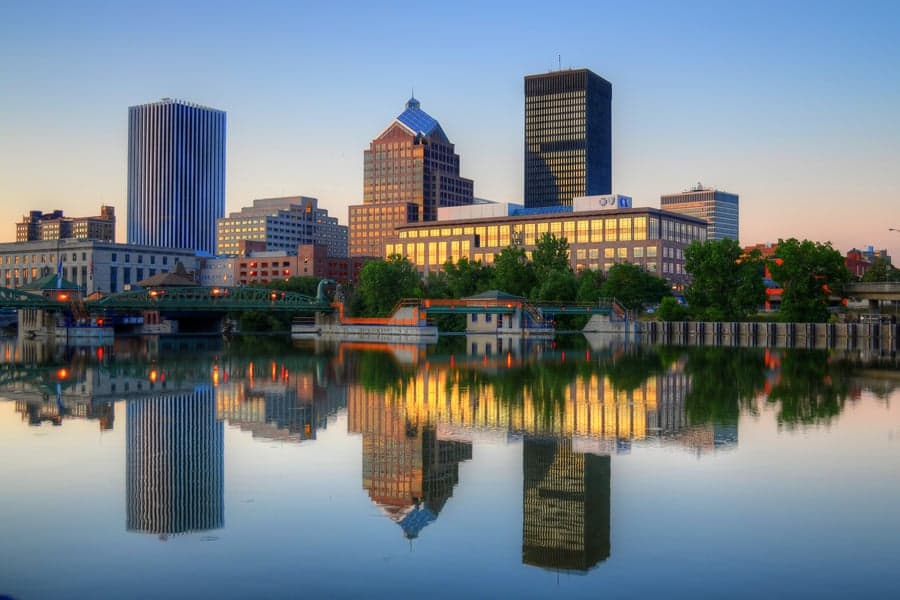
Photo: Wikipedia
Political ClimatePolitical Climate in Rochester, NY
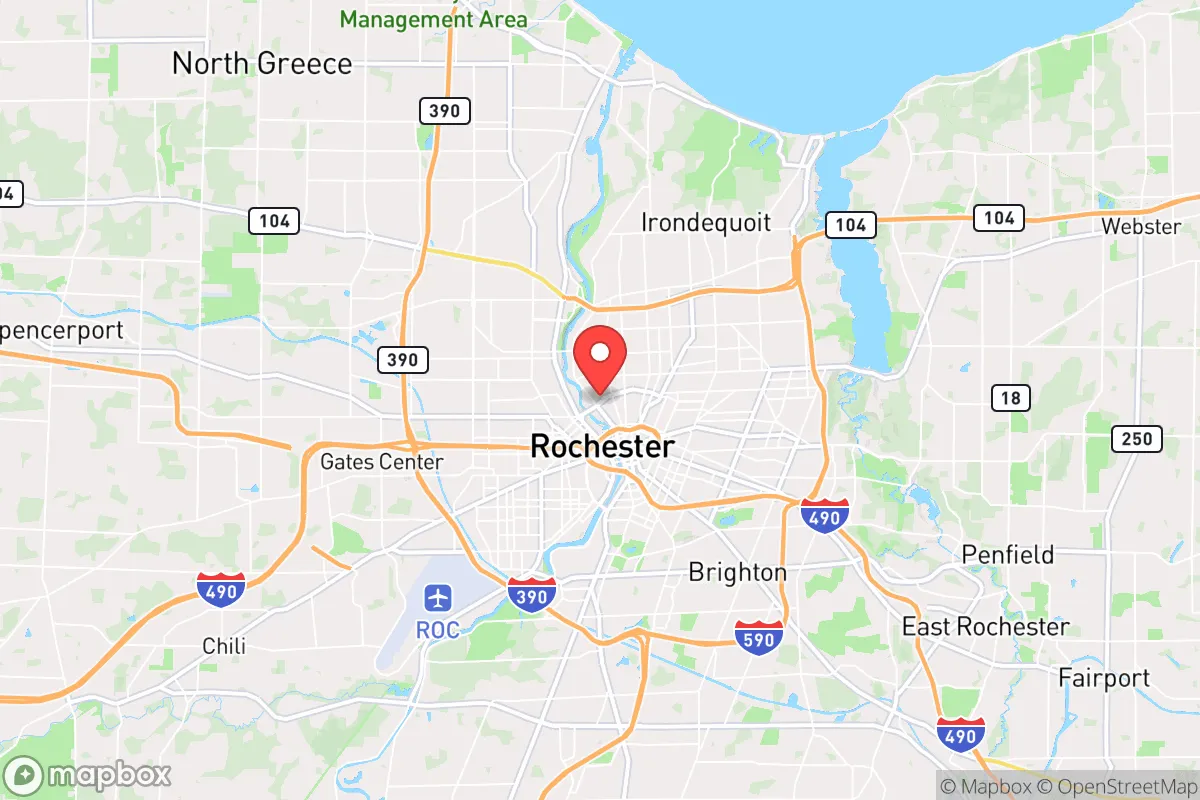
District shown is the primary district for this city’s centroid. Cities may span multiple districts.
Local Political AnalysisPolitical Analysis of Rochester, NY
Rochester, New York, has a political climate that leans heavily to the left, with a Cook PVI of D+10, meaning it votes about 10 points more Democratic than the national average. This isn't a recent shift; the city has been a Democratic stronghold for decades, but the nature of that politics has changed. In the past, you had more of a moderate, union-backed Democrat—folks who might disagree on social issues but were focused on jobs and keeping the city running. Now, it's a much more progressive machine, with a city council and county legislature that are increasingly pushing policies that feel less about practical governance and more about social engineering. The trajectory is clear: the city is moving further left, and the surrounding suburbs are starting to feel the pressure.
How it compares
To really get the picture, you have to look at the contrast with the surrounding areas. Drive 15 minutes east to Pittsford or Brighton, and you'll find a much more balanced political mix—still blue-leaning, but with a healthy dose of fiscal conservatism and a lot of folks who vote with their wallets. Head south to places like Henrietta or Greece, and you see a more purple landscape, where local elections are actually competitive. But the city itself? It's an island of deep blue in a sea of moderate red and purple. Compared to Buffalo, which has a similar D+ lean but a more pragmatic, blue-collar Democratic tradition, Rochester's politics feel more ideological, more focused on national progressive talking points than on fixing potholes and keeping the tax base from fleeing. The contrast with nearby conservative towns like Brockport or even parts of Monroe County's rural edges is stark—you go from a place where the government is actively involved in everything from housing to business regulations to areas where the motto is basically "leave us alone."
What this means for residents
For a long-time resident, the biggest red flag is the creeping sense of government overreach. It's not just about taxes, though those are high—property taxes in Monroe County are among the steepest in the state. It's the feeling that the city government is more interested in telling you how to live than in making sure the streets are safe and the schools are functional. You see it in zoning battles that make it hard to start a small business, in the push for policies that prioritize certain groups over others, and in a general attitude that the government knows best. The progressive agenda here isn't just about social issues; it's about a fundamental belief that the city should manage your life, from what kind of housing you can build to what kind of energy you can use. For someone who values personal freedom and local control, it can feel suffocating. The long-term concern is that this approach drives out the very people and businesses that could keep the city vibrant, leaving behind a hollowed-out core that's dependent on state and federal handouts.
One cultural distinction that really grates on a conservative-leaning resident is the city's embrace of "sanctuary city" policies and its aggressive stance on policing. The city council has made it clear they want to limit cooperation with federal immigration enforcement, which creates a tension between local law and federal law. More concerning is the defund-the-police rhetoric that's been floating around for years. While it hasn't fully materialized, the constant pressure to cut the police budget has led to a noticeable drop in officer morale and a rise in response times. You see it in the boarded-up storefronts on Monroe Avenue and the feeling that you can't walk through certain parts of the city after dark without looking over your shoulder. The city's focus on social justice initiatives often feels like it comes at the expense of basic public safety. It's a trade-off that a lot of us who remember a safer, more prosperous Rochester find hard to swallow. The future? Unless there's a serious course correction, I see the city continuing to drift left, becoming a place where the government's reach extends further into your daily life, and the cost of living—in both taxes and personal freedom—keeps climbing.

State Political ClimatePolitical Climate in New York
State Political AnalysisPolitical Environment in the State
New York State has long been a Democratic stronghold, but the reality on the ground is far more nuanced than the blue-on-the-electoral-map stereotype suggests. The state has voted for every Democratic presidential nominee since 1988, but that top-line number masks a deep and widening chasm between a handful of ultra-liberal urban centers and a vast, increasingly red rural and suburban hinterland. Over the last 20 years, the Democratic margin has actually shrunk in statewide races as upstate and exurban counties have swung hard right, even as New York City and its immediate suburbs have become more uniformly progressive. For a conservative considering relocation, the state is less a monolith and more a collection of warring fiefdoms, where your quality of life and political freedom depend almost entirely on which zip code you choose.
Urban vs. rural divide
The political map of New York is a tale of two states. The five boroughs of New York City alone account for roughly 40% of the state's vote, and they are overwhelmingly Democratic — often delivering margins of 80-20 or worse for Republicans. Buffalo and Rochester in western New York are similarly blue, though with smaller populations. The real action is in the suburbs and the vast rural stretches. Long Island's Nassau and Suffolk counties have been trending purple-to-red in recent cycles, with Suffolk County flipping to Trump in 2020 and 2024 after years of close races. Staten Island, technically a NYC borough, is a Republican outlier within the city, consistently voting red in presidential races. Upstate, counties like Oneida, Rensselaer, and Niagara have moved sharply right, while the Adirondack and Southern Tier regions are now reliably Republican. The divide is so stark that a resident of Manhattan and a resident of Allegany County live under effectively different political systems, despite sharing a governor.
Policy environment
New York's policy environment is a textbook case of progressive governance that conservatives find deeply concerning. The state has the highest combined state and local tax burden in the nation, with income tax rates topping out at 10.9% and property taxes among the highest in the country. The regulatory climate is dense: the state's Climate Leadership and Community Protection Act mandates a 100% zero-emission electricity grid by 2040, which has driven up energy costs and forced the closure of natural gas plants. On education, New York has some of the most restrictive homeschooling laws in the Northeast, requiring annual assessments and detailed curriculum submissions. Healthcare is heavily regulated, with the state expanding Medicaid eligibility and imposing strict insurance mandates. Election laws have been loosened significantly: no-excuse absentee voting, early voting, and automatic voter registration are now law, which critics argue weakens ballot integrity. The state also passed the Reproductive Health Act in 2019, codifying abortion access up to birth, and the Gender Expression Non-Discrimination Act, which conservatives view as overreach into parental rights and medical autonomy.
Trajectory & freedom
Over the past decade, New York has become less free by almost any conservative metric. The SAFE Act of 2013, passed after the Sandy Hook shooting, banned "assault weapons" and limited magazine capacity to seven rounds, making New York one of the most restrictive states for gun owners. In 2022, the state passed the Concealed Carry Improvement Act in response to a Supreme Court ruling, which created "sensitive locations" where guns are banned — including places of worship, public parks, and Times Square — and required applicants to demonstrate "good moral character." On parental rights, the state's Child Victims Act extended the statute of limitations for child sexual abuse claims, but also opened the door to lawsuits against schools and churches that conservatives argue has chilled religious expression. The New York Health Act, a single-payer bill, has been introduced repeatedly but hasn't passed — yet. Property rights have been eroded by rent control laws in NYC and the Housing Stability and Tenant Protection Act of 2019, which limited landlords' ability to raise rents or evict tenants, even for non-payment. The trajectory is clearly toward more government control over personal choices, from what you can carry to where you can live.
Civil unrest & political movements
New York has been a flashpoint for political activism on both sides. The Black Lives Matter protests of 2020 in NYC were among the largest and most destructive in the country, with looting and property damage that led to a lasting debate about public safety. The state's sanctuary city policies, codified by the New York City Council's "City of Yes" initiative, have made it a magnet for illegal immigration, with the city spending over $6 billion on migrant services since 2022 — a cost that has sparked backlash even among some Democrats. On the right, the New York State Rifle & Pistol Association has been the lead plaintiff in multiple Supreme Court cases, including the landmark NYSRPA v. Bruen decision that struck down the state's restrictive carry laws. The Upstate New York secession movement, while fringe, has gained some traction in rural counties like Tioga and Delaware, where residents feel ignored by Albany. Election integrity remains a hot-button issue: the state's 2020 election was marred by a massive influx of absentee ballots and a slow count, and the 2022 gubernatorial race saw allegations of ballot harvesting in NYC. A new resident would notice the visible presence of both progressive activism in the cities and a quieter, but growing, conservative resistance in the suburbs and countryside.
Projection
Looking ahead 5-10 years, New York's political trajectory is likely to continue its current path: more progressive state-level policy, but with a growing conservative counterweight in the suburbs and upstate. Demographic trends are working against the state's leftward shift: New York lost a congressional seat after the 2020 census due to population decline, driven largely by out-migration from NYC and the downstate suburbs to red states like Florida and Texas. The people leaving tend to be higher-income and more conservative, while the people arriving — largely immigrants and young progressives — reinforce the urban Democratic base. This means the state's politics will likely become even more polarized, with Albany passing increasingly progressive laws while rural and suburban residents feel more alienated. The 2026 gubernatorial race could be a bellwether: if a moderate Republican can win upstate and Long Island while losing NYC by a smaller margin, the state might see a slight rightward correction. But the structural advantages of the Democratic machine — gerrymandered districts, a compliant media, and a deep bench of activist judges — make a full reversal unlikely. A conservative moving in now should expect to live in a state where their vote matters less at the state level, but where local control in red counties can still provide a buffer.
For a conservative considering New York, the bottom line is this: the state government will be hostile to your values, but your day-to-day freedom depends on where you live. If you choose a red county like Oneida or Niagara, you'll find like-minded neighbors, lower taxes, and a slower pace of life. If you choose NYC or its inner suburbs, you'll be subject to the full weight of progressive governance — high taxes, restrictive gun laws, and a culture that may feel alien. The state's trajectory is toward more control, not less, but there are still pockets where a conservative can thrive. Just know that you'll be fighting an uphill battle at the ballot box, and your property taxes will be among the highest in the nation regardless of where you settle. If you value personal freedom and limited government, New York is a tough sell — but if you have family ties or a job that keeps you here, it's not impossible to carve out a good life in the right corner of the state.
* Values derived from national, state, county, city and local statistics and may differ in a specific area. Last updated: 2026-05-01T23:58:20.000Z
Narrative content on this page is AI-generated and may contain mistakes. Verify any details that matter before acting on them.
ReloMaps may earn a commission from affiliate links at no extra cost to you.

