
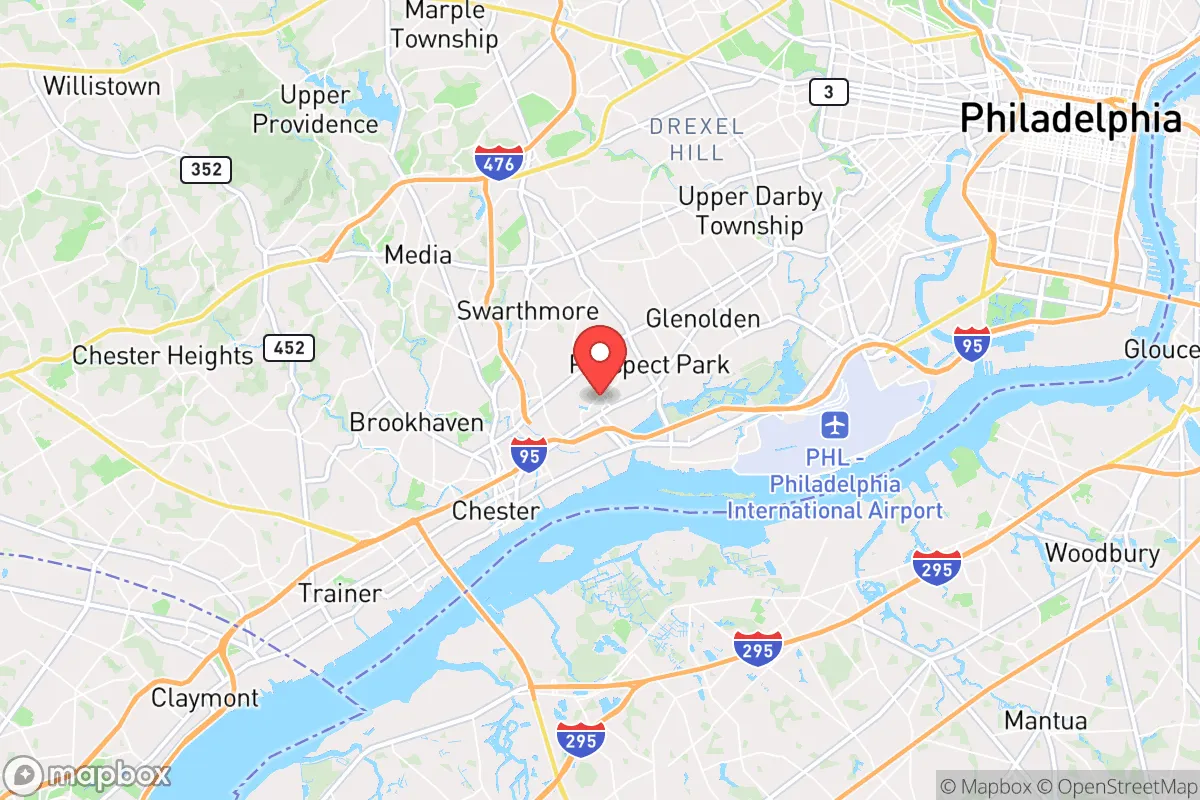
Photo: Wikipedia
Political ClimatePolitical Climate in Ridley Park, PA
District shown is the primary district for this city’s centroid. Cities may span multiple districts.
* Lean and PVI are calculated from Ridley Park, PA’s own 2020 presidential results (precinct returns summed to the city), with 2024 estimated from the surrounding county’s 2020–2024 shift, Cook-style. Sources: state election offices; VEST 2020 precinct results (CC BY 4.0).
Political rankings in Pennsylvania
- Most Conservative Cities in Pennsylvania
- Most Liberal Cities in Pennsylvania
- Best Conservative-Leaning Towns in the Northeast
- Best Conservative-Leaning Towns in the Mid-Atlantic
- Most Affordable Liberal-Leaning Small Towns in the U.S.
- Safest Liberal-Leaning Cities in the U.S.
- Most Conservative Counties in Pennsylvania
- Most Liberal Counties in Pennsylvania
Local Political AnalysisPolitical Analysis of Ridley Park, PA
Ridley Park, Pennsylvania, is a solidly Democratic stronghold in Delaware County, with a Cook Partisan Voting Index (PVI) of D+15, meaning it votes about 15 points more Democratic than the national average. This stands in stark contrast to the state of Pennsylvania as a whole, which has a Cook PVI of EVEN, reflecting its status as a true swing state. Over the past decade, Ridley Park has only deepened its blue lean, driven by a mix of union-affiliated working-class families, suburban professionals, and a growing number of younger residents moving in from Philadelphia. The area's political trajectory is one of steady Democratic consolidation, even as nearby towns like Media and Swarthmore have also trended left, while more conservative pockets like Aston and Chester Heights remain Republican-leaning.
How it compares
Ridley Park’s D+15 rating places it among the most Democratic-leaning communities in Delaware County, but it’s not an outlier. The borough sits within Pennsylvania’s 5th Congressional District, which has a PVI of D+14, and its voting patterns mirror those of neighboring Ridley Township and Prospect Park. In the 2024 presidential election, Ridley Park delivered roughly 65% of its vote to the Democratic candidate, while Pennsylvania as a whole split almost evenly. This gap is significant: a Ridley Park voter is about twice as likely to be a Democrat as a voter in the state overall. For context, nearby Republican-leaning towns like Media (R+2) or the more conservative Garnet Valley area (R+5) show how sharply the political map can shift within a 10-minute drive. The borough’s Democratic edge is fueled by strong union presence—particularly among SEPTA workers and local trades—and a high proportion of college-educated residents who lean left on social issues.
What this means for residents
For liberal residents, Ridley Park’s political climate means local elections are rarely competitive, and Democratic candidates for borough council, school board, and county offices typically win by wide margins. Progressive policies on zoning, public transit, and environmental initiatives often get a sympathetic ear. For conservative residents, the reality is more nuanced: while they are a clear minority, they are not marginalized. Local Republican committees remain active, and conservative voices are heard on issues like property taxes and school curriculum debates. The borough’s Democratic lean does not translate into radicalism—Ridley Park is a moderate, family-oriented community where fiscal pragmatism often trumps ideological purity. Both sides can expect respectful discourse at town hall meetings, though the political winds clearly favor the left in most contested races.
Culturally, Ridley Park’s Democratic tilt is reflected in its support for public education, with the Ridley School District consistently funding programs and facilities through local taxes. The borough also participates in county-wide initiatives like the Delaware County Sustainability Commission, which pushes for green energy and waste reduction—policies that align with the Democratic base. However, the area retains a strong sense of local tradition, with annual events like the Ridley Park Fourth of July Parade and the Ridley Park Farmers Market that draw residents across the political spectrum. The biggest policy distinction from the state at large is on gun control: Ridley Park’s local ordinances are more restrictive than Pennsylvania’s state law, which is preempted from enacting many local firearm regulations. This creates a subtle tension, but most residents accept it as part of the borough’s character. Looking ahead, as Pennsylvania’s swing-state status persists, Ridley Park will likely remain a reliable blue anchor in a purple county, with its political identity shaped more by local concerns than national trends.

State Political ClimatePolitical Climate in Pennsylvania
State Political AnalysisPolitical Environment in the State
Pennsylvania is the ultimate swing state, with a Cook PVI of EVEN that perfectly captures its 50-50 split. Over the past 20 years, it has shifted from a reliably blue-leaning state in presidential races (voting Democratic from 1992 to 2012) to a true battleground where margins are razor-thin — Trump won it in 2016 by 44,000 votes, Biden flipped it back in 2020 by 80,000, and the 2024 race was again decided by less than 2 points. The dominant coalitions are the urban-suburban crescent around Philadelphia (Bucks, Montgomery, Delaware, Chester counties) and Pittsburgh (Allegheny County) pulling left, countered by the vast "T" of rural central and northern counties — places like Tioga, Bradford, and Bedford — that vote 65-70% Republican. The result is a state that feels like two different countries sharing a border.
Urban vs. rural divide
The political map of Pennsylvania is best understood as a battle between the Philadelphia metro and the rest of the state. Philadelphia itself delivers about 500,000 Democratic votes every election, enough to offset Republican margins in dozens of rural counties. The suburban collar counties — Bucks, Montgomery, Delaware, and Chester — have been trending blue since 2016, driven by college-educated voters shifting away from the GOP. Pittsburgh's Allegheny County is similarly Democratic, though the surrounding counties like Washington, Westmoreland, and Butler are deeply red. The real story is the "Pennsylvania T": the rural spine running from Erie down through Centre County and across to the Poconos. Counties like Potter, Sullivan, and Forest routinely vote 75-80% Republican. The key swing areas are the "collar counties" around Scranton/Wilkes-Barre (Lackawanna and Luzerne) and the Lehigh Valley (Northampton and Lehigh) — these working-class, union-heavy regions have been the most volatile, flipping from Obama to Trump to Biden and back again.
Policy environment
Pennsylvania's policy landscape reflects its divided government. The state has a flat income tax rate of 3.07% — one of the lowest in the nation — and a sales tax of 6% (8% in Philadelphia and Pittsburgh). Property taxes are high, averaging about 1.5% of home value, which is a major complaint for homeowners. The regulatory posture is moderate: Pennsylvania is not a "right-to-work" state, meaning unions remain powerful, especially in construction and public schools. Education policy is locally controlled, with school funding a perennial battleground — a 2023 state Supreme Court ruling declared the current funding system unconstitutional, setting up a major reform fight. Election laws are relatively accessible: no-excuse mail-in voting was expanded in 2019 under Act 77, though it remains controversial among conservatives. Voter ID is required for first-time voters but not for regulars. Gun laws are among the most permissive in the Northeast: no permit needed for open carry (except in Philadelphia), and concealed carry permits are issued on a "shall-issue" basis. However, the state does have universal background checks for handgun purchases and a 48-hour waiting period.
Recent policy direction
The last five years have seen Pennsylvania lurch in both directions depending on which party controls the governor's mansion. Under Democratic Governor Josh Shapiro (elected 2022), the state has moved left on several fronts. In 2023, Shapiro signed an executive order banning state agencies from cooperating with out-of-state investigations into abortion or gender-affirming care — a direct response to post-Dobbs legal battles. The state also expanded Medicaid under the Affordable Care Act and created a state-based health insurance exchange. On the other hand, the Republican-controlled legislature has blocked most gun control measures, including "red flag" laws and universal background checks for long guns. Property rights are generally strong: Pennsylvania is a "Dillon's Rule" state, meaning local governments only have powers explicitly granted by the state, which limits municipal overreach. On privacy and surveillance, the state has no comprehensive data privacy law, though a bill is pending. Voting access has been a flashpoint: Act 77's no-excuse mail-in voting survived a 2024 state Supreme Court challenge, but the legislature has not passed a voter ID law for mail ballots. The net effect is a state where your experience depends heavily on where you live — Philadelphia and Pittsburgh have strong tenant protections and sanctuary policies, while rural counties are essentially governed as conservative strongholds.
Civil unrest & political movements
Pennsylvania has been a hotspot for political activism on both sides. The 2020 election aftermath saw massive protests in Philadelphia over police reform, while rural counties like Lancaster and York hosted large "Stop the Steal" rallies. The state was ground zero for election integrity debates: the 2020 count in Philadelphia took days, leading to conspiracy theories and a 2021 GOP-ordered "forensic audit" of the 2020 election in Fulton County that found no evidence of widespread fraud. Immigration politics are muted compared to border states, but Philadelphia's sanctuary city status (since 2017) is a constant source of tension with the state legislature, which has tried and failed to pass a ban on sanctuary policies. The "Second Amendment sanctuary" movement is strong in rural counties — over 30 counties have passed resolutions declaring themselves sanctuaries from state or federal gun laws. On the left, the Pittsburgh-area Sunrise Movement and Philadelphia's progressive DA Larry Krasner (who survived a 2023 impeachment attempt by the GOP legislature) represent the activist energy. The most visible flashpoint for a new resident would be the constant political advertising — Pennsylvania is the most expensive media market in the country for political ads, and you'll see them year-round.
Projection
Over the next 5-10 years, Pennsylvania is likely to remain a toss-up, but the demographic trends favor Democrats slightly. The Philadelphia suburbs are getting more diverse and more educated, while rural counties are aging and shrinking. In-migration is modest — about 50,000 net new residents per year, mostly from New York and New Jersey, settling in the Lehigh Valley and the Philadelphia collar counties. These newcomers tend to be moderate-to-liberal, which will push the state's lean slightly blue. However, the state's electoral college math means it will remain a top target for both parties. The wild card is the state's aging population: Pennsylvania has the third-oldest median age in the nation (after Maine and Florida), and older voters lean Republican. If the GOP can hold the working-class voters in the Scranton/Wilkes-Barre area and the "T", they can keep the state competitive. For a relocator, expect the policy environment to remain gridlocked — no major tax cuts or expansions, no dramatic shifts on guns or abortion, just a slow drift toward the national median. The state will likely pass a data privacy law and maybe a modest increase in the minimum wage, but don't expect a political revolution in either direction.
For a new resident, the bottom line is that Pennsylvania offers a genuine choice: you can live in a deep-blue city like Philadelphia or Pittsburgh with all the amenities and progressive policies that entails, or you can settle in a red rural county like Bedford or Franklin where life is more conservative and property taxes are lower. The state's divided government means neither side gets everything it wants, which frustrates activists but creates a stable, predictable environment for most people. If you're looking for a place where your vote actually matters in national elections, Pennsylvania is one of the few states left where that's true. Just be prepared for the weather — and the political ads.
* Values derived from national, state, county, city and local statistics and may differ in a specific area. Last updated: 2026-11-23T01:25:16.000Z
Narrative content on this page is AI-generated and may contain mistakes. Verify any details that matter before acting on them.
ReloMaps may earn a commission from affiliate links at no extra cost to you.

