Photo: Wikipedia
Political ClimatePolitical Climate in Rhode Island
Political Environment in the State
Rhode Island has been a reliably blue state for decades, with a Cook Partisan Voting Index of D+8, meaning it consistently votes about 8 points more Democratic than the national average. The dominant coalition is a mix of urban progressives in Providence and union-aligned Democrats in the working-class mill towns, with a small but vocal Republican presence mostly confined to the rural western half and the East Bay suburbs. Over the past 20 years, the state has drifted steadily leftward on social and economic policy, though the pace has accelerated noticeably since 2020, driven by an influx of out-of-state transplants and a state legislature that has become increasingly comfortable with one-party rule.
Urban vs. rural divide
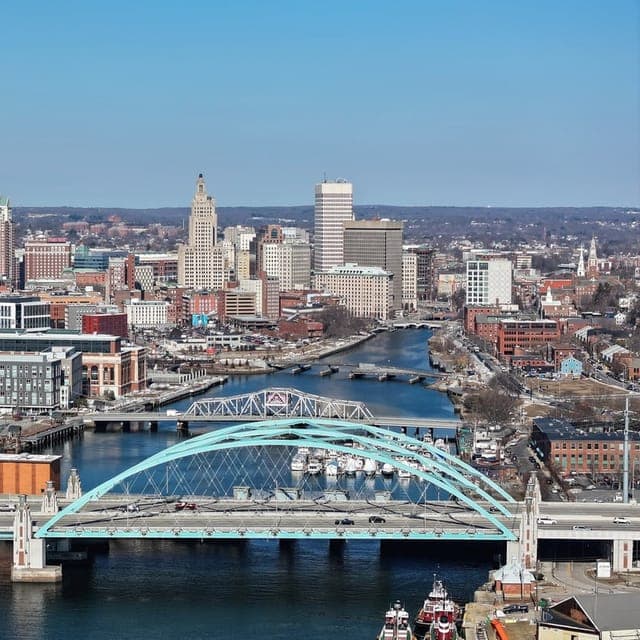
The political map of Rhode Island is essentially a story of Providence versus everything else, but even the "everything else" is more nuanced than you might think. Providence itself is the engine of the state's Democratic dominance — a dense, diverse city where progressive activists and university students drive turnout for candidates like Senator Sheldon Whitehouse and Governor Dan McKee. The city’s wards routinely vote 80-90% Democratic, and its influence is magnified because it contains roughly one-sixth of the state's population. Surrounding it, the inner-ring suburbs like Cranston, Warwick, and Pawtucket lean Democratic but are more moderate, often splitting tickets in local races. The real contrast comes when you head west. Towns like Foster, Scituate, and Glocester in the rural western part of the state are the closest thing Rhode Island has to a redoubt — they vote Republican by comfortable margins, driven by gun rights, property tax concerns, and a general distrust of Providence-centric governance. The East Bay, particularly Barrington and Bristol, is a different animal: wealthy, educated, and socially liberal, these towns vote Democratic but are fiscally conservative in local matters. The only reliably Republican stronghold of any size is the town of East Greenwich, which has a long history of electing GOP officials to the General Assembly. The divide isn't just urban vs. rural — it's also coastal vs. inland, with the coastal towns trending bluer and the inland hill towns trending redder.
Policy environment
Rhode Island's policy environment is heavily tilted toward government intervention and high taxation. The state has one of the highest combined state and local tax burdens in the country, with a progressive income tax that tops out at 5.99% on income over $155,050, and property taxes that are among the highest in New England — especially in Providence and Pawtucket, where effective rates can exceed 2.5%. The regulatory posture is aggressive: the state has a strict renewable energy mandate (100% by 2033), a $15 minimum wage that was phased in ahead of many neighboring states, and some of the most restrictive zoning laws in the region, which have contributed to a housing shortage. On education, Rhode Island has a strong teachers' union presence and a state-run school funding formula that heavily favors urban districts, leaving rural towns like Burrillville and Exeter struggling to fund their local schools without crushing tax hikes. Healthcare is dominated by the state's Medicaid expansion and a robust insurance regulatory framework, but the state has also passed laws that restrict private practice autonomy for doctors. Election laws are relatively liberal: same-day voter registration, no-excuse mail voting, and automatic voter registration are all in place. The state also has a "sanctuary state" law (the 2017 Rhode Island Trust Act) that limits local cooperation with federal immigration enforcement, which has been a flashpoint in more conservative towns.
Trajectory & freedom
Over the past five years, Rhode Island has become measurably less free in several key areas. The most visible example is the 2022 passage of a "red flag" law (the Extreme Risk Protection Order Act), which allows courts to temporarily seize firearms from individuals deemed a risk to themselves or others, without a criminal conviction or a full hearing. This was followed by a 2023 ban on "ghost guns" and a 2024 law raising the minimum age to purchase any firearm to 21. On parental rights, the state passed a 2023 law that prohibits schools from notifying parents if a student changes their gender identity or pronouns, overriding local school board policies in towns like North Kingstown and Coventry that had adopted parental notification rules. Medical autonomy took a hit with the 2022 passage of a law requiring COVID-19 vaccines for all healthcare workers, which led to a wave of resignations in rural hospitals. Property rights are under pressure from a 2024 "just cause" eviction law that makes it harder for landlords to remove tenants, effectively reducing the supply of rental housing. On the tax front, the state has made no meaningful progress on cutting income or property taxes, and the 2024 budget included a new "millionaire's surcharge" that pushed the top marginal rate to 8.99% on income over $1 million. The only bright spot for liberty-minded residents is the 2023 repeal of the state's "master lever" voting system, which had allowed straight-ticket voting and was widely seen as benefiting incumbents.
Civil unrest & political movements
Rhode Island has seen its share of political activism, though it tends to be more organized and less chaotic than in larger states. The most visible movement in recent years has been the "School Committee Wars" — a grassroots backlash against COVID-era school closures and curriculum changes that led to conservative takeovers of school boards in towns like Cranston, Warwick, and Coventry. These groups have been vocal on issues like critical race theory, mask mandates, and parental notification, and they've had some success in electing candidates, though the state legislature has consistently overridden local decisions with statewide mandates. On the left, the Rhode Island Political Cooperative (RIPAC) has been a force in Providence and Central Falls, pushing for rent control, defunding the police, and a Green New Deal-style energy transition. Immigration politics have been a flashpoint in the working-class suburbs of Pawtucket and Central Falls, where the 2017 Trust Act has been blamed for straining local services. There have been sporadic protests outside the State House in Providence, including a 2023 demonstration against the transgender notification law that drew several hundred people. Election integrity has been a quieter issue here than in swing states, but the 2020 and 2022 cycles saw a small but persistent group of activists questioning mail-in ballot procedures, particularly in Providence where a 2020 audit found a handful of irregularities. Overall, the political temperature is lower than in states like Texas or Florida, but the fault lines are real and visible in local elections.
Projection
Looking ahead 5-10 years, Rhode Island is likely to become more, not less, progressive. The demographic trends are clear: the state's population is aging and shrinking, but the growth that does occur is concentrated in Providence and the coastal suburbs, driven by out-of-state transplants from Massachusetts and New York who bring their politics with them. The rural western towns that vote Republican are losing population, while the urban core is gaining. The state legislature is unlikely to flip — Republicans hold only 15 of 75 House seats and 6 of 38 Senate seats, and gerrymandering has locked in Democratic supermajorities. The most realistic scenario is a continuation of the current trajectory: higher taxes, more regulation, and a steady expansion of state authority over local schools, housing, and healthcare. The one wild card is the housing crisis — if the state's restrictive zoning and high taxes drive out enough middle-class families, the tax base could erode to the point where even the progressive coalition has to reconsider. But for now, the momentum is all one way.
For a conservative-leaning individual or family considering a move to Rhode Island, the bottom line is this: you will be living in a state where your vote for statewide office is effectively meaningless, where your taxes will be among the highest in the nation, and where your local school board may be overruled by the state legislature on issues you care about. The best you can hope for is to find a town like Foster, Scituate, or East Greenwich where local government is more aligned with your values, but even there, the state-level headwinds are strong. If you value personal freedom, low taxes, and local control, Rhode Island is not an easy place to call home — and it's getting harder every year.

Most Conservative Cities in Rhode Island
Most Liberal Cities in Rhode Island
* Values derived from national, state, county, city and local statistics and may differ in a specific area. Last updated: 2026-04-19T01:38:18.000Z
Narrative content on this page is AI-generated and may contain mistakes. Verify any details that matter before acting on them.
ReloMaps may earn a commission from affiliate links at no extra cost to you.

