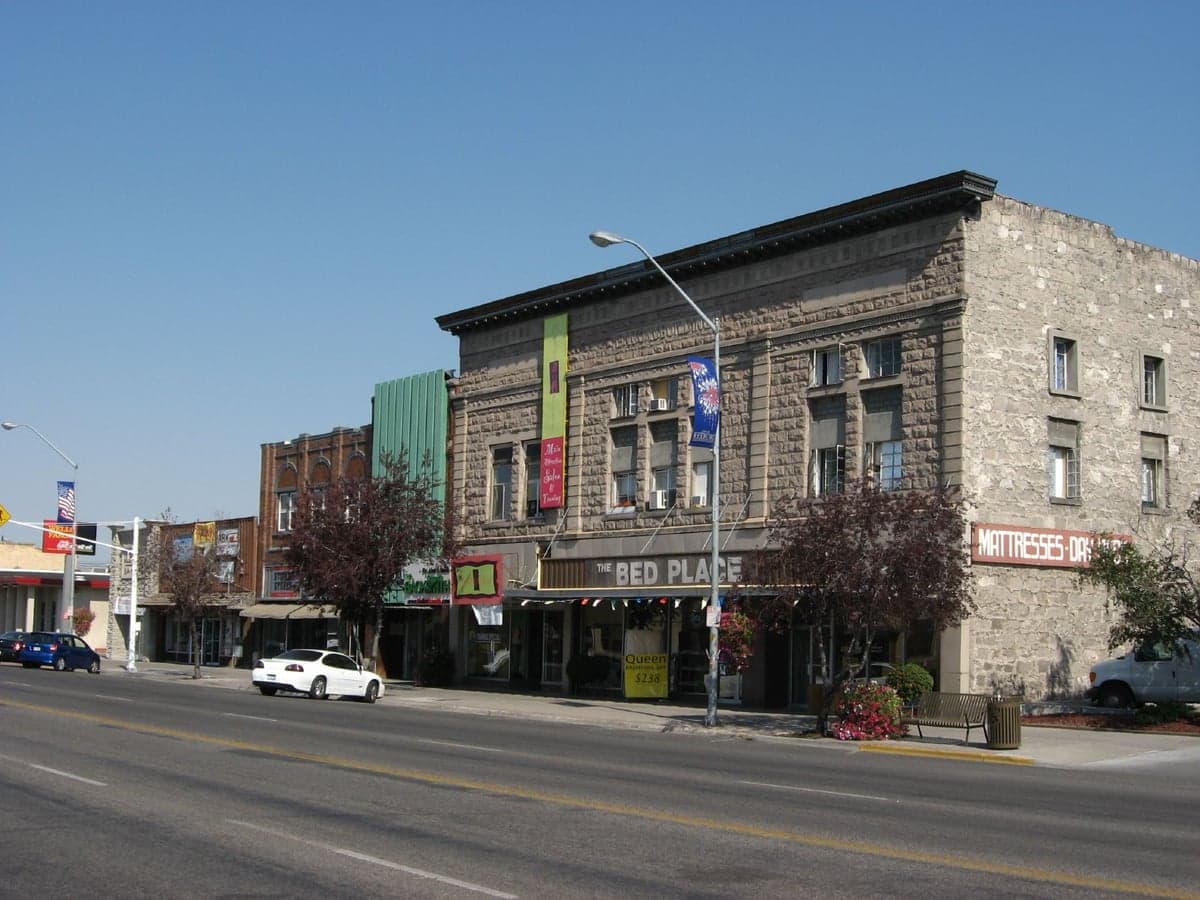
Photo: Wikipedia
Strategic Assessment of Rexburg, ID
Workable tactical position. Some exposure to population density or targets, but generally defensible in a crisis.
What does the Strategic Assessment tell us?
Our Strategic Assessment grades tactical survivability of an area. Major population centers, military targets, fallout zones, natural disasters, and border exposure all drive risk — lower exposure means a more defensible position in a crisis.
This is heavily inspired by Joel Skousen's Strategic Relocation book. Highly recommended you checkout the book ($)What does this tell us?
Our Strategic Assessment grades tactical survivability of an area. Major population centers, military targets, fallout zones, natural disasters, and border exposure all drive risk — lower exposure means a more defensible position in a crisis.
This is heavily inspired by Joel Skousen's Strategic Relocation book. Highly recommended you checkout the book ($)Strategic Pillars

Key Distances
Regional Safe Places
Below is our recommended "safe zones" in Idaho and the surrounding area based on our strategic heuristics. For most people, it's unrealistic to live in a “safe zone” full-time due to work, family or other personal reasons. They tend to be more rural. However, many of these areas are perfect for second homes and retreat properties that double as a vacation home or even a short-term rental.
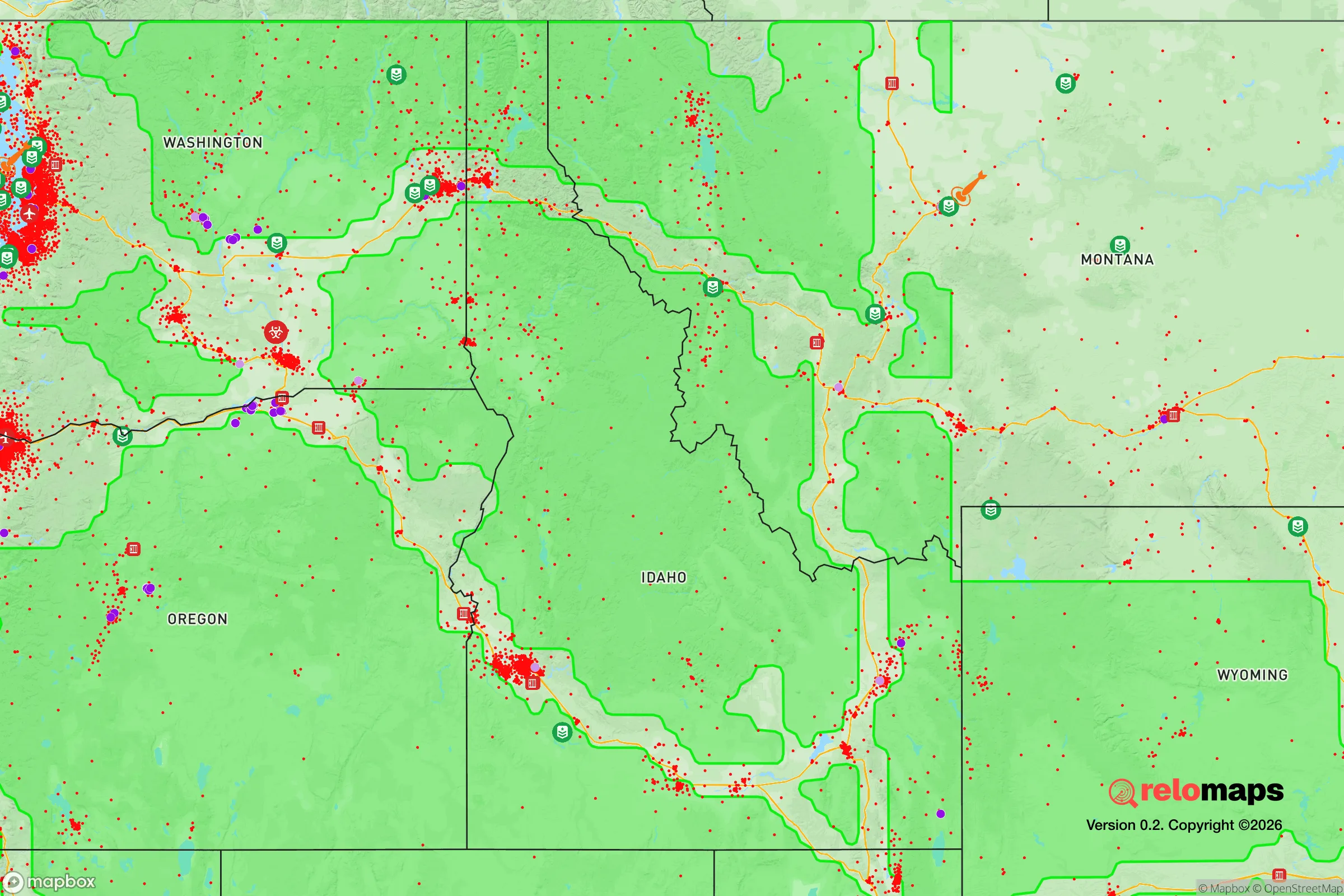
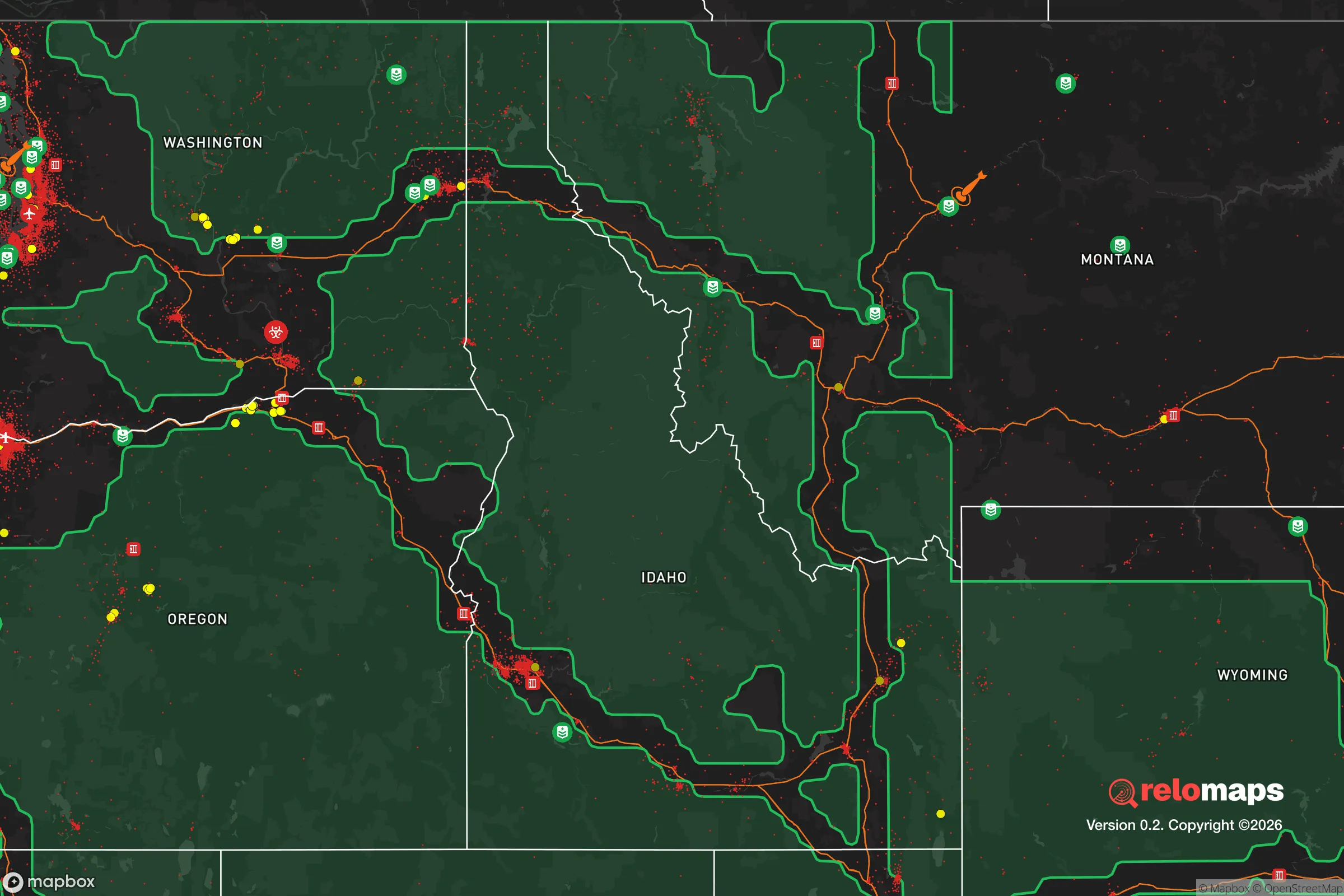


Important Note: For informational purposes only. This does not mean nothing bad ever happens in the green zones. Please use common sense. This is based on public data and modeled with AI. We tried to take a conservative approach but mistakes happen. We update this regularly as new information becomes available.
Solar Generator Recommendations
Backup power matters more here than in safer locations. We've picked three solar generators across budgets and capacity tiers — start with the budget unit if you only need a few essentials, or step up if you want to run a fridge and HVAC for days at a time.

Jackery Portable Power Station Explorer 300
Budget OptionPower on the Go: Weighing only 11 lbs, it's convenient to set up and store with book-sized foldable solar panels

BLUETTI Portable Power Station AC180
Designed for both indoor and outdoor scenarios, AC180 is highly capable as it has a robost capacity and continuous output power.

EF ECOFLOW DELTA Pro Ultra Power Station
Upgraded PickEcoFlow DELTA Pro Ultra is a whole-home energy system designed to grow with your family. Integrated with the Smart Home Panel 2, it scales to meet your evolving energy needs — keeping your home powered, intelligent, and secure through every stage of life.
We earn a commission, at no additional cost to you.
Strategic Assessment Analysis
Rexburg, Idaho, offers a compelling mix of geographic isolation and practical self-sufficiency that makes it a serious contender for those prioritizing resilience and disaster preparedness. Its location in the Upper Snake River Valley, far from major population centers and coastal vulnerabilities, provides a natural buffer against many of the cascading failures that threaten more densely populated regions. For a relocator thinking about long-term stability, Rexburg’s combination of a robust local food system, a reliable water supply, and a community culture that leans toward preparedness creates a strategic foundation that is hard to find elsewhere in the lower 48.
Geographic position and natural advantages for long-term stability
Rexburg sits on the eastern edge of the Snake River Plain, a high-elevation (4,865 feet) plateau that is naturally insulated from many of the climate and geopolitical risks that plague coastal and border regions. The area is roughly 250 miles from the nearest major metropolitan area (Salt Lake City) and over 300 miles from the Pacific coast, placing it well outside the likely blast or fallout zones of any major strategic target. The surrounding landscape is dominated by agricultural land, the Teton Range to the east, and the Snake River itself, which provides a reliable surface water source. The region’s elevation and latitude mean a cooler, drier climate than much of the West, reducing risks from wildfires (though not eliminating them) and limiting the spread of many vector-borne diseases. The local geology is stable, with no significant seismic activity in the immediate area, though the Yellowstone Caldera to the west is a distant but real long-term concern. For a relocator, the key advantage is simple: Rexburg is far from the places that would be hit first in a major conflict or natural disaster, and its local geography supports a self-reliant lifestyle.
Risks, exposures, and proximity to fallout-relevant landmarks
No location is without risk, and Rexburg has specific exposures that a serious planner must weigh. The most significant man-made risk is proximity to the Idaho National Laboratory (INL), about 50 miles southwest near Idaho Falls. The INL is a major nuclear research and testing facility, housing several reactors and waste storage sites. While the facility has a strong safety record, a catastrophic accident or a deliberate attack on the INL could produce a radioactive release that would affect downwind areas, including Rexburg, depending on prevailing winds (which are generally from the southwest). This is a real, if low-probability, risk that a resilience-minded relocator should acknowledge. Additionally, the area is within the fallout shadow of potential strikes on the Intermountain West’s critical infrastructure—namely, the Minuteman III missile silos scattered across Montana and the Dakotas, and the major transportation hubs in Salt Lake City and Denver. Rexburg is far enough from these targets to avoid direct blast effects, but prevailing winds could carry fallout from a strike on the INL or from a major event at the Yellowstone Caldera. On the natural disaster front, the primary risks are winter storms (heavy snow, ice, and extreme cold) and occasional flooding from the Snake River or its tributaries during rapid snowmelt. The 1976 Teton Dam collapse, which devastated the area, is a historical reminder that water infrastructure failures can be catastrophic. For a relocator, the calculus is clear: Rexburg’s risks are manageable and largely predictable, but they require preparation—especially for winter self-sufficiency and awareness of the INL’s status.
Practical resilience for a relocator: food, water, energy, and defensibility
Rexburg’s practical resilience is where it truly shines for a self-sufficiency-minded individual or family. The area is one of the most productive agricultural regions in the United States, with a growing season that supports potatoes, wheat, barley, hay, and a wide variety of vegetables. Local farmers’ markets, co-ops, and direct-from-farm purchasing are common, and the LDS Church’s strong emphasis on food storage means that many residents already maintain substantial pantries and supply networks. For a relocator, this means you can realistically source a significant portion of your diet locally, even in a grid-down scenario. Water is abundant: the Snake River is a perennial, high-volume water source, and the local aquifer is deep and well-recharged. Most homes in the area have access to well water, and the city’s municipal supply is treated and reliable. For off-grid living, a well and a hand pump or solar-powered pump are straightforward investments. Energy is a mixed picture. The region is served by Rocky Mountain Power, which relies on a mix of coal, natural gas, and hydroelectric power. The grid is generally stable, but winter storms can cause outages. Solar potential is good (over 200 sunny days per year), though the high latitude means winter generation is limited. Wood heating is common and practical, given the surrounding forests. Defensibility is a strong point: Rexburg is a small city (population ~40,000) with a low crime rate and a community culture that is heavily influenced by the LDS Church, which emphasizes neighborly cooperation and emergency preparedness. The surrounding terrain is open farmland, which limits avenues for surprise approach, and the city’s layout is compact and walkable. For a relocator, the key takeaway is that Rexburg offers a rare combination of local food production, abundant water, and a community that is already oriented toward self-reliance, making it one of the more practical locations in the West for a long-term resilience strategy.
Overall, Rexburg presents a strong strategic picture for a relocator focused on disaster readiness and self-sufficiency. Its geographic isolation from major targets, combined with a robust local food system and a community culture that values preparedness, creates a foundation that is hard to beat. The risks—primarily from the INL, winter weather, and the distant Yellowstone Caldera—are real but manageable with proper planning. For a family or individual willing to invest in winter-ready infrastructure, a well, and a solid food storage plan, Rexburg offers a low-drama, high-stability environment that supports a self-reliant lifestyle. It is not a bunker location, but it is a genuinely resilient community where you can live a normal, productive life while being well-positioned to weather most disruptions.

* Values derived from national, state, county, city and local statistics and may differ in a specific area. Last updated: 2026-07-13T09:59:13.000Z
Narrative content on this page is AI-generated and may contain mistakes. Verify any details that matter before acting on them.
ReloMaps may earn a commission from affiliate links at no extra cost to you.

