Photo: Wikipedia
Demographics of Rexburg, ID
Affluence Level in Rexburg, ID
A below-average socioeconomic profile. Incomes, home values, and educational attainment trail the U.S., with higher poverty and unemployment.
People of Rexburg, ID
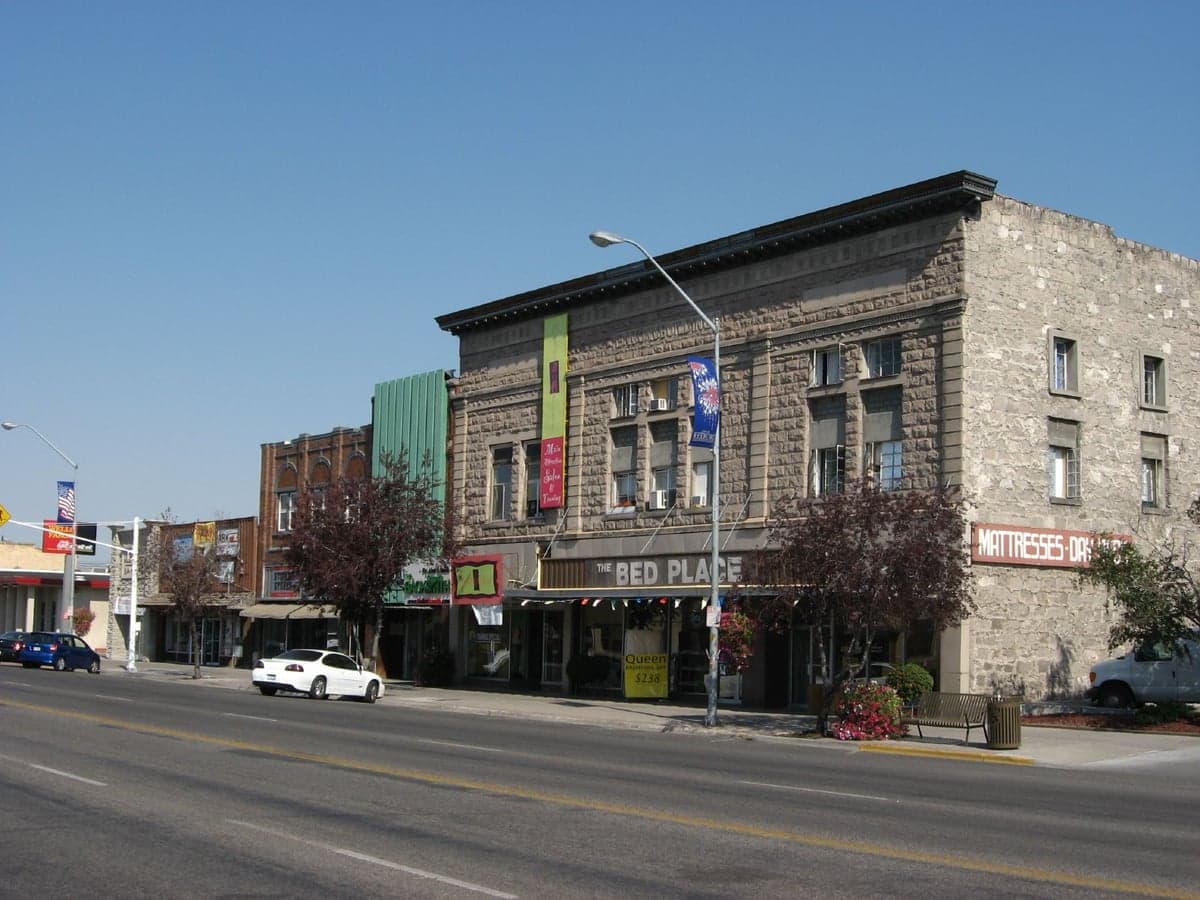
Rexburg, Idaho, is a predominantly white, family-oriented college town with a strong Latter-day Saint (LDS) cultural identity, shaped by its history as an agricultural settlement and the presence of Brigham Young University-Idaho (BYU-Idaho). With a population of 39,589, the city is notably young and educated, with 40.8% of residents holding a college degree, and it remains one of the least ethnically diverse cities in the state. The population is overwhelmingly native-born (95.0%), with a small but growing Hispanic community (11.3%) and a tiny East/Southeast Asian presence (1.8%), reflecting a community that is stable, religiously observant, and oriented toward family life and higher education.
How the city was settled and grew
Rexburg was founded in 1883 by LDS pioneers sent by church leaders to settle the Upper Snake River Valley for agriculture. The original settlers were predominantly of Northern European descent—English, Scandinavian, and Welsh converts to Mormonism—who established a grid of farms and a small town center. The city’s growth was driven by the construction of the Rexburg Tabernacle (1911) and the establishment of Ricks College (1888), a junior college that later became BYU-Idaho. The historic College District, centered around the university campus, was built by these early LDS families, who constructed modest homes and meetinghouses. The South Rexburg area, along the Teton River, became the heart of the agricultural community, with large farmsteads and grain elevators. The North Rexburg neighborhood, near the railroad depot, housed merchants and tradespeople who served the farming population. By 1950, the population was nearly 100% white and LDS, with a strong sense of religious and cultural cohesion.
Modern era (post-1965)
The post-1965 era brought significant change through the expansion of Ricks College into a four-year university (BYU-Idaho, 2001) and the growth of the LDS Church’s missionary and educational programs. The student population surged, drawing young LDS singles and families from across the U.S. and abroad, though the city’s racial composition remained overwhelmingly white. The University Village neighborhood, built in the 1990s and 2000s, became a hub for student housing, with apartment complexes and townhomes catering to the influx. The Bella Vista subdivision, developed in the 2000s, attracted young families and faculty, with larger single-family homes and a suburban feel. The Hispanic population grew modestly, from under 5% in 2000 to 11.3% by 2020, concentrated in the West Rexburg area near the industrial parks and agricultural processing plants, where many work in food production and construction. The East/Southeast Asian population (1.8%) is almost entirely composed of international students and faculty at BYU-Idaho, living in the College District and University Village. The Black population (1.1%) and Indian subcontinent population (0.0%) remain negligible, reflecting the city’s limited draw for non-LDS or non-white migrants.
The future
Rexburg’s population is projected to continue growing slowly, driven by BYU-Idaho’s enrollment (currently around 36,000 students) and the city’s appeal to LDS families seeking a safe, affordable, and religiously aligned community. The population is likely to become slightly more diverse, with the Hispanic share expected to rise to 15-18% by 2040, as families settle in the West Rexburg and South Rexburg areas for work in agriculture and services. The East/Southeast Asian population may grow modestly as BYU-Idaho recruits more international students, but it will remain a small fraction of the total. The white LDS majority will persist, with new subdivisions like Porter Park and Rexburg Meadows attracting young families from other LDS-heavy regions of the West. The city’s cultural identity will remain strongly tied to the LDS Church and BYU-Idaho, with limited secularization or ethnic diversification. For a new resident, Rexburg offers a stable, religiously conservative environment with a young, educated population, but little racial or cultural variety.
Rexburg is becoming a more established college town with a growing Hispanic working class, but its core identity as a white, LDS, family-oriented community will endure. For someone moving in now, the city offers a predictable, safe, and affordable lifestyle centered on church and university life, with limited exposure to the ethnic and cultural diversity found in larger Idaho cities like Boise or Idaho Falls.

* Values derived from national, state, county, city and local statistics and may differ in a specific area. Last updated: 2026-07-13T09:59:13.000Z
Narrative content on this page is AI-generated and may contain mistakes. Verify any details that matter before acting on them.
ReloMaps may earn a commission from affiliate links at no extra cost to you.

