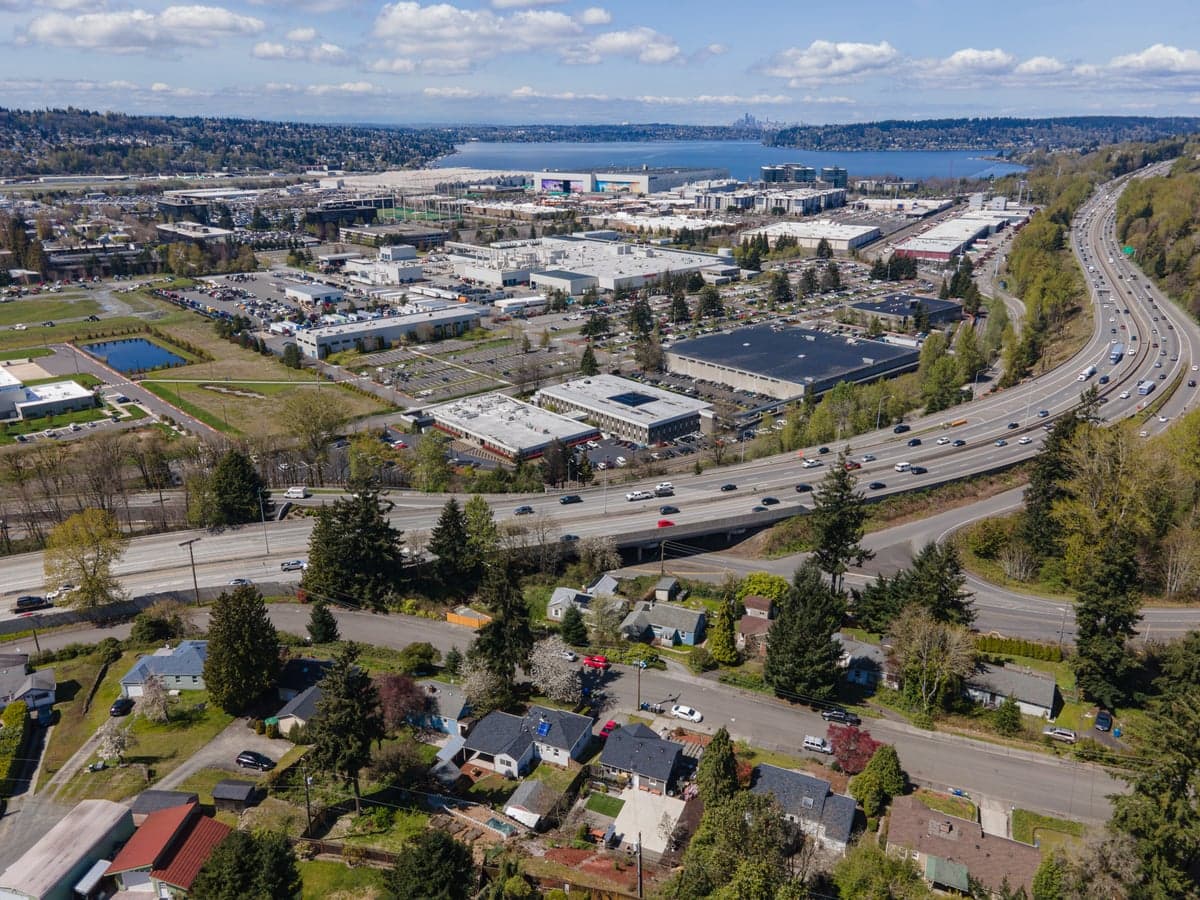
Photo: Wikipedia
Personal Sovereignty in Renton, WA
Viable for self-reliance. Generally workable, though some barriers may limit total independence.
What does Personal Sovereignty tell us?
Personal Sovereignty measures your capacity for self-reliance and independence with minimal government friction. Higher scores mean fewer barriers between you and the way you want to live... but it assumes you have the space you need and good neighbors.
What does this tell us?
Personal Sovereignty measures your capacity for self-reliance and independence with minimal government friction. Higher scores mean fewer barriers between you and the way you want to live... but it assumes you have the space you need and good neighbors.
State Policy
Energy independence: Importer (55% of energy produced in-state)
Personal Liberty
Homesteading

Personal Liberty Analysis
Renton, Washington presents a mixed personal sovereignty environment where state-level progressive policies often override local preferences, creating a regulatory landscape that leans interventionist on taxation, firearms, and property rights. While King County’s third-largest city offers proximity to outdoor recreation and a growing job market anchored by Boeing and Paccar, residents face a state income tax that is effectively zero (Washington has no personal income tax) but high sales taxes (10.1% in Renton as of 2026) and property taxes that rank among the top 10 nationally. For a conservative-leaning individual or family prioritizing autonomy, Renton’s appeal lies in its economic opportunity and natural setting, but the trade-off is a dense web of state mandates that limit local control over everything from energy codes to land use.
Tax burden and regulatory posture in Renton compared to surrounding areas
Washington’s lack of a personal income tax is a significant draw for sovereignty-minded residents, but the state compensates with some of the highest sales and property taxes in the country. Renton’s combined state and local sales tax rate of 10.1% is among the highest in King County, and property taxes in the Renton School District average roughly 1.1% of assessed value, which on a $600,000 home translates to about $6,600 annually. The state’s regulatory posture is notably heavy-handed in areas like energy efficiency (Washington mandates strict building codes for new construction, including heat pumps and electric vehicle charging infrastructure) and environmental permitting (the State Environmental Policy Act, or SEPA, can delay or block development projects). Compared to neighboring jurisdictions like unincorporated King County or rural Pierce County, Renton’s city-level regulations add layers: a tree canopy ordinance restricts removal of large trees on private property, and the city’s zoning code limits home-based businesses more tightly than state law requires. For a family looking to minimize tax exposure or regulatory friction, Renton is not a low-touch environment; it sits firmly in the high-regulation, high-tax quadrant of Washington cities, though still less burdensome than Seattle or Bellevue.
Self-defense and gun law specifics in Renton and Washington State
Washington’s firearm laws have tightened significantly since 2020, and Renton residents must navigate a state-level framework that is among the most restrictive in the Pacific Northwest. The state bans the sale of semi-automatic rifles to anyone under 21, requires a 10-day waiting period for all firearm purchases (including handguns), and mandates a background check for private transfers. Magazine capacity is capped at 10 rounds for rifles and 15 rounds for handguns, and open carry of firearms in public is legal only with a valid concealed pistol license (CPL) in cities with populations over 100,000—Renton qualifies. The CPL process itself is shall-issue for residents who pass a background check and complete a firearms safety course, but the state’s “red flag” law allows law enforcement or family members to petition for temporary firearm removal without a criminal conviction. Self-defense law in Washington follows a “no duty to retreat” standard in places where a person is lawfully present, but the state’s castle doctrine is narrower than in many conservative states: deadly force is justified only if the intruder is committing a violent felony or entering with intent to commit one, and the burden of proof falls on the defender in civil suits. For a gun owner, Renton’s local police department generally enforces state law without additional city-level restrictions, but the overall environment is one of increasing regulation—not a haven for those seeking maximal Second Amendment autonomy.
Self-reliance and homesteading viability in Renton’s zoning and land-use rules
Renton’s urban character and zoning codes make traditional homesteading or off-grid living largely impractical within city limits. The median lot size for single-family homes in Renton is about 7,000 square feet, with many newer subdivisions on lots under 5,000 square feet. City zoning prohibits keeping livestock (chickens are allowed with a permit, but no goats, pigs, or horses) and restricts accessory dwelling units (ADUs) to one per lot, with strict size and parking requirements. Off-grid systems like solar panels are permitted but must connect to the grid under state net-metering rules; standalone battery storage is allowed but subject to building permits and fire code inspections. Rainwater collection for potable use is legal in Washington but requires a permit from the Department of Health, and composting toilets are not allowed in homes connected to municipal sewer. For a family seeking true self-reliance—growing food, generating power, or living without utility hookups—Renton’s suburban density and city ordinances are a significant barrier. The most viable option for homesteading within commuting distance of Renton is to look east toward the Cascade foothills (e.g., Maple Valley or Enumclaw) or south toward rural Pierce County, where lot sizes of 1-5 acres are common and zoning allows livestock, private wells, and septic systems. Within Renton itself, the best a sovereignty-minded resident can do is maximize a small urban lot with raised garden beds, a greenhouse, and solar panels—but full self-sufficiency is not realistic.
Personal liberties in Renton: parental rights, medical autonomy, speech, and property
Washington state law preempts many local ordinances on personal liberties, creating a uniform but often progressive baseline that Renton cannot alter. Parental rights in education are limited: the state mandates that schools adopt policies allowing students to use their chosen name and pronouns without parental notification, and sex education curricula (including LGBTQ+ content) are required in all public schools. Medical autonomy is similarly constrained: Washington has no parental consent requirement for minors to receive reproductive health services (including abortion) or gender-affirming care, and the state’s shield laws protect providers who offer such care to out-of-state patients. Free speech protections follow First Amendment standards, but Renton’s noise ordinances and public assembly permits can be used to limit protests or expressive activity in residential areas. Property rights are notably weak in Washington: the state’s Growth Management Act (GMA) forces cities to adopt urban growth boundaries that restrict development on rural land, and Renton’s shoreline master program limits construction near Lake Washington and the Cedar River. For a conservative family, the most concerning liberty issue is likely the erosion of parental authority in medical and educational decisions—a trend that is baked into state law and unlikely to change at the local level. On the positive side, Washington’s strong property rights protections against eminent domain (the state requires “just compensation” and a public use test) offer some security, and Renton’s city council has not enacted rent control or tenant protection ordinances beyond state minimums.
Overall, Renton offers a personal sovereignty profile that is moderate by Washington standards but restrictive compared to states like Idaho, Texas, or Florida. The absence of a state income tax is a genuine advantage for financial autonomy, but high sales and property taxes, tight gun laws, limited homesteading potential, and state preemption of parental and medical rights create a net environment where individual freedom is constrained by progressive policy at the state level. For a relocation-minded conservative, Renton works best as a compromise: strong job market, outdoor access, and a diverse community, but with the understanding that many personal sovereignty decisions are made in Olympia, not at City Hall. If maximizing autonomy is the top priority, rural areas east of the Cascades or south toward Oregon offer a lighter regulatory touch—but for those who need to stay in the Seattle metro for work or family, Renton is a pragmatic choice that requires active engagement with state politics to protect personal liberties.

* Values derived from national, state, county, city and local statistics and may differ in a specific area. Last updated: 2026-09-03T05:07:46.000Z
Narrative content on this page is AI-generated and may contain mistakes. Verify any details that matter before acting on them.
ReloMaps may earn a commission from affiliate links at no extra cost to you.

