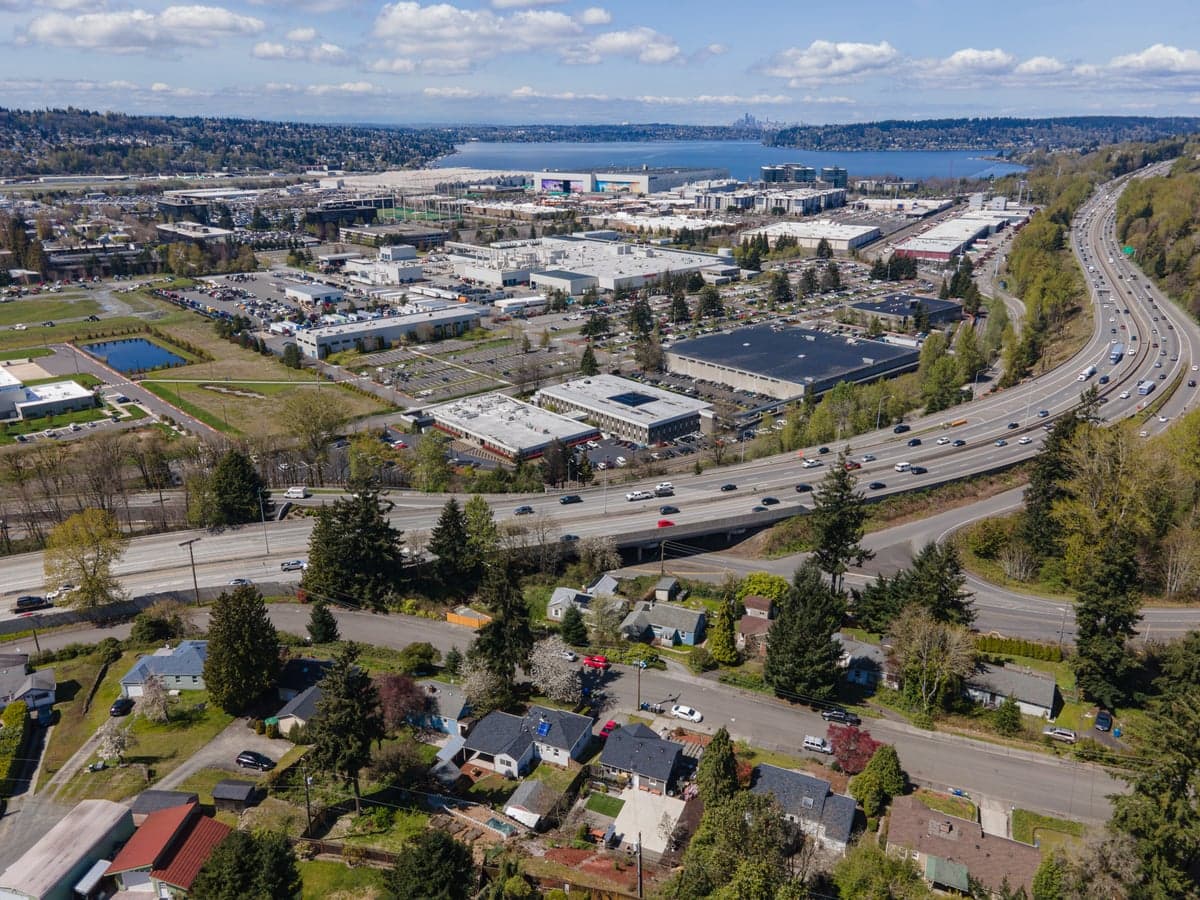
Photo: Wikipedia
Demographics of Renton, WA
Affluence Level in Renton, WA
An upper-middle-class area. Household wealth, education levels, and homeownership run ahead of national benchmarks.
People of Renton, WA
The people of Renton, Washington today form a strikingly diverse, majority-minority city of 105,279, where no single racial or ethnic group holds a numerical majority. White residents make up 40.4% of the population, while East and Southeast Asian communities account for 22.9%, Hispanic or Latino residents 14.6%, Black residents 8.9%, and Indian subcontinent residents 2.9%. This demographic mosaic, shaped by successive waves of industrial employment and immigration, gives Renton a distinctive character as a working-class city with a growing professional class, anchored by Boeing’s massive assembly plant and a rapidly expanding tech corridor along Lake Washington.
How the city was settled and grew
Renton’s human history begins with the Duwamish and Snoqualmie peoples, who lived along the Cedar River for millennia before white settlement. The modern city was founded in 1875 when Captain William Renton established a coal-mining operation, drawing a first wave of European immigrants—primarily Welsh, Irish, and German miners—who settled in the Renton Hill neighborhood near the original mine shafts. The arrival of the Northern Pacific Railway in the 1880s transformed Renton into a coal-shipping hub, and the town incorporated in 1901 with fewer than 500 residents. The early 20th century brought a second wave: Scandinavian loggers and millworkers, who built homes in the Kennydale area along the lake, and Japanese immigrant laborers who worked in the coal mines and railroad yards, establishing a small but vibrant community near downtown. Boeing’s decision to build its first major plant in Renton in 1941 during World War II triggered the city’s explosive growth. The wartime influx of workers from the Midwest and South—many of them Black families fleeing Jim Crow—settled in the Sunset and Benson Hill neighborhoods, creating the foundation of Renton’s Black community. By 1950, the population had surged past 16,000, and the city’s identity as a blue-collar aerospace town was firmly set.
Modern era (post-1965)
The 1965 Immigration and Nationality Act opened doors that reshaped Renton’s population dramatically. The first major post-1965 wave came from East and Southeast Asia: Vietnamese refugees after 1975, followed by Filipino, Korean, and Chinese immigrants drawn to Boeing’s engineering and manufacturing jobs. These communities concentrated in the Highlands neighborhood, where Asian-owned businesses now line Sunset Boulevard, and in the Talbot Hill area near the Boeing plant. The 1980s and 1990s saw a surge of Hispanic immigration, primarily from Mexico and Central America, as construction and service-sector jobs expanded alongside the region’s tech boom. Hispanic residents settled heavily in the Benson Hill and Fairwood areas, where they now represent over 20% of the population in some census tracts. The most recent wave, beginning around 2000, brought Indian subcontinent professionals—engineers and IT workers—who clustered in the Newcastle area (technically unincorporated but closely tied to Renton) and the newer developments around The Landing, Renton’s mixed-use retail and residential district. Today, 11.6% of Renton’s population is foreign-born, and the city’s public schools serve students speaking over 80 languages. The Black population, which peaked at around 12% in the 1990s, has declined slightly to 8.9% as some families moved to more affordable suburbs farther south, while the Asian share has grown steadily from 10% in 1990 to nearly 23% today.
The future
Renton’s population is becoming more diverse and more educated simultaneously. The share of college-educated adults now stands at 39.0%, up from 28% in 2010, driven by the expansion of tech employers like Amazon, Microsoft, and Boeing’s engineering divisions. The Asian and Indian subcontinent populations are projected to continue growing, as the city’s proximity to Seattle and Bellevue tech hubs makes it a relatively affordable alternative for skilled immigrants. Hispanic growth is also expected to remain steady, fueled by family reunification and service-sector employment. The white population, while still the largest single group, is aging and declining as a share, a trend common across the Puget Sound region. New residential construction is concentrated in the Downtown Renton and The Landing districts, where luxury apartments and townhomes are attracting younger, higher-income residents—many of them white and Asian professionals—while the older single-family neighborhoods like Kennydale and Benson Hill remain more diverse and family-oriented. The city’s cultural identity is evolving from a blue-collar aerospace town into a multiethnic, mixed-income suburb with a growing professional class, though Boeing remains the largest employer and a powerful cultural anchor.
For someone moving to Renton now, the city offers a rare combination: genuine racial and economic diversity, a strong industrial heritage, and growing opportunities in tech and aerospace. The population is becoming more Asian and more educated, but the city retains a working-class backbone that distinguishes it from the more uniformly affluent suburbs to the north and east. New arrivals will find a place where neighborhoods have distinct ethnic identities, where the schools are improving but still face challenges, and where the sense of community is rooted in the shared experience of building airplanes and raising families.

* Values derived from national, state, county, city and local statistics and may differ in a specific area. Last updated: 2026-09-03T05:07:46.000Z
Narrative content on this page is AI-generated and may contain mistakes. Verify any details that matter before acting on them.
ReloMaps may earn a commission from affiliate links at no extra cost to you.

