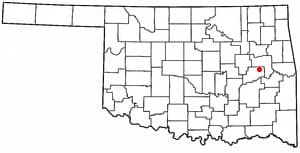
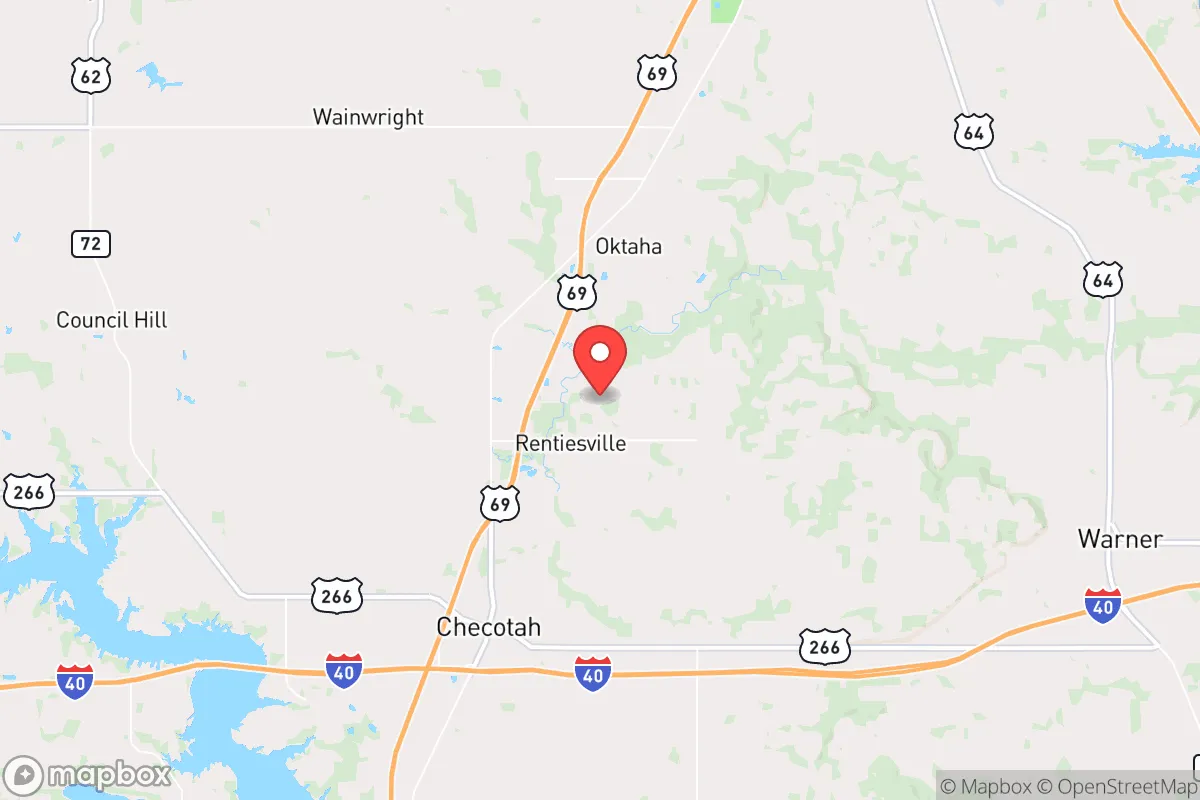
Photo: Wikipedia
Political ClimatePolitical Climate in Rentiesville, OK
District shown is the primary district for this city’s centroid. Cities may span multiple districts.
Inherited from parent county — no local data available.
* Lean and PVI are calculated from the surrounding county’s 2020 and 2024 presidential results, Cook-style — a finer measure here than its congressional district (OK-2).
Political rankings in Oklahoma
- Most Conservative Cities in Oklahoma
- Most Liberal Cities in Oklahoma
- Best Liberal-Leaning Towns in the South
- Safest Liberal-Leaning Towns in the South
- Safest Conservative-Leaning Towns in the South
- Affordable Small Towns for Conservatives
- Most Affordable Liberal-Leaning Small Towns in the U.S.
- Safest Conservative-Leaning Cities in the U.S.
- Most Conservative Counties in Oklahoma
- Most Liberal Counties in Oklahoma
Local Political AnalysisPolitical Analysis of Rentiesville, OK
Rentiesville, Oklahoma, is about as deep red as it gets in a state that's already deep red. The town sits in McIntosh County, which has a Cook Partisan Voting Index of R+27, meaning it votes nearly thirty points more Republican than the national average. That's a full nine points more conservative than Oklahoma's statewide PVI of R+18, and it's not a new trend—this area has been reliably Republican for decades, with the shift accelerating after the 2000s as rural communities across eastern Oklahoma moved further right. If you're looking for a place where the political needle barely moves election to election, this is it.
How it compares
To understand Rentiesville's politics, you have to look at the surrounding landscape. The town is a small, unincorporated community in a county that's overwhelmingly white, older, and heavily reliant on agriculture and energy jobs—demographics that lean hard Republican. Compare that to Oklahoma City or Tulsa, which have PVI scores closer to R+12 and R+15 respectively, and you see the gap. Even nearby Muskogee, about 20 miles north, is slightly less conservative at R+20, thanks to a more diverse economy and a small but notable Native American and Black population. Rentiesville itself is historically a Black town, founded by formerly enslaved people after the Civil War, but today its voting patterns mirror the surrounding county's rural conservatism rather than the more Democratic-leaning urban Black communities in places like Tulsa's Greenwood district. The contrast is stark: you can drive 30 minutes to Eufaula or Checotah and find similar politics, but head west to Okmulgee or south to McAlester, and you'll see slightly more moderate pockets, though still solidly red.
What this means for residents
For conservative residents, Rentiesville is a comfortable fit. Local elections are rarely competitive, and the county commission, school board, and sheriff's office are reliably Republican. You'll find churches, gun shops, and "God Bless America" signs without much pushback. For liberal residents, it's a different story. There's no active Democratic party presence in McIntosh County, and progressive candidates often struggle to get on the ballot. Socially, you might feel isolated if you're vocal about your views, but most folks keep politics neighborly—it's a small town where everyone knows each other, and ideological differences rarely cause open conflict. The practical impact is that policy leans heavily toward low taxes, limited regulation, and Second Amendment rights, with little appetite for public transit, affordable housing initiatives, or environmental restrictions. If you're moving here, expect a hands-off government that prioritizes rural interests over urban ones.
Culturally, Rentiesville stands out for its history. The town hosts the annual Rentiesville Blues Festival and the Oklahoma Blues Hall of Fame, a nod to its deep musical roots. But politically, that heritage doesn't translate to a more progressive tilt—it's a place where tradition and self-reliance are valued above all. The trajectory looks steady: as Oklahoma's rural areas continue to age and depopulate, Rentiesville will likely stay R+27 or even drift further right, while the state as a whole may inch toward R+20 as suburbs grow. For anyone considering a move, the takeaway is simple: if you're conservative, you'll feel at home; if you're liberal, you'll need to find your community in nearby towns or online. Either way, the pace of life is slow, the politics are predictable, and the people are genuine.

State Political ClimatePolitical Climate in Oklahoma
State Political AnalysisPolitical Environment in the State
Oklahoma is one of the most reliably Republican states in the country, with a Cook Partisan Voting Index of R+18, meaning it votes about 18 points more Republican than the national average. Over the past 20 years, the state has shifted sharply rightward—George W. Bush won it by 31 points in 2004, but Donald Trump carried it by 33 points in 2020 and by a similar margin in 2024. The dominant coalition is a mix of rural conservatives, evangelical Christians, and oil-and-gas interests, with Democrats now largely confined to a few urban pockets and tribal communities. For a relocator, this means state policy consistently reflects conservative priorities, but the degree of that conservatism varies noticeably depending on where you land.
Urban vs. rural divide
The political map of Oklahoma is a textbook study in urban-rural polarization. Oklahoma City and Tulsa are the two blue-ish anchors, but even they are not uniformly liberal. Oklahoma County (OKC) voted for Trump by 8 points in 2024, while Tulsa County went for Trump by 15 points—both are competitive but still lean right. The real Democratic strongholds are Norman (home to the University of Oklahoma) and Stillwater (Oklahoma State), where college-town dynamics produce pockets of blue. Meanwhile, the rural panhandle and small towns like Guymon, Woodward, and McAlester routinely vote 80%+ Republican. The most notable shift in the last decade has been the suburban ring around Oklahoma City—places like Edmond, Yukon, and Mustang—which have moved from competitive to solidly red as conservative families fled the city core. Conversely, Lawton (home to Fort Sill) and Ponca City have become more Republican as military and energy workers align with the national GOP.
Policy environment
Oklahoma’s policy environment is aggressively conservative. The state has a flat income tax of 4.75% (down from 5% in 2022, with a trigger to drop to 3.99% if revenue targets are met), no estate tax, and a state sales tax of 4.5% (local add-ons can push it to 10%+ in some cities). Property taxes are among the lowest in the nation, averaging about 0.9% of assessed value. Education policy is a flashpoint: the state has one of the nation’s broadest school voucher programs (the Oklahoma Parental Choice Tax Credit Act, passed in 2023), allowing families up to $7,500 per child for private school expenses. Healthcare is limited—Oklahoma did expand Medicaid under the 2020 voter-approved State Question 802, but the state legislature has since added work requirements and premiums for able-bodied adults. Election laws are strict: voter ID is required, absentee ballot applications must be notarized (unless the voter is military or overseas), and early voting is limited to three days before an election. The state also has a constitutional carry law (permitless carry for adults 21 and over, passed in 2019) and a near-total abortion ban (SB 612, 2022, with no exceptions for rape or incest).
Recent policy direction
The last five years have seen Oklahoma accelerate its conservative trajectory across multiple fronts. On gun rights, the 2019 constitutional carry law was followed in 2023 by HB 3095, which prohibits state and local enforcement of federal gun laws deemed unconstitutional (a “Second Amendment Sanctuary” measure). On parental and education rights, the 2022 “Parental Bill of Rights” (HB 1775) bans teaching of certain concepts about race and gender, and the 2023 “Save Women’s Sports Act” (SB 200) bars transgender girls from female school sports. On speech and privacy, the state passed a law in 2023 (SB 101) requiring social media platforms to verify the age of users and obtain parental consent for minors. On medical and bodily autonomy, the near-total abortion ban is paired with a 2023 law (HB 1020) that allows doctors to refuse to perform procedures they object to on moral or religious grounds. On property rights, the state has a strong “right to farm” constitutional amendment (State Question 777, passed in 2016) that protects agricultural practices from local regulation. On taxation, the 2024 legislative session passed a bill to gradually eliminate the state income tax entirely, contingent on revenue growth. On voting and ballot access, the 2023 “Election Integrity Act” (SB 440) shortened the absentee ballot request window and increased penalties for ballot harvesting. For a relocator, the net effect is a state that is actively expanding individual liberty in some areas (guns, taxes, school choice) while restricting it in others (abortion, transgender rights, certain speech).
Civil unrest & political movements
Oklahoma has a history of populist and anti-establishment movements, from the 1995 Oklahoma City bombing to the 2014 “Oklahoma Sharia” controversy (a failed attempt to ban foreign law in courts). In recent years, the most visible flashpoints have been around education funding and tribal sovereignty. The 2018 teacher walkout—one of the largest in U.S. history—saw 30,000 educators and supporters rally at the state capitol, leading to a $6,000 average teacher pay raise. On the right, the “Oklahoma Freedom Caucus” has become a powerful force in the legislature, pushing for further tax cuts, school choice expansion, and anti-ESG (environmental, social, and governance) investing laws. Immigration politics are heated: in 2024, the state passed HB 4156, which makes it a state crime to be in Oklahoma without legal immigration status, mirroring Texas’s SB 4. Sanctuary policies are nonexistent—the state has a 2019 law (SB 452) that penalizes cities that adopt sanctuary ordinances. Election integrity remains a live issue: after the 2020 election, the state conducted a forensic audit of voting machines in 22 counties (finding no widespread fraud), but the legislature still passed tighter absentee ballot rules. Nullification rhetoric is common among the far right, particularly around federal gun laws and marijuana enforcement (Oklahoma legalized medical marijuana in 2018 via State Question 788, but recreational use remains illegal). A new resident would notice the ubiquity of “Don’t Tread on Me” flags and the occasional “Secede” bumper sticker, but these are more cultural signaling than serious political movements.
Projection
Over the next 5-10 years, Oklahoma is likely to become more Republican, not less, driven by two demographic trends. First, in-migration from California and Texas—many of them conservatives seeking lower taxes and less regulation—is accelerating, particularly in the Oklahoma City suburbs and the Tulsa exurbs. Second, rural depopulation is concentrating GOP voters in already-red areas, while the urban cores of OKC and Tulsa are growing but not fast enough to flip the state. The Native American population (about 14% of the state) is a wildcard: tribal nations like the Cherokee, Choctaw, and Chickasaw have become more politically active, particularly around sovereignty issues (the 2020 McGirt v. Oklahoma Supreme Court decision affirmed that much of eastern Oklahoma remains tribal land for criminal jurisdiction). This could create friction with state authorities, but it’s unlikely to shift the partisan balance. The income tax elimination trajectory, if realized, would make Oklahoma even more attractive to conservative relocators, while the abortion ban and transgender restrictions will continue to deter liberal newcomers. Expect the state to remain a laboratory for conservative policy, with the legislature pushing further on school choice, gun rights, and anti-ESG measures.
For a new resident, the bottom line is straightforward: Oklahoma is a deeply conservative state where your experience will vary dramatically by location. If you’re a conservative family, the suburbs of Edmond or Broken Arrow offer excellent schools, low taxes, and a community that shares your values. If you’re a liberal individual, you’ll find a more welcoming environment in Norman or the Plaza District in Oklahoma City, but you’ll still be voting in a state where your presidential candidate loses by 30 points. The state’s policy direction is clear and accelerating—if you’re comfortable with that, you’ll find a lot to like. If you’re not, you’ll be swimming against a strong current.
* Values derived from national, state, county, city and local statistics and may differ in a specific area. Last updated: 2026-11-19T20:27:57.000Z
Narrative content on this page is AI-generated and may contain mistakes. Verify any details that matter before acting on them.
ReloMaps may earn a commission from affiliate links at no extra cost to you.

