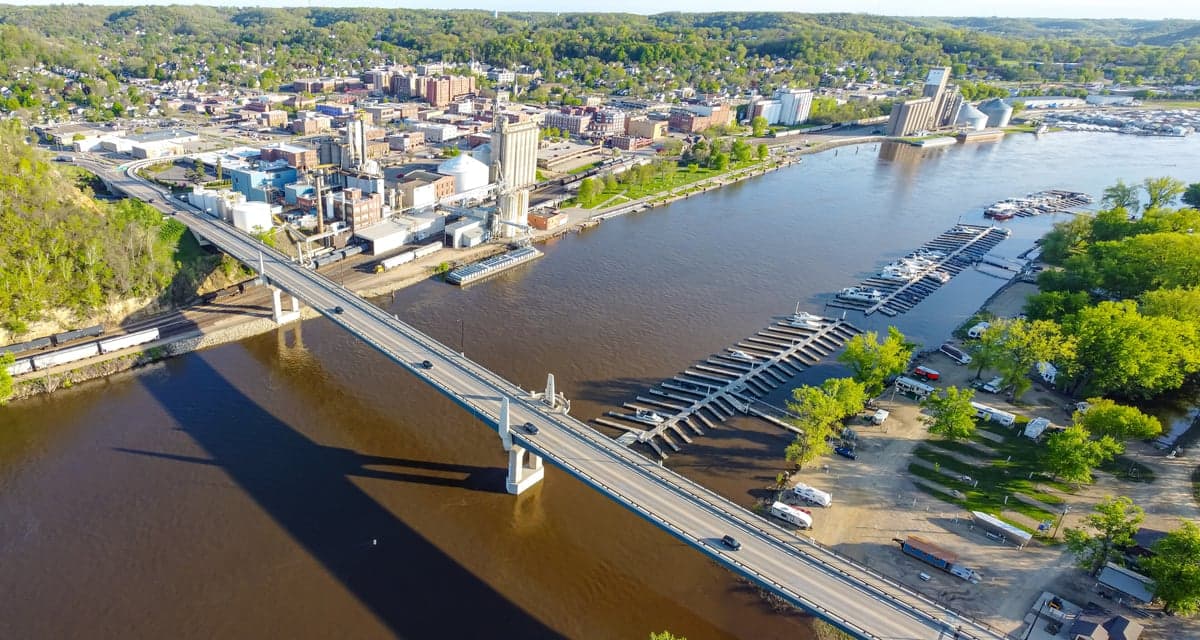
Photo: Wikipedia
Political ClimatePolitical Climate in Red Wing, MN
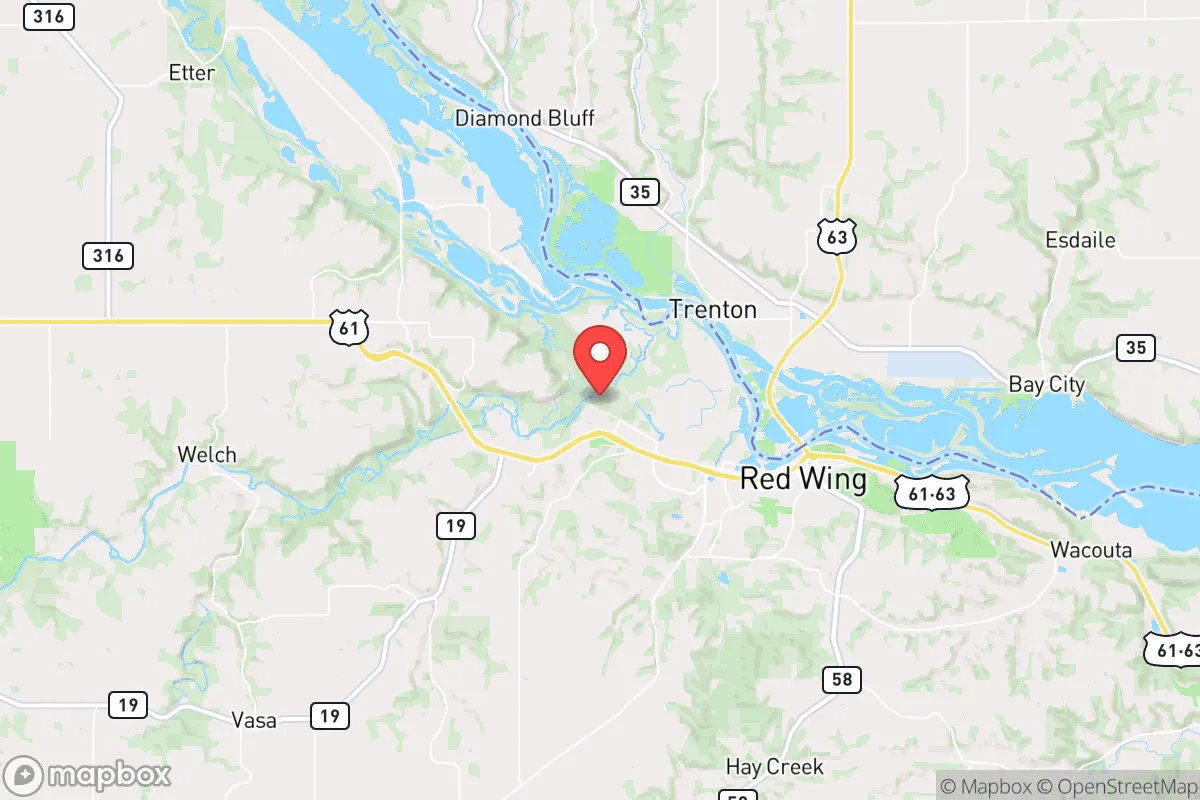
District shown is the primary district for this city’s centroid. Cities may span multiple districts.
Lean and PVI are calculated from Red Wing, MN’s own 2020 and 2024 presidential results, Cook-style. Sources: state election offices; VEST 2020 precinct results (CC BY 4.0).
Political rankings in Minnesota
- Most Conservative Cities in Minnesota
- Most Liberal Cities in Minnesota
- Best Liberal-Leaning Towns in the Midwest
- Safest Liberal-Leaning Towns in the Midwest
- Safest Conservative-Leaning Towns in the Midwest
- Affordable Small Towns for Conservatives
- Most Affordable Liberal-Leaning Small Towns in the U.S.
- Safest Conservative-Leaning Cities in the U.S.
- Most Conservative Counties in Minnesota
- Most Liberal Counties in Minnesota
Local Political AnalysisPolitical Analysis of Red Wing, MN
Red Wing leans reliably Republican, with a Cook Partisan Voting Index (PVI) of R+9, meaning the area votes about nine points more conservative than the national average. That’s a solid red pocket in a state that’s been a blue-leaning battleground for decades. But if you’ve lived here a while, you know the story isn’t as simple as a single number—the political reality is more about a quiet, pragmatic conservatism than any loud partisan fervor. The trajectory has been fairly stable over the past decade, with the city itself showing slightly more moderation than the surrounding rural townships, though the overall trend mirrors the broader state shift toward sharper polarization.
How it compares
Compared to Minnesota as a whole, Red Wing is a clear outlier. The state’s Cook PVI is unknown in the provided data, but it’s widely considered a D+1 or D+2 lean in recent cycles—meaning the state tilts slightly Democratic. Red Wing’s R+9 puts it roughly 10 points to the right of the state average. That gap becomes obvious when you drive 45 minutes west to Rochester, which leans more moderate-to-liberal thanks to the Mayo Clinic’s workforce, or an hour north to the Twin Cities metro, where Democratic margins are heavy. On the flip side, head 20 minutes south to Lake City or east to Ellsworth, Wisconsin, and you’ll find even redder territory. Inside Goodhue County, Red Wing is the political center-left; the smaller towns like Cannon Falls and Zumbrota are more conservative, while the city itself has a noticeable progressive minority, especially among younger residents and those tied to the local college or healthcare sectors.
What this means for residents
For conservative residents, Red Wing feels like a comfortable place to live without the constant political friction you might find in a deep-blue suburb. Local elections tend to favor center-right candidates, and issues like property taxes, school funding, and small business regulation dominate the conversation. You’ll see plenty of Trump signs in yards during election season, but the local GOP is more Chamber of Commerce than firebrand. For liberal residents, life here is manageable but requires some navigation. You’ll find like-minded folks at the library events, the farmers market, or through the local Democratic-Farmer-Labor Party chapter, but you won’t see many progressive policy wins at the city council level. The practical effect is that both sides tend to get along day-to-day—neighbors help each other with snow removal regardless of bumper stickers—but the political ceiling for progressive initiatives is low.
Culturally, Red Wing stands out for its strong sense of local identity that transcends party lines. The city’s historic downtown, the Red Wing Shoe Company’s legacy, and the Mississippi River bluffs create a shared pride that softens partisan edges. Policy-wise, the city has maintained a relatively low tax burden compared to the metro, and zoning debates often pit property rights advocates against preservationists in a way that doesn’t break cleanly along party lines. Looking ahead, the area’s R+9 lean is likely to hold steady, though in-migration from the Twin Cities could nudge it slightly left over the next decade. For now, Red Wing offers a political climate where you can live your values without feeling like you’re in a war zone—a rarity in 2026.

State Political ClimatePolitical Climate in Minnesota
State Political AnalysisPolitical Environment in the State
Minnesota has shifted from a reliably purple swing state to a solidly blue one over the past two decades, driven by the explosive growth of the Twin Cities metro and a sharpening urban-rural divide. In 2024, Kamala Harris carried the state by roughly 4 points, a margin that has narrowed from the 7-point win Joe Biden posted in 2020 and the 1.5-point squeaker Hillary Clinton managed in 2016. The state’s political center of gravity now lies in Hennepin and Ramsey counties, which together cast enough votes to outweigh the rest of the state, while Greater Minnesota has swung hard in the opposite direction. For a conservative relocator, the practical reality is that you’ll be living under a unified Democratic state government, but the degree of that control varies enormously depending on whether you settle in the Iron Range, a lake-country exurb, or a Minneapolis neighborhood.
Urban vs. rural divide
The political map of Minnesota is a story of two states. The Twin Cities metro — Minneapolis, St. Paul, and their inner-ring suburbs like Bloomington and Richfield — is the engine of Democratic votes, routinely delivering 65-75% margins. The suburban ring has been the key battleground: places like Anoka County and Washington County were reliably red as recently as 2012 but have flipped blue, with college-educated voters in suburbs like Woodbury and Maple Grove shifting left. Meanwhile, rural and exurban counties have gone the opposite direction. St. Louis County, home to Duluth and the Iron Range, was once a Democratic stronghold but has become competitive as union miners and working-class voters have drifted right. The Rochester area, anchored by the Mayo Clinic, remains a moderate swing zone — it voted for Biden in 2020 but swung back toward Trump in 2024. The bottom line: if you’re a conservative looking for like-minded neighbors, you’ll find them in the outer exurbs like St. Cloud or the lake country around Brainerd, but you’ll be living in a state where the metro sets the political agenda.
Policy environment
Minnesota’s policy environment is defined by high taxes and a robust regulatory state, but with notable exceptions. The state has a progressive income tax with rates up to 9.85%, and property taxes are above the national average. There is no sales tax on clothing or groceries, which softens the blow for families. The regulatory posture is business-friendly in some sectors (agriculture, mining) but heavily restrictive in others (environmental permitting, labor). Education policy is a flashpoint: Minnesota has some of the nation’s strongest teacher unions, and the state recently eliminated the requirement for teacher licensing exams, a move that conservatives criticize as lowering standards. Healthcare is dominated by large systems like Mayo Clinic and HealthPartners, and the state runs its own health insurance exchange with relatively generous subsidies. Election laws are among the most accessible in the country — same-day voter registration, no-excuse absentee voting, and automatic voter registration at DMVs. For a conservative, the policy environment means you’ll pay more in taxes and deal with more state oversight, but you’ll also find strong public services, good schools, and a functional government.
Recent policy direction
The 2023-2024 legislative session was a watershed for Democrats, who held a trifecta for the first time in a decade and passed a sweeping agenda. On gun and self-defense law, the state enacted a red-flag law (extreme risk protection orders) and universal background checks for private sales, while leaving permitless carry untouched — a compromise that satisfied neither side. On parental and education rights, the legislature passed a law requiring school districts to provide LGBTQ-inclusive curricula and materials, and banned book bans in public schools, which conservatives see as an erosion of parental control. Medical and bodily autonomy saw the state codify abortion rights into law and protect gender-affirming care for minors, making Minnesota a regional sanctuary for those seeking such services. On property rights, the state tightened rent control rules and expanded tenant protections, which landlords argue reduces housing supply. Taxation saw a new 1% surcharge on high-income earners (over $1 million) and a child tax credit that sends up to $1,750 per kid to low- and middle-income families. Voting and ballot access expanded with automatic voter registration and pre-registration for 16- and 17-year-olds. The overall direction is clearly leftward, but the state has not gone as far as California or New York — there’s no statewide rent control, no ban on natural gas, and no assault weapons ban.
Civil unrest & political movements
Minnesota has been a national flashpoint for political movements since the 2020 murder of George Floyd in Minneapolis, which sparked the largest protests in the state’s history and a summer of civil unrest that included the burning of a police precinct. The aftermath saw a surge in both progressive activism (defund-the-police campaigns, rent strikes) and conservative backlash (the “Back the Blue” movement, a wave of sheriff elections won by hardline candidates). The state has a strong tradition of grassroots organizing on both sides: the Minnesota Freedom Fund (bail reform) and the Minnesota Gun Owners Caucus (gun rights) are both active and influential. Immigration politics are less heated than in border states, but the Twin Cities metro has a large Somali and Hmong population, and the state is a “sanctuary” in practice if not in law — local police generally do not cooperate with ICE detainers. Election integrity controversies have been muted compared to states like Arizona or Georgia, but the 2020 and 2024 results were contested by some rural county GOP parties. The most visible flashpoint for a new resident would be the political yard signs and bumper stickers — you’ll see “Let’s Go Brandon” and “In This House We Believe” in equal measure, often on the same block in swing suburbs.
Projection
Over the next 5-10 years, Minnesota is likely to remain blue but become more competitive, driven by two countervailing trends. On one hand, the Twin Cities metro continues to grow and diversify, with young professionals and immigrants moving in who lean Democratic. On the other hand, rural and exurban areas are depopulating and aging, but the remaining voters are becoming more conservative, and the state’s electoral map is becoming more polarized. The wild card is the Iron Range and northern Minnesota, where the decline of mining and the rise of renewable energy could shift economic loyalties. In-migration patterns are mixed: the state is gaining people from the coasts (especially California and New York) who tend to be liberal, but also from the Midwest (Wisconsin, Iowa) who are more moderate. A conservative moving in now should expect that the state’s political trajectory will continue leftward on social issues, but that the margin may narrow as rural voters turn out in higher numbers. The practical implication: if you’re a conservative, you’ll be in the minority in state politics, but you’ll have strong representation in the legislature from rural and exurban districts, and you’ll find a vibrant conservative community in places like St. Cloud, Brainerd, and the outer-ring suburbs.
For a new resident, the bottom line is that Minnesota is a high-tax, high-service state with a Democratic government that is actively expanding the social safety net and regulating gun ownership, while protecting abortion and transgender rights. If you’re a conservative, you’ll find the tax burden and regulatory environment frustrating, but you’ll also find excellent schools, clean air and water, and a functional government that delivers services. The political climate is intense but not hostile — you can live comfortably in a conservative exurb or small town and largely ignore the politics of the metro. Just know that the state’s direction is set in Minneapolis and St. Paul, and that direction is firmly leftward. If that’s a dealbreaker, you’re better off in the Dakotas or Iowa. If you can live with it, Minnesota offers a high quality of life with a political scene that, while polarized, is still more civil than many other states.
* Values derived from national, state, county, city and local statistics and may differ in a specific area. Last updated: 2026-11-23T04:54:22.000Z
Narrative content on this page is AI-generated and may contain mistakes. Verify any details that matter before acting on them.
ReloMaps may earn a commission from affiliate links at no extra cost to you.

