Photo: Wikipedia
Demographics of Red Wing, MN
Affluence Level in Red Wing, MN
A below-average socioeconomic profile. Incomes, home values, and educational attainment trail the U.S., with higher poverty and unemployment.
People of Red Wing, MN
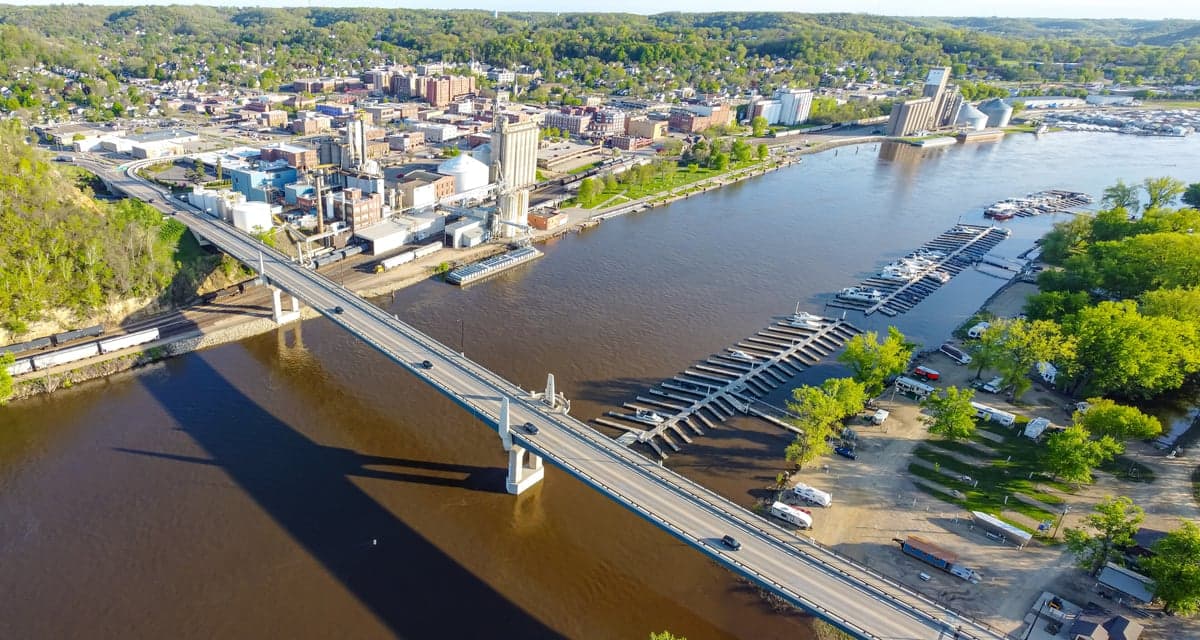
The people of Red Wing, Minnesota, today number 16,660, forming a community that is notably older and more rooted than the state average, with a strong sense of place shaped by its river bluff setting and industrial heritage. The city is predominantly white (85.0%), with a Hispanic population of 7.0% and a Black population of 3.2%, reflecting modest but steady diversification since the late 20th century. Its foreign-born share sits at just 3.1%, well below the national average, and the college-educated rate of 26.2% trails the state figure, pointing to a workforce historically tied to manufacturing and trades. Distinctive markers include a deep civic pride in the city’s pottery and shoe-making legacy, a visible Hmong community presence, and a population that remains concentrated in historic neighborhoods rather than sprawling outward.
How the city was settled and grew
Red Wing’s human history begins with the Dakota people, who established villages along the Mississippi River at the base of Barn Bluff, using the area as a seasonal gathering and trading site. The first permanent European-American settlers arrived in the 1850s, drawn by the river’s commercial potential and the promise of fertile bottomland. These early settlers—primarily Yankees from New England and German immigrants—built the city’s first frame houses in what is now the West End Historic District, a neighborhood of Greek Revival and Italianate homes that still anchors the city’s architectural identity. By the 1870s, the arrival of the railroad and the founding of the Red Wing Stoneware Company (later Red Wing Pottery) triggered a second wave: skilled Swedish and Norwegian craftsmen who settled in the North End around the pottery works, building modest clapboard houses and forming the core of the city’s Scandinavian character. A third wave came between 1900 and 1920, when the Red Wing Shoe Company expanded, drawing Polish and Czech laborers into the South End near the factory, a neighborhood of small bungalows and duplexes that remains working-class today. By 1950, the city was nearly 99% white, with a population of about 10,000, and its ethnic enclaves—Swedish in the North End, Polish in the South End, German scattered across the West End—were well established.
Modern era (post-1965)
The post-1965 period brought the first significant non-European immigration to Red Wing. Following the end of the Vietnam War, a small but visible Hmong refugee community settled in the city, drawn by entry-level jobs at the shoe factory and the meatpacking plant in nearby Zumbrota. These families concentrated in the Central Park neighborhood, a grid of postwar ranches and split-levels east of downtown, where a Hmong mutual assistance association formed and a handful of Asian grocery stores opened. The Hispanic population began growing in the 1990s, driven by Mexican and Central American workers recruited for seasonal agricultural labor and later for manufacturing. They settled primarily in the South End and along Old West Main Street, where rental duplexes and older single-family homes offered affordable entry points. The Black population, which grew from negligible to 3.2% by 2020, arrived more diffusely, with families moving in from the Twin Cities for lower housing costs and jobs at the county government center and the local hospital. Unlike the Hmong and Hispanic communities, Black residents did not form a single concentrated neighborhood, instead dispersing across the West End and Central Park. The city’s overall racial composition shifted slowly: the white share dropped from 97% in 1990 to 85% in 2020, while the Hispanic share rose from 1% to 7%, and the Asian (East/Southeast Asian) share reached 0.9%, almost entirely Hmong. The Indian-subcontinent population remains at 0.0%.
The future
Red Wing’s population is projected to remain stable or decline slightly over the next decade, as the city’s median age (42.3) and low birth rate limit natural growth. The foreign-born share is likely to increase modestly, driven by continued Hispanic in-migration for manufacturing and service jobs, but will remain far below the national average. The Hmong community, now in its third generation, is seeing younger members move to the Twin Cities for college and professional careers, which may slowly reduce the East/Southeast Asian share. The Black population is expected to grow incrementally as affordable housing in the Twin Cities becomes scarcer, drawing more families to the South End and Central Park neighborhoods. The city’s cultural identity is evolving from a homogeneous Scandinavian-German enclave toward a more pluralistic, though still majority-white, community. For someone moving in now, Red Wing offers a stable, safe environment with a strong sense of local history, but the demographic changes are gradual enough that the city’s character—rooted in its river bluff landscape and manufacturing past—will remain recognizable for decades.
Red Wing is becoming a slightly more diverse, slowly aging community where the old ethnic neighborhoods of the North End and South End are gradually absorbing new groups, but the pace of change is measured. For a family or individual seeking a quiet, historically grounded city with a conservative-leaning culture and a low crime rate, Red Wing offers continuity rather than transformation—a place where the past is still visible in the streets and the future arrives in small increments.

* Values derived from national, state, county, city and local statistics and may differ in a specific area. Last updated: 2026-11-23T04:54:22.000Z
Narrative content on this page is AI-generated and may contain mistakes. Verify any details that matter before acting on them.
ReloMaps may earn a commission from affiliate links at no extra cost to you.

