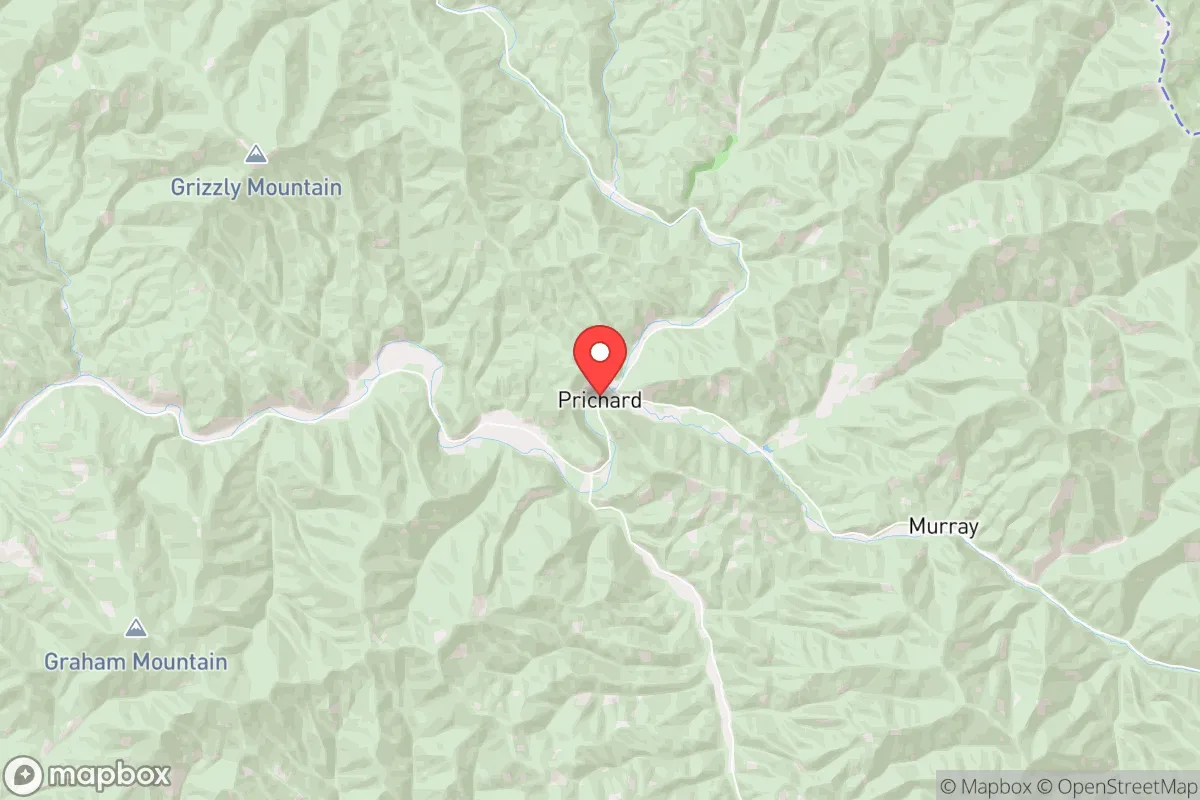

Demographics of Prichard, ID
Affluence Level in Prichard, ID
A middle-class area roughly in line with national averages across income, home values, education, and employment.
People of Prichard, ID
The people of Prichard, Idaho, today number 4,328 and form one of the state’s most ethnically homogeneous communities, with 88.7% of residents identifying as White and a foreign-born population of just 0.9%. The city is characterized by a working-class, rural identity where only 10.0% of adults hold a college degree, and the small Hispanic community (3.9%) represents the largest minority group. Prichard’s population density remains low, and its distinctive marker is a deep-rooted sense of local continuity — most current residents have family ties reaching back multiple generations within the same few square miles.
How the city was settled and grew
Prichard was founded in the late 19th century as a railroad and timber hub in northern Idaho’s Panhandle, drawing its first permanent settlers from the Upper Midwest and New England. The original wave consisted of loggers, mill workers, and railroad laborers, predominantly of Northern European ancestry — English, German, and Scandinavian families who built the earliest homes in what is now Old Town Prichard, the historic core along the rail line. By 1910, a second wave of homesteaders arrived under the federal Enlarged Homestead Act, taking up small farms in the surrounding valley; these families settled the area now known as Meadow Creek Flats, a low-density residential strip east of downtown. The timber industry remained the dominant employer through the 1950s, and the neighborhoods that grew during this period — particularly Mill Hill, a working-class district on the south side — were built by and for mill families. No significant non-European population arrived during these early decades; the city remained almost entirely White until the late 20th century.
Modern era (post-1965)
After the 1965 Hart-Cellar Act, Prichard saw virtually no immigration-driven diversification. The foreign-born share today sits at less than 1%, and the city’s racial composition has shifted only marginally. The most notable change has been a slow increase in Hispanic residents, who now make up 3.9% of the population — up from negligible levels in 1990. These families have concentrated primarily in West Prichard, a newer subdivision of manufactured homes and starter houses built in the 2000s along Highway 3. Domestic in-migration has been modest and largely White: retirees from California and Washington have trickled into Pine Ridge Estates, a gated community of custom homes on the city’s northern edge, while younger families seeking affordable housing have filled Valley View Addition, a 1990s-era subdivision near the high school. The East/Southeast Asian population (0.8%) and Indian subcontinent population (0.0%) remain statistically negligible, and the Black population is recorded at zero. Prichard has not experienced the suburbanization boom seen in Idaho’s larger cities; its growth has been slow, organic, and overwhelmingly White.
The future
Prichard’s population is projected to grow modestly over the next decade, driven by spillover from Coeur d’Alene and Spokane as housing costs push buyers farther into rural areas. This in-migration is likely to remain predominantly White and older, with retirees and remote workers seeking lower property taxes and larger lots. The Hispanic share may continue its slow climb as agricultural and service-sector jobs draw new families, but the city’s extremely low foreign-born rate (0.9%) and lack of major employers suggest diversification will remain incremental. New construction is concentrating in Meadow Creek Flats and West Prichard, where undeveloped land is still available, while Old Town and Mill Hill are largely built out. The cultural identity of Prichard is likely to stay rooted in its timber-and-railroad heritage, with a conservative, family-oriented social character that appeals to those seeking an affordable, low-crime, and ethnically homogeneous environment.
For someone moving in now, Prichard offers a stable, slow-growing community where nearly nine in ten neighbors share the same racial background and where change arrives gradually. The city is becoming slightly more diverse at the margins — primarily through Hispanic growth — but its core demographic profile is unlikely to shift dramatically in the next 20 years. New residents should expect a tight-knit, rural atmosphere with limited amenities and a population that values continuity over transformation.

* Values derived from national, state, county, city and local statistics and may differ in a specific area. Last updated: 2026-11-18T21:18:25.000Z
Narrative content on this page is AI-generated and may contain mistakes. Verify any details that matter before acting on them.
ReloMaps may earn a commission from affiliate links at no extra cost to you.

