Photo: Wikipedia
Demographics of Portage Lakes, OH
Affluence Level in Portage Lakes, OH
A below-average socioeconomic profile. Incomes, home values, and educational attainment trail the U.S., with higher poverty and unemployment.
People of Portage Lakes, OH
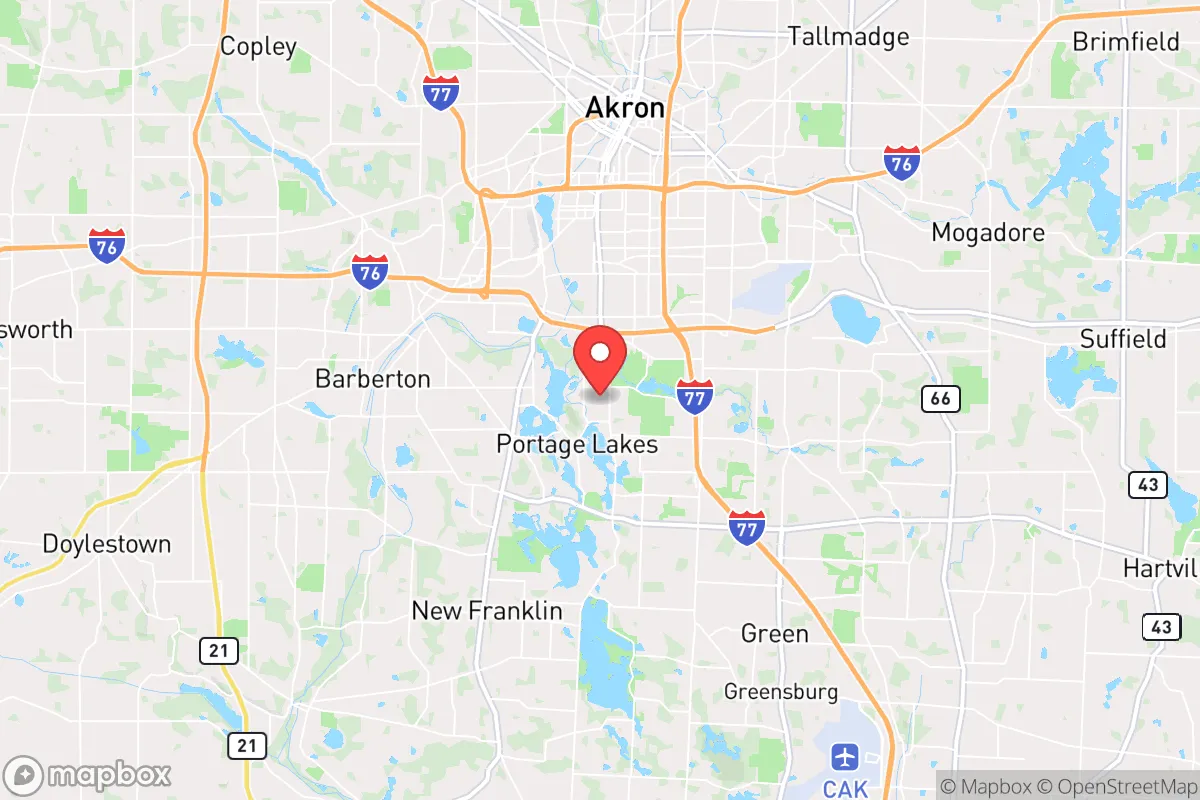
The people of Portage Lakes, Ohio, today form a tight-knit, predominantly white community of 6,199 residents, known for its strong sense of local identity centered on the chain of glacial lakes that give the city its name. With a population density that feels suburban yet relaxed, the city carries a distinctive character as a year-round recreation hub where lakefront living, fishing, and boating define daily life. The population is notably less diverse than the national average, with 88.4% identifying as white, and a foreign-born share of just 1.7%, reflecting a community shaped more by domestic migration than international immigration. This is a place where families and retirees alike are drawn to the water, the quiet streets, and the no-frills, self-reliant atmosphere that has persisted for generations.
How the city was settled and grew
Portage Lakes was never a single planned settlement but rather a collection of small, independent communities that grew up around the lakes themselves. The area's original population was drawn by the construction of the Ohio & Erie Canal in the 1820s and 1830s, which connected the lakes to the larger waterway system. German and Irish laborers, who dug the canal and later worked in nearby sandstone quarries, were the first to settle in what are now the Manchester and Turkeyfoot Lake neighborhoods. By the late 19th century, the lakes became a popular summer resort destination for wealthy families from Akron and Cleveland, leading to the construction of cottages and seasonal homes, particularly around Long Lake and East Reservoir. The permanent population remained small and seasonal until the mid-20th century, when improved roads and the rise of automobile ownership made year-round lake living feasible for middle-class families. The post-World War II era saw a wave of returning veterans and their families, many of them of German, Irish, and Italian descent, building modest ranch homes and split-levels along the shorelines, especially in the Rolling Acres and Lakeview districts. These groups established the area's cultural foundation: a blue-collar, outdoors-oriented, and self-sufficient community that valued privacy and neighborly familiarity over urban amenities.
Modern era (post-1965)
After the 1965 Hart-Cellar Act reshaped U.S. immigration patterns, Portage Lakes saw very little direct impact. The foreign-born population remains minimal at 1.7%, and the city has not experienced the large-scale immigration waves seen in nearby Akron or Cleveland. Instead, the modern era has been defined by domestic in-migration from within Ohio and the broader Midwest. Families and empty-nesters have been drawn to the area for its relatively affordable lakefront properties, low crime rates, and proximity to Akron's employment base. The Black population, at 2.7%, and East/Southeast Asian population, at 2.6%, are small but present, with most of these residents settling in the more accessible, non-lakefront neighborhoods like Manchester and the area around Portage Lakes Drive. The Hispanic population, at 1.6%, is similarly dispersed. Notably, the Indian subcontinent population is recorded at 0.0%, underscoring that the area has not attracted the professional immigrant communities that have grown in larger Ohio cities. The city's racial and ethnic composition has remained remarkably stable since the 1990s, with white residents continuing to make up the overwhelming majority. The college-educated share stands at 33.1%, slightly below the national average, reflecting a workforce that leans toward skilled trades, small business ownership, and local service industries rather than white-collar corporate employment.
The future
Demographic projections for Portage Lakes suggest a continuation of current trends rather than dramatic change. The population is likely to remain predominantly white and native-born, with modest growth driven by domestic migration from other parts of Ohio and the Midwest. The city's appeal to retirees and second-home buyers will likely sustain demand for lakefront properties, particularly around Turkeyfoot Lake and Long Lake, while younger families may be priced out of the most desirable waterfront lots and instead settle in the Rolling Acres and Manchester neighborhoods. Diversity is expected to increase only slightly, as the area lacks the large employers or urban infrastructure that typically attract significant international immigration. The cultural identity of Portage Lakes is likely to remain centered on its lakes, its quiet residential streets, and its independent, self-reliant character. For a new resident, this means joining a community where neighbors know each other, outdoor recreation is the primary social currency, and the pace of life is deliberately slow.
For someone moving in now, Portage Lakes offers a stable, predictable, and family-oriented environment where the population is not rapidly changing. The city is becoming neither more diverse nor more urban; it is solidifying its identity as a lakeside retreat for those who value privacy, nature, and a low-key lifestyle. The bottom line is that this is a place for people who want to own a piece of waterfront, raise a family in a safe setting, and be part of a community that has changed little in the last fifty years.

* Values derived from national, state, county, city and local statistics and may differ in a specific area. Last updated: 2026-09-29T01:28:16.000Z
Narrative content on this page is AI-generated and may contain mistakes. Verify any details that matter before acting on them.
ReloMaps may earn a commission from affiliate links at no extra cost to you.

