Photo: Wikipedia
Demographics of Westmoreland County
Affluence Level in Westmoreland County
A middle-class area roughly in line with national averages across income, home values, education, and employment.
People of Westmoreland County
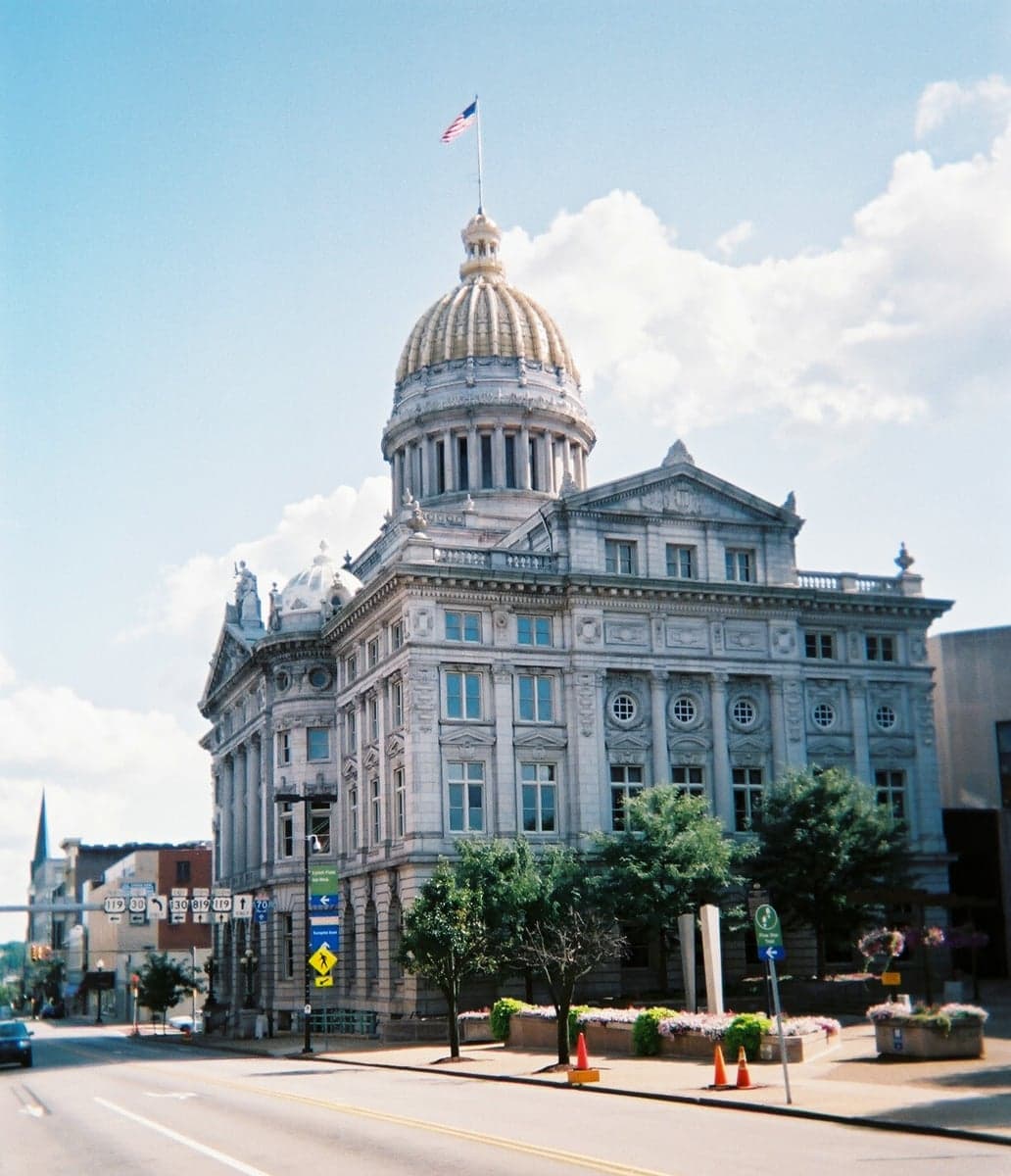
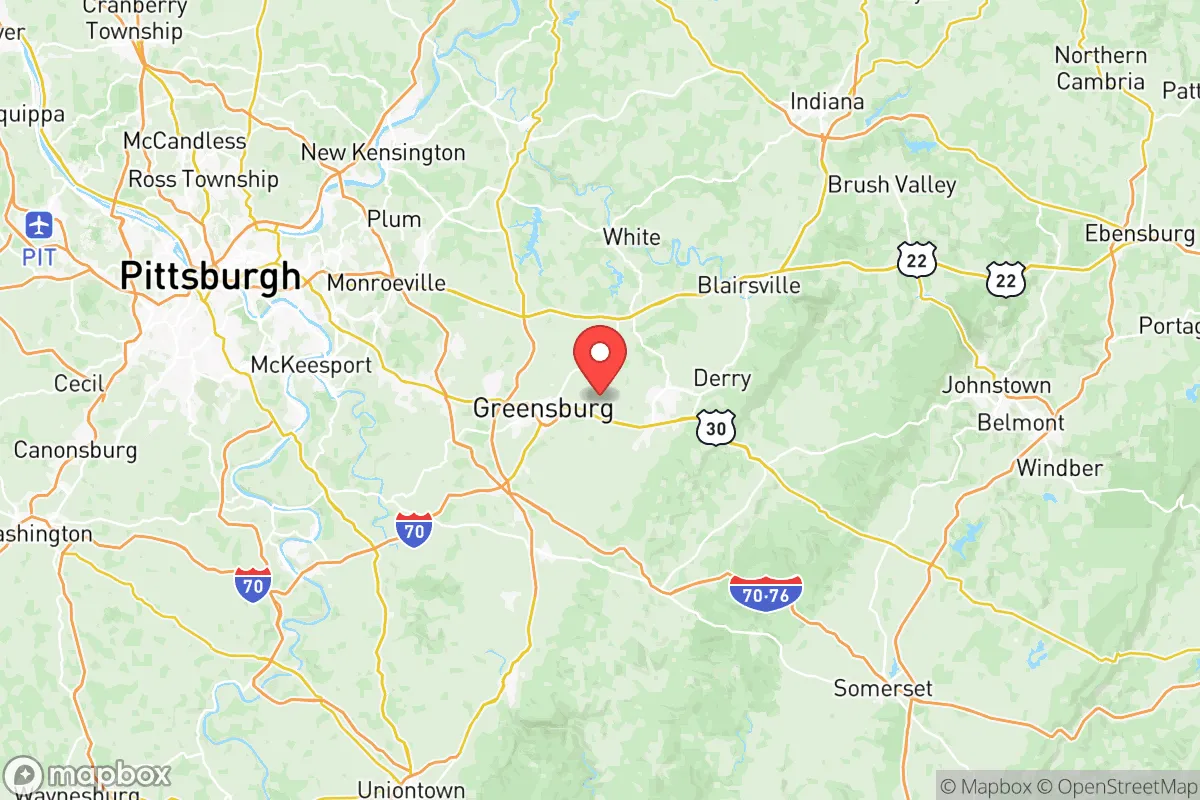
Westmoreland County, Pennsylvania, is home to 353,345 residents who overwhelmingly trace their roots to European settlement waves of the 18th and 19th centuries, with 92.0% of the population identifying as white alone. The county remains one of the least ethnically diverse in the Pittsburgh metro area, with a foreign-born population of just 0.6% and a character shaped by its industrial and agricultural past. Its people are concentrated in historic towns like Greensburg, the county seat, and former coal and steel hubs such as Latrobe, Jeannette, and Mount Pleasant, where a strong sense of local identity and traditional values persists. This is a region where family names and church affiliations often go back generations, and where the population is slowly aging and declining.
Settlement & growth (pre-1960)
Before European settlement, the area now known as Westmoreland County was part of the hunting grounds of the Iroquois Confederacy, particularly the Seneca and Shawnee peoples, who used the region for seasonal travel and trade along the Loyalhanna Creek and the Kiskiminetas River. The French and British contested the territory during the mid-1700s, with Fort Necessity (in present-day Fayette County) and Fort Ligonier (just west of Westmoreland) marking early conflict points. The county was officially created in 1773 from Bedford County, making it the first county formed entirely within Pennsylvania after the colonial era began.
The first major wave of European settlers were Scots-Irish Presbyterians, who arrived in the 1770s and 1780s, pushing westward from Philadelphia and Lancaster. They established farms and small communities in the fertile valleys around Greensburg, Hannastown (the original county seat, burned by the British and Seneca in 1782), and New Alexandria. These settlers were largely subsistence farmers, and their descendants still form a significant portion of the county's rural population today.
The second major wave came with German-speaking immigrants, primarily Lutherans and Reformed Protestants, who arrived in the early to mid-1800s. They settled in areas like Latrobe (founded by the Pennsylvania Railroad in 1852 and named after a railroad engineer), Derry, and Stahlstown, where they established tight-knit farming communities and churches. The German influence is still visible in local surnames, food traditions, and the region's strong work ethic.
The third and most transformative wave was driven by the industrial revolution, beginning around 1870 and lasting through the 1920s. The discovery of vast bituminous coal seams and the expansion of the Pennsylvania Railroad turned Westmoreland County into a powerhouse of coal mining, coke production, and steel manufacturing. Towns like Jeannette (founded as a glass-manufacturing center in 1888), Mount Pleasant (a coal and coke hub), Monessen (a steel mill town on the Monongahela River), and Scottdale (home to a major coke works) boomed. This industrial expansion drew a diverse influx of immigrants: Italians (especially from southern Italy) arrived in large numbers between 1890 and 1910, settling in Jeannette, Mount Pleasant, and Monessen; Poles and Slovaks came to work the mines and mills, forming ethnic parishes in Arnold and New Kensington; and smaller groups of Hungarians, Lithuanians, and Ukrainians also established communities. By 1920, Westmoreland County had one of the highest percentages of foreign-born residents in Pennsylvania outside Philadelphia.
African Americans arrived in smaller numbers during this period, primarily from the post-Reconstruction South, to work in the steel mills and coal mines. They settled mostly in the industrial river towns like Monessen and New Kensington, where they formed small but enduring communities. However, the county's black population never exceeded 3% during this era, as industrial jobs were often segregated and housing discrimination was widespread.
The Great Depression and World War II halted large-scale immigration. After the war, the county's industrial base began a slow decline, as coal mining mechanized and steel production shifted to larger, more efficient mills elsewhere. Suburbanization began in earnest in the 1950s, with families moving from the crowded mill towns to new developments around Greensburg and Latrobe, but the county's population peaked around 1960 at roughly 352,000.
Modern era (post-1965)
The 1965 Hart-Cellar Act, which opened immigration to non-European countries, had almost no impact on Westmoreland County. The county's foreign-born population remains at just 0.6% in 2026, one of the lowest rates in Pennsylvania. Unlike Pittsburgh or Philadelphia, which saw modest growth in Asian and Hispanic communities after 1965, Westmoreland County remained overwhelmingly white and native-born.
The dominant demographic story of the modern era is population decline and out-migration. From a peak of roughly 352,000 in 1960, the county's population fell to 353,345 by 2026, a net loss of about 50,000 people. The collapse of the steel and coal industries in the 1970s and 1980s triggered a massive exodus of young adults and families, particularly from the river towns. Monessen lost over half its population between 1960 and 2020; New Kensington and Arnold saw similar declines. Those who left moved to the Sun Belt (Florida, Texas, the Carolinas) or to the outer suburbs of Pittsburgh, such as Murrysville and Penn Township.
The county's racial and ethnic composition has shifted only slightly. The white population dropped from 96% in 1990 to 92.0% today. The black population grew from 1.8% to 2.4%, concentrated in Monessen and New Kensington. The Hispanic population rose from 0.5% to 1.5%, with small but growing clusters in Greensburg and Latrobe, largely driven by Mexican and Puerto Rican families working in agriculture, construction, and service industries. East/Southeast Asian communities (Chinese, Vietnamese, Filipino) make up 0.6%, mostly professionals and academics associated with the University of Pittsburgh at Greensburg and Saint Vincent College in Latrobe. The Indian subcontinent population is 0.3%, a very recent arrival tied to medical and tech jobs in the broader Pittsburgh region.
Suburbanization has reshaped where people live. The historic mill towns continue to lose population, while the more rural townships—Hempfield, Unity, and Derry—have seen modest growth as bedroom communities for Pittsburgh commuters. The county's college-educated share is 31.8%, below the national average, reflecting the loss of younger, more educated workers to larger cities.
The future
Westmoreland County's population is projected to continue a slow decline over the next 10–20 years, driven by an aging population (median age is 46, well above the national median of 38) and net out-migration of young adults. The county is not attracting significant international immigration, and domestic migration is largely negative, with most movers heading to warmer, faster-growing regions.
Diversity will increase, but only marginally. The Hispanic population is likely to grow to 2–3% by 2040, driven by natural increase and continued labor demand in agriculture and construction. The black population may hold steady or decline slightly as older residents pass away and younger ones leave. East/Southeast Asian and Indian communities will remain very small, likely under 1% each, unless a major employer (such as a new hospital or tech campus) draws a larger professional cohort.
Culturally, the county is becoming more politically conservative relative to the state, as the remaining population skews older, whiter, and more rural. The historic ethnic identities—Italian, Polish, Slovak, German—are fading into a broader "American" identity, though they remain visible in church festivals, food traditions, and family names. The county's future is likely to be one of slow shrinkage, with population concentrating in the Greensburg area and the more accessible townships, while the river towns continue to hollow out.
For someone moving in now, Westmoreland County offers a stable, low-cost, low-crime environment with strong community ties and access to Pittsburgh's job market within a 45-minute commute. It is not a place of rapid change or demographic dynamism, but rather a region where the past is still very much present, and where the people who remain are deeply rooted in the land and its history.

* Values derived from national, state, county, city and local statistics and may differ in a specific area. Last updated: 2026-06-16T11:24:54.000Z
Narrative content on this page is AI-generated and may contain mistakes. Verify any details that matter before acting on them.
ReloMaps may earn a commission from affiliate links at no extra cost to you.

