
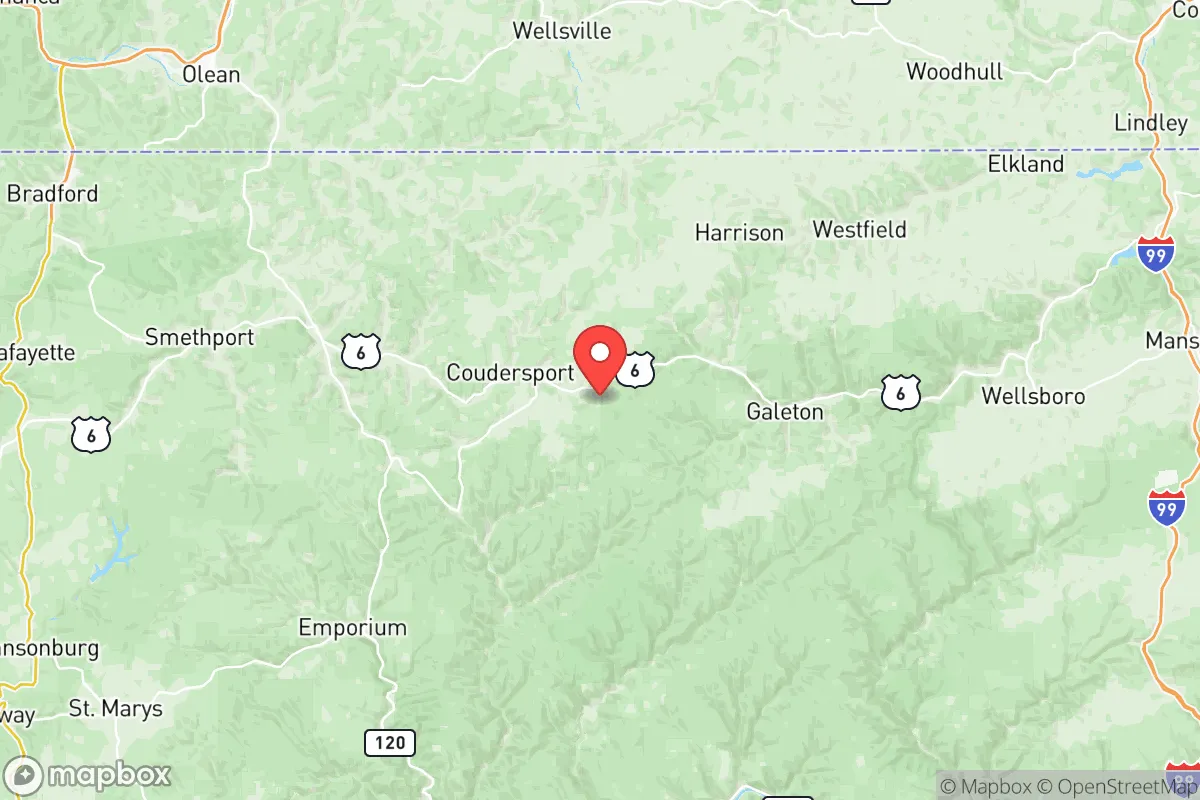
Photo: Wikipedia
Strategic Assessment of Potter County
Workable tactical position. Some exposure to population density or targets, but generally defensible in a crisis.
What does the Strategic Assessment tell us?
Our Strategic Assessment grades tactical survivability of an area. Major population centers, military targets, fallout zones, natural disasters, and border exposure all drive risk — lower exposure means a more defensible position in a crisis.
This is heavily inspired by Joel Skousen's Strategic Relocation book. Highly recommended you checkout the book ($)What does this tell us?
Our Strategic Assessment grades tactical survivability of an area. Major population centers, military targets, fallout zones, natural disasters, and border exposure all drive risk — lower exposure means a more defensible position in a crisis.
This is heavily inspired by Joel Skousen's Strategic Relocation book. Highly recommended you checkout the book ($)Strategic Pillars
Key Distances
Strategic Assessment Analysis
Potter County, Pennsylvania, offers a compelling strategic profile for relocators prioritizing resilience and self-sufficiency, largely due to its remote, forested geography and low population density. Located in the north-central tier of the state, the county is anchored by the small borough of Galeton and the county seat of Coudersport, both of which sit within the vast expanse of the Susquehannock State Forest. This positioning provides a natural buffer from the dense urban corridors and major industrial targets that define much of the Eastern Seaboard, making it a location worth serious consideration for those focused on long-term preparedness.
Geographic position and natural advantages for long-term security
Potter County's primary strategic asset is its location within the Allegheny Plateau, a region characterized by deep valleys, steep hills, and extensive hardwood forests. This terrain naturally limits large-scale development and keeps population density among the lowest in Pennsylvania—roughly 16 people per square mile. The county is part of the larger Pennsylvania Wilds region, a 2-million-acre landscape that offers significant natural resources and a degree of geographic isolation. For a relocator, this means fewer neighbors, less traffic, and a lower likelihood of being affected by cascading failures from nearby metropolitan areas. The nearest major city, Williamsport, is over an hour's drive south, while Buffalo, New York, and State College are roughly two hours away. This distance from population centers reduces exposure to civil unrest, supply chain disruptions, and the immediate fallout from a major event targeting a high-value urban area. The county's elevation—much of it above 2,000 feet—also provides a cooler climate and reduces the risk of flooding compared to low-lying river towns, though winter weather can be severe and should be factored into any preparedness plan.
Risks, exposures, and proximity to fallout-relevant landmarks
While Potter County is remote, it is not entirely free from risk. The most significant man-made threat comes from its proximity to the West Valley Demonstration Project in western New York, a decommissioned nuclear fuel reprocessing site about 90 miles northwest of Coudersport. Though not an active reactor, the site contains stored radioactive waste and has been a source of environmental concern for decades. A major incident there could affect downwind areas, including parts of northern Potter County. Additionally, the county lies within a few hundred miles of several major East Coast population and industrial centers—New York City, Philadelphia, and the Pittsburgh metro area—any of which could be primary targets in a conflict. While Potter County itself is not a likely target, its location relative to prevailing westerly winds means that fallout from a strike on Pittsburgh or the Ohio River Valley industrial corridor could potentially reach the region, depending on the scale of the event. Natural risks are more mundane but still relevant: the area is prone to heavy snow, ice storms, and occasional flooding along the Allegheny River and its tributaries. Wildfire risk is low compared to the western U.S., but dry summers can create conditions for forest fires in the state forests. The county has no major refineries, military bases, or ports, which is a net positive for a relocator seeking to avoid collateral damage from strategic strikes.
Practical resilience for a relocator: food, water, energy, and defensibility
For someone serious about self-sufficiency, Potter County offers a mixed but generally favorable picture. Water availability is a strong point: the county is dotted with numerous streams, creeks, and rivers, including the headwaters of the Genesee River and Pine Creek. Groundwater is generally accessible via wells, though drilling depths vary by location and should be tested for quality before purchase. The county's forested landscape also supports hunting—white-tailed deer, turkey, and small game are abundant—and the region has a history of subsistence farming, though the growing season is short (roughly 120 days) and soils are rocky and acidic. For food production, a greenhouse or hoop house would be a practical investment. Energy resilience is more challenging. The grid in rural Potter County is less robust than in urban areas, and power outages from winter storms are common. Off-grid solar is viable but requires battery storage to handle long stretches of cloudy weather; a backup generator running on propane or diesel is a near-necessity. Firewood is abundant and widely used for heating, which is a major advantage. Defensibility is naturally high due to the terrain: many properties are located on dead-end roads or at the end of long driveways, offering good situational awareness and limited access points. However, the county's small population also means that emergency services—law enforcement, fire, and medical—are spread thin. Response times in the more remote townships, such as Austin or Ulysses, can exceed 30 minutes. A relocator should plan to be self-reliant for medical emergencies and security, as the nearest hospital is in Coudersport, and it is a small critical-access facility.
Overall, Potter County presents a strong strategic option for the disaster-conscious relocator who values isolation, natural resources, and a low-risk profile relative to major targets. Its weaknesses—harsh winters, limited healthcare access, and a short growing season—are manageable with proper planning and investment. The county's location in the Pennsylvania Wilds offers a genuine buffer from the vulnerabilities of the Eastern Seaboard, while its abundant water and timber provide a foundation for long-term self-sufficiency. For a single individual or family willing to accept the trade-offs of rural life, Potter County ranks as a resilient, defensible, and strategically sound choice in the northeastern United States.

* Values derived from national, state, county, city and local statistics and may differ in a specific area. Last updated: 2026-11-17T04:57:53.000Z
Narrative content on this page is AI-generated and may contain mistakes. Verify any details that matter before acting on them.
ReloMaps may earn a commission from affiliate links at no extra cost to you.

