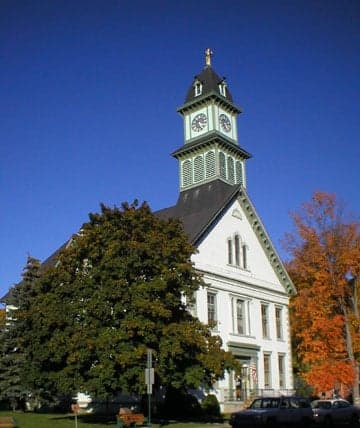
Photo: Wikipedia
Political ClimatePolitical Climate in Potter County
Showing county-level results — no local-only data available.
Lean and PVI are calculated from this county’s 2020 and 2024 presidential results, Cook-style.
Political rankings in Pennsylvania
- Most Conservative Cities in Pennsylvania
- Most Liberal Cities in Pennsylvania
- Best Conservative-Leaning Towns in the Northeast
- Best Conservative-Leaning Towns in the Mid-Atlantic
- Most Affordable Liberal-Leaning Small Towns in the U.S.
- Safest Liberal-Leaning Cities in the U.S.
- Most Conservative Counties in Pennsylvania
- Most Liberal Counties in Pennsylvania
Local Political AnalysisPolitical Analysis of Potter County
Potter County is one of the most reliably Republican counties in all of Pennsylvania, carrying a Cook Partisan Voting Index (PVI) of R+32. That means the county consistently votes about 32 points more Republican than the national average, a stark contrast to the state of Pennsylvania as a whole, which sits at a PVI of EVEN. In practical terms, this isn't a swing county; it's a deep-red stronghold where Democratic candidates rarely break 35% of the vote in presidential elections, and local offices are almost entirely held by Republicans. The political trajectory here has been stable for decades, with no signs of shifting toward the center — if anything, the rural-urban divide has only hardened since 2020.
How it compares
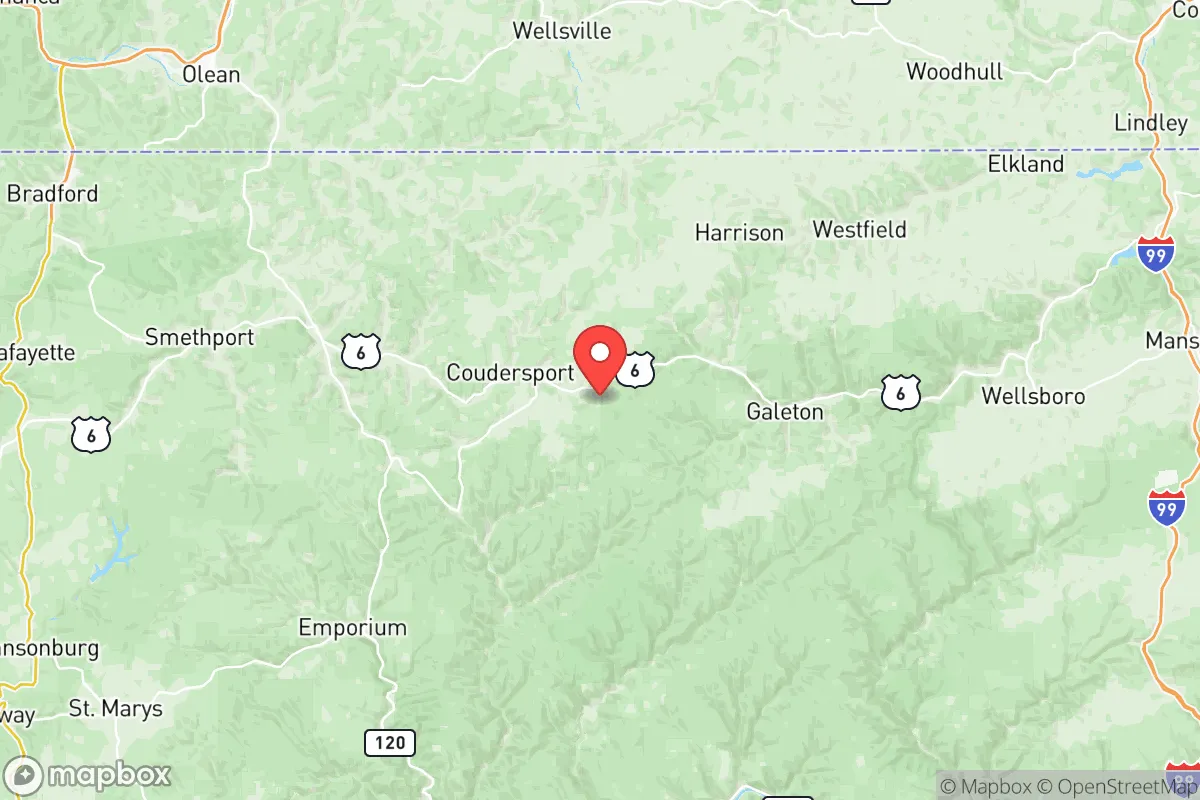
The gap between Potter County and the rest of Pennsylvania is enormous. While the state as a whole is a perfect 50/50 battleground — swinging between Philadelphia and Pittsburgh suburbs — Potter County sits in the rural northern tier where Democratic registration is sparse. To put it in perspective, a Republican running for statewide office can expect to win Potter by 60 to 70 points, while needing to run up similar margins in other deep-red counties like Tioga or Bradford to offset the blue votes from Philadelphia and Allegheny. Within the county itself, there is some variation: the borough of Galeton tends to be slightly more moderate, occasionally producing a few more Democratic votes than the rest of the county, while Coudersport, the county seat, is reliably conservative but sees a small contingent of moderate Republicans and independents. The truly deep-red precincts are in the rural townships — places like Sweden Township and Hector Township — where Republican votes can exceed 85%. There are no blue-leaning towns of any size; the closest thing to a swing precinct might be around Austin, but even there, the margin is still heavily Republican.
What this means for residents
For conservative residents, Potter County feels like a political safe haven. Local government, school boards, and law enforcement are all aligned with conservative values, and there's little friction in daily life around political signage, public meetings, or community events. Taxes and regulations are generally viewed favorably by the business community, and the Second Amendment is broadly supported without much debate. For liberal residents, the reality is different. It can be isolating to be in the political minority, and there are few organized Democratic groups or progressive spaces outside of occasional statewide election canvassing. That said, most residents report that political disagreements are handled civilly — this isn't a place where people stop talking to each other over a yard sign. The bigger cultural divide is less about party and more about lifestyle: longtime locals versus newcomers from more urban areas, or those involved in the natural gas industry versus those in tourism or conservation.
One notable cultural distinction is the county's strong independent streak. Even within the Republican majority, there's a healthy skepticism of both state government in Harrisburg and federal authority — a legacy of the region's logging and railroad history. This manifests in local resistance to certain state mandates, whether related to environmental regulations or school curriculum. For a liberal resident, this can feel frustrating, but it also means that local governance is highly responsive to community input, regardless of party. Overall, Potter County offers a stable, predictable political environment that reflects its rural character — and that stability is unlikely to change in the near future, barring a major demographic shift.

State Political ClimatePolitical Climate in Pennsylvania
State Political AnalysisPolitical Environment in the State
Pennsylvania is the ultimate swing state, with a Cook PVI of EVEN that perfectly captures its razor-thin margins in presidential elections—think Trump’s 2016 win by 44,000 votes and Biden’s 2020 flip by 80,000. Over the last 20 years, the state has shifted from a reliably blue-leaning battleground to a true toss-up, driven by the collapse of union Democrat strongholds in the west and the explosive growth of the Philadelphia suburbs. For a conservative-leaning relocator, this means your vote genuinely counts, but you’ll be living in a state where no single party holds a commanding grip on power.
Urban vs. rural divide
The political map of Pennsylvania is a tale of three regions. Philadelphia and its collar counties—Montgomery, Delaware, Chester—are the engine of the Democratic vote, delivering margins of 80-20 in the city and 60-40 in the inner suburbs. Pittsburgh, once a union bastion, has gone blue but with less enthusiasm, while the vast rural expanse from the Poconos to the Ohio border is deep red. The real story is the suburban shift: counties like Bucks and Chester, which voted for Romney in 2012, now back Democrats by 5-10 points, driven by college-educated professionals fleeing the GOP’s cultural posture. Meanwhile, the old coal and steel towns—Scranton, Wilkes-Barre, Erie—have swung hard right, with Luzerne County flipping from Obama to Trump by 20 points. The result is a state where the political energy is split between the liberal I-95 corridor and the conservative “T” stretching from the northern tier down through central PA.
Policy environment
Pennsylvania’s policy landscape is a mixed bag that reflects its divided government. The state has a flat income tax of 3.07%, one of the lowest in the nation, and no tax on Social Security benefits—a major plus for retirees. Property taxes are high, averaging 1.58% of home value, but there’s a homestead exemption and a property tax/rent rebate program for seniors. The regulatory posture is moderate: Pennsylvania is not a right-to-work state, but it’s also not California. Gun laws are relatively permissive—no permit needed for open carry, a shall-issue concealed carry system, and preemption of local ordinances—though Philadelphia and Pittsburgh have their own restrictions. Education is a flashpoint: the state has a patchwork of 500 school districts, with funding disparities that have led to a 2023 court ruling declaring the system unconstitutional. School choice is limited to charter schools, with no voucher program, though a 2024 pilot program for Educational Savings Accounts (ESAs) for special needs students passed. Election laws are moderate: no-excuse mail-in voting was enacted in 2019 (Act 77), but it’s been a source of constant partisan fighting, with Republicans pushing for voter ID and Democrats defending mail-in access. Healthcare is a mixed picture: Medicaid expansion is in place, but the state runs its own ACA exchange with relatively stable premiums.
Recent policy direction
The last five years have seen Pennsylvania lurch in both directions, reflecting its purple status. On gun rights, the 2024 passage of a “constitutional carry” bill (HB 979) eliminated the permit requirement for concealed carry, making Pennsylvania a shall-issue state with no training mandate—a win for Second Amendment advocates. On education, the 2023 court ruling on funding equity has forced the legislature to consider a $5 billion increase in basic education funding, which could raise property taxes or income taxes. Parental rights saw a win with Act 70 of 2024, which requires schools to notify parents of any changes to a student’s health or well-being, including gender identity—a direct response to the culture war. On medical freedom, the state has no vaccine mandate for adults, but COVID-era school mandates were contentious. Privacy and surveillance: Pennsylvania has a strict wiretap law (two-party consent), but no comprehensive data privacy law yet—a bill (HB 1201) is pending. On property rights, the state has no statewide rent control, but Philadelphia has its own. Voting access remains a battleground: Act 77’s mail-in voting survived a 2024 court challenge, but the state Supreme Court is considering a voter ID requirement for mail ballots. The overall direction is a tug-of-war: the legislature (Republican-controlled House and Senate) pushes right on guns and education, while the governor’s office (Democrat Josh Shapiro) uses veto power to block abortion restrictions and expand voting access.
Civil unrest & political movements
Pennsylvania has seen its share of political flashpoints. The 2020 election aftermath was intense: Trump’s “Stop the Steal” rallies in Harrisburg and Philadelphia drew thousands, and the state became a national focus for election integrity debates, with Republican-led audits in counties like Lycoming and York. Philadelphia saw significant civil unrest in 2020 after the George Floyd protests, with looting and property damage in Center City and University City, leading to a lasting law-and-order backlash in the suburbs. Immigration politics are quieter than in border states, but sanctuary city debates flare in Philadelphia, which limits cooperation with ICE—a point of tension with rural counties that pass resolutions declaring themselves “Second Amendment sanctuaries.” The state has a strong grassroots movement on both sides: the Pennsylvania Freedom Caucus (hardline conservative) pushes for school choice and election integrity, while groups like Indivisible and Keystone Progress organize on the left. A notable flashpoint is the 2023 school board wars in Central Bucks County, where conservative parents clashed with progressive boards over library books and transgender policies, leading to a recall effort. For a new resident, the political temperature is high but localized—you’ll see more yard signs and bumper stickers than street protests, except in Philadelphia and Pittsburgh.
Projection
Over the next 5-10 years, Pennsylvania is likely to remain a toss-up, but the demographic trends favor a slow shift leftward. The Philadelphia suburbs are growing and diversifying, while rural counties are aging and shrinking. The state’s population is projected to grow by only 2% by 2030, with most growth in the southeast and the Lehigh Valley (Allentown, Bethlehem, Easton). In-migration from New York and New Jersey is bringing more moderate-to-liberal voters to the Poconos and the I-78 corridor. However, the rural conservative vote is not going away—it’s just becoming more concentrated. The wild card is the state’s electoral map: Pennsylvania loses a congressional seat after 2030 reapportionment, which could shift the balance. For a conservative moving in, expect the state to remain purple but with a slight blue tint in statewide races, while local control in rural areas stays firmly red. The policy environment will continue to seesaw: gun rights are likely secure, but education funding and tax policy will be a constant fight. The key takeaway: Pennsylvania is not trending toward a one-party state anytime soon, so your vote will matter in every election.
For a new resident, the bottom line is that Pennsylvania offers a genuine swing-state experience with tangible policy consequences. You’ll pay low income taxes but high property taxes, enjoy strong gun rights outside of Philadelphia, and navigate a school system that’s underfunded but locally controlled. The political climate is intense but not chaotic—you’ll be part of a state where every election is a battle, and your voice actually counts. If you’re conservative, you’ll find safe havens in the rural north and central regions, but you’ll need to engage in the suburbs to hold the line. If you’re liberal, the cities and inner suburbs are your base, but you’ll face a Republican legislature that checks the governor’s power. Either way, Pennsylvania rewards the engaged citizen.
* Values derived from national, state, county, city and local statistics and may differ in a specific area. Last updated: 2026-11-17T04:57:53.000Z
Narrative content on this page is AI-generated and may contain mistakes. Verify any details that matter before acting on them.
ReloMaps may earn a commission from affiliate links at no extra cost to you.

