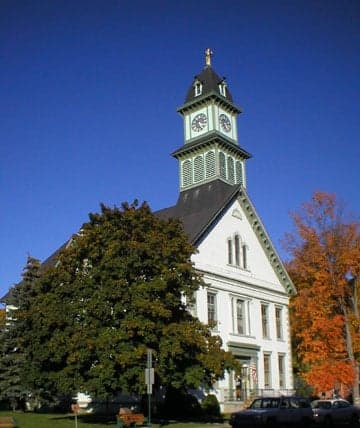
Photo: Wikipedia
Demographics of Potter County
Affluence Level in Potter County
A middle-class area roughly in line with national averages across income, home values, education, and employment.
People of Potter County
Potter County, Pennsylvania, is one of the most homogenous and sparsely populated areas in the state, with just 16,276 residents spread across a vast, forested landscape. The population is overwhelmingly white (94.9%) and native-born, with a foreign-born share of only 0.5%, reflecting a deep-rooted, insular character shaped by centuries of isolation. Distinctive markers include a strong reliance on natural resource extraction, a pronounced rural identity, and a population density that ranks among the lowest in Pennsylvania, creating a community where family names and local histories stretch back generations.
Settlement & growth (pre-1960)
Before European settlement, the region now known as Potter County was part of the traditional hunting grounds of the Seneca Nation, one of the Six Nations of the Iroquois Confederacy. The area was largely uninhabited year-round, used instead for seasonal hunting and travel along the Sinnemahoning Creek and the headwaters of the Allegheny River. The first European incursion came during the French and Indian War, but no permanent settlements were established until after the American Revolution.
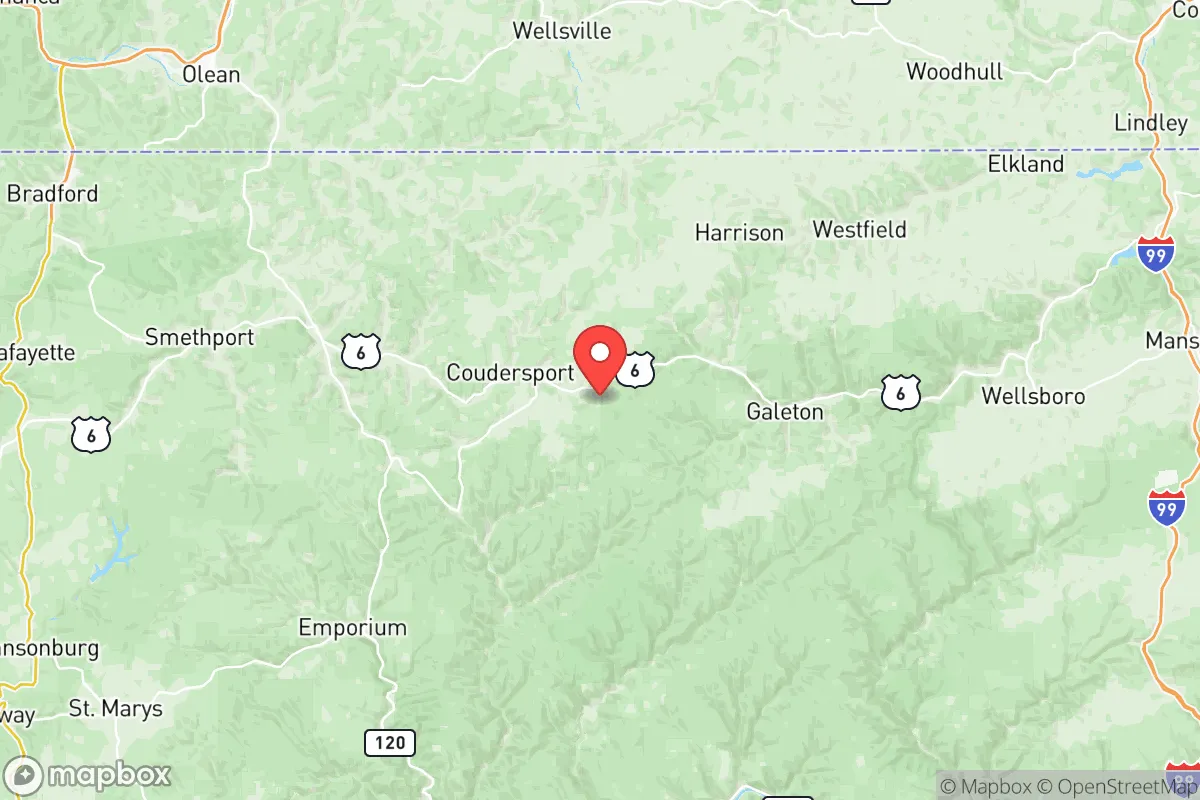
The county was formally created in 1804 from a portion of Lycoming County, but actual settlement did not begin in earnest until the 1810s and 1820s. The first wave of settlers were primarily of English and Scots-Irish descent, moving west from the more crowded counties of central Pennsylvania. They were drawn by the promise of cheap, abundant land in the dense forests of the Allegheny Plateau. These early pioneers established small, isolated homesteads and the first true settlements, including Galeton (originally called "The Gulf") and Coudersport, which was laid out as the county seat in 1807 and named for a local landowner. The rugged terrain and poor roads meant that these communities grew slowly, remaining self-sufficient farming and logging hamlets for decades.
The second major wave of population growth came with the timber boom of the mid-to-late 19th century. The vast old-growth hemlock and white pine forests of Potter County became a primary target for logging companies. This industry pulled in a new group of settlers: German and Irish immigrants who arrived in the 1850s through 1880s to work in the sawmills and logging camps. Towns like Austin, Oswayo, and Shinglehouse were founded or expanded rapidly as company towns, with the population peaking around 1900 at over 30,000 residents. The 1911 Austin Dam failure, which killed 78 people and destroyed much of the town, marked a turning point, as the timber industry began to decline and the population started a long, steady drop.
By the early 20th century, the third wave arrived: a smaller influx of Italian and Eastern European immigrants, primarily Poles and Slovaks, who came to work in the remaining sawmills and the emerging tanning and leather industries. These groups concentrated in Galeton and Ulysses, where small ethnic enclaves formed around Catholic churches and fraternal societies. However, the county's population had already peaked, and the Great Depression accelerated out-migration as the timber industry collapsed. From 1930 to 1960, Potter County lost roughly a third of its residents, with many families leaving for industrial jobs in Erie, Buffalo, and Detroit. The post-World War II era saw no new growth, as the county remained a quiet, depopulating backwater with an economy based on small-scale farming, forestry, and a nascent tourism sector centered on the Susquehannock State Forest.
Modern era (post-1965)
The 1965 Hart-Cellar Act had virtually no impact on Potter County. The foreign-born population today sits at just 0.5%, and the county did not experience any significant immigration from Asia, Latin America, or the Indian subcontinent. The small Hispanic population (1.7%) and the tiny Black (0.4%), East/Southeast Asian (0.2%), and Indian-subcontinent (0.3%) communities are almost entirely the result of individual relocations—often tied to the healthcare and corrections sectors—rather than any chain migration or enclave formation.
The dominant demographic trend since 1965 has been domestic out-migration and aging. Young adults have consistently left for college and jobs in larger cities, while the county has attracted a modest number of retirees and second-home buyers drawn to the low cost of living and outdoor recreation. The population fell from roughly 17,000 in 1970 to a low of around 16,000 in the 1990s, before stabilizing near the current 16,276. Suburbanization did not occur in any meaningful way, as there are no major suburbs; the county's largest borough, Coudersport, has fewer than 2,500 residents. The most notable modern economic development was the opening of a state correctional institution near Galeton in the 1990s, which brought a small number of new residents and stabilized the local economy. The county's racial and ethnic composition has remained virtually unchanged for decades, making it one of the least diverse counties in Pennsylvania.
The future
Potter County's population is projected to continue a slow decline, driven by an aging demographic profile and limited economic opportunities for younger families. The median age is well above the national average, and the college-educated share (17.1%) is significantly lower than the state average, suggesting that the county will struggle to attract knowledge-economy workers. There is no indication that the county will become more diverse; the foreign-born and minority populations are so small that even modest growth would represent a large percentage change, but no new immigrant communities are forming. The most likely future is a continuation of the status quo: a shrinking, aging, overwhelmingly white population concentrated in Coudersport, Galeton, and the smaller boroughs of Austin, Oswayo, and Shinglehouse, with a growing reliance on tourism and second-home development in the state forest lands to slow the decline.
For someone moving in now, Potter County offers a deeply traditional, quiet, and safe rural environment where community ties are strong and change comes slowly. The trade-off is clear: a population that is stable in its homogeneity but shrinking in its vitality, with few newcomers and limited economic dynamism. It is a place for those seeking isolation, low taxes, and a connection to the past, rather than for those looking for diversity, growth, or career opportunity.

* Values derived from national, state, county, city and local statistics and may differ in a specific area. Last updated: 2026-11-17T04:57:53.000Z
Narrative content on this page is AI-generated and may contain mistakes. Verify any details that matter before acting on them.
ReloMaps may earn a commission from affiliate links at no extra cost to you.

