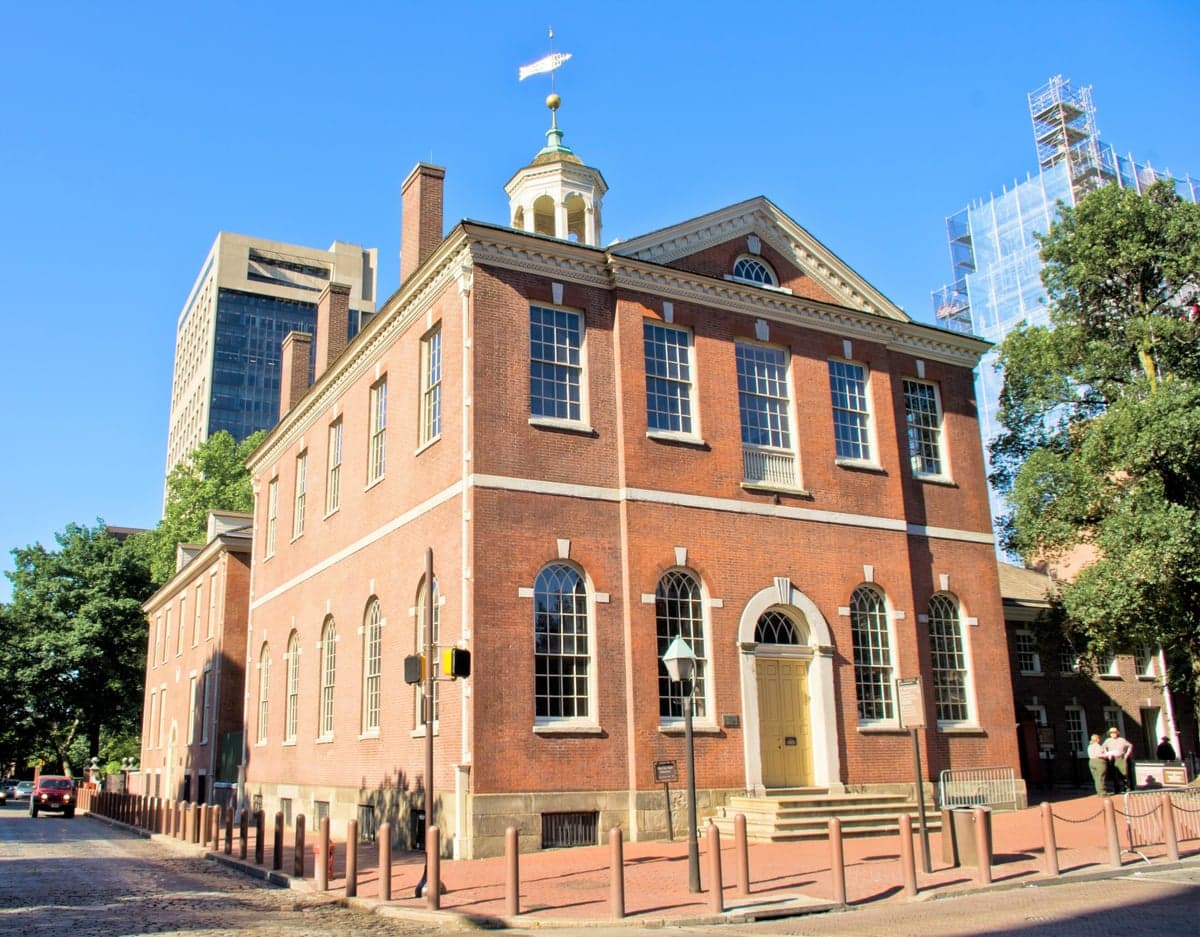
Photo: Wikipedia
Political ClimatePolitical Climate in Philadelphia County
Showing district-level results — no local-only data available.
Local Political AnalysisPolitical Analysis of Philadelphia County
Philadelphia County is one of the most reliably Democratic strongholds in the entire country, carrying a Cook Partisan Voting Index (PVI) of D+19. That means the county consistently votes about 19 points more Democratic than the national average. In the 2024 presidential election, Kamala Harris carried the county by roughly 40 points, a margin that has held steady for decades. The county's political trajectory is not shifting toward the center; if anything, the urban core is getting bluer while the outer edges of the state trend red. The surrounding state of Pennsylvania, by contrast, has a Cook PVI of EVEN — a perfect swing state that flipped from Trump in 2016 to Biden in 2020 and back to Trump in 2024. Philadelphia County is the engine that keeps Pennsylvania competitive for Democrats, but it also creates a sharp urban-rural divide that defines the state's politics.
How it compares
Philadelphia County is an island of deep blue in a purple state. While the county votes D+19, the rest of Pennsylvania is essentially a toss-up. The contrast is stark: in 2024, Philadelphia County gave Kamala Harris roughly 80% of the vote, while rural counties like Tioga and Bradford gave Donald Trump 75% or more. Even within Philadelphia County, there is variation. The Center City and University City neighborhoods are the most liberal, with precincts regularly hitting 90% Democratic. Northeast Philadelphia, particularly around Fox Chase and Somerton, has historically been more moderate and includes some of the county's few swing precincts — areas where working-class white voters have drifted toward Republicans in recent cycles. South Philadelphia remains reliably blue but has a more moderate, union-heavy Democratic base. The county's Republican vote is concentrated in a few pockets: Roxborough and Manayunk have some GOP-leaning precincts, and the far Far Northeast near Bustleton and Holmesburg has seen a modest rightward shift. Still, no precinct in Philadelphia County has voted Republican in a presidential election since 2012.
What this means for residents
For liberal residents, Philadelphia County is a political safe zone. Local elections are effectively decided in the Democratic primary, and the city government — from the mayor's office to the city council — is uniformly Democratic. Progressive policies like a $15 minimum wage, paid sick leave, and tenant protections have passed easily. For conservative residents, the experience is different. They are a clear minority in local politics, with little representation on city council or in the state legislature's Philadelphia delegation. However, their votes still matter in statewide races: Philadelphia County's massive Democratic turnout is what keeps Pennsylvania competitive, meaning a conservative voter in Roxborough or Northeast Philadelphia is part of a statewide coalition that has won the presidency twice in the last decade. The practical effect is that conservative residents often feel politically isolated locally but can still influence state-level outcomes through turnout in the suburbs and exurbs.
Culturally, Philadelphia County's political lean shapes everything from policing to public education. The city has a strong union tradition — the Philadelphia Federation of Teachers and AFSCME District Council 33 are major political players. The county also has a large and politically active Black population, particularly in North Philadelphia and West Philadelphia, which drives the city's focus on criminal justice reform and economic equity. Policy-wise, Philadelphia has its own soda tax, a landlord-tenant law that heavily favors renters, and a school district that is funded separately from the rest of the state. These distinctions make Philadelphia County feel more like a city-state within Pennsylvania — politically, culturally, and economically distinct from the surrounding suburbs and rural areas. For anyone moving here, understanding that the county operates on a different political wavelength than the rest of the state is essential to navigating daily life, from property taxes to public transit funding.

State Political ClimatePolitical Climate in Pennsylvania
State Political AnalysisPolitical Environment in the State
Urban vs. rural divide
The political map of Pennsylvania is a textbook case of the urban-rural chasm. Philadelphia and its collar counties (Montgomery, Delaware, Chester, Bucks) are the engine of the Democratic vote, delivering margins of 400,000 to 500,000 votes that Democrats need to offset the rest of the state. Pittsburgh and Allegheny County are similarly blue, though less overwhelmingly so. The rural "T" that runs from the northern tier down through the center and into the south-central region—places like Tioga County, Bradford County, and Franklin County—vote 65-75% Republican. The real story is in the exurbs and small cities that have flipped or tightened: Erie County went from blue-leaning to a pure toss-up, Luzerne County (Wilkes-Barre) swung hard red in 2016 and stayed there, and Northampton County (Bethlehem) is now a perennial bellwether. The suburbs of Philadelphia, particularly Bucks County, have moved leftward as college-educated professionals pour in, while the southwestern coal country around Washington County and Greene County has become a Republican stronghold.
Policy environment
Pennsylvania's policy environment is a mixed bag that reflects its divided government. The state has a flat income tax of 3.07%, one of the lowest in the nation, and a sales tax of 6% (higher in Philadelphia at 8%). Property taxes are high, especially in the Philadelphia suburbs, but there is a homestead exemption that offers some relief. The regulatory posture is moderate—not as business-friendly as Texas or Florida, but far less burdensome than New York or California. Education policy is a flashpoint: the state has a patchwork of 500 school districts, with wide disparities in funding and outcomes. School choice is limited to charter schools and a small, means-tested voucher program for special needs students; there is no universal school choice or Education Savings Account program. Healthcare is dominated by large systems like UPMC and Penn Medicine, and the state expanded Medicaid under the Affordable Care Act. Election laws are relatively accessible: no-excuse mail-in voting was enacted in 2019 (Act 77), though it remains controversial among conservatives. Voter ID is required for first-time voters but not for established ones, a middle ground that frustrates both sides.
Recent policy direction
The last five years have seen Pennsylvania lurch in contradictory directions, reflecting its purple status. On gun rights, the state is a "shall issue" for concealed carry, and preemption laws prevent local municipalities from enacting their own restrictions—a win for gun owners. However, in 2023, the Democratic governor and legislature enacted a "red flag" law (Act 18 of 2023) allowing temporary firearm removal for individuals deemed a threat, which gun rights advocates oppose. On education and parental rights, the state has not passed a Parents' Bill of Rights, but school boards have become battlegrounds over curriculum and library materials, especially in conservative counties like York County and Cumberland County. On speech and privacy, there is no state-level shield law for journalists, and surveillance laws are standard. Medical and bodily autonomy: abortion remains legal up to 24 weeks, with no additional restrictions beyond federal law, and the governor has vetoed several attempts to restrict it further. Property rights are generally strong, though the state has a robust eminent domain framework for infrastructure projects. Taxation has been stable, with no major income tax hikes, but property tax reform remains elusive. Voting and ballot access: Act 77's no-excuse mail-in voting survived a court challenge in 2024, but the state Supreme Court has split on issues like ballot dating requirements, creating uncertainty each election cycle.
Civil unrest & political movements
Pennsylvania has seen its share of political flashpoints. The 2020 election aftermath was intense, with Trump supporters rallying at the state capitol in Harrisburg and filing numerous lawsuits over mail-in ballot procedures. Election integrity remains a live issue, with conservative groups like the Pennsylvania Voter Alliance pushing for stricter ID laws and audits. On the left, the Black Lives Matter protests in Philadelphia in 2020 were large and occasionally violent, leading to property damage and a lasting debate over policing. Immigration politics are relatively muted compared to border states, but Philadelphia is a sanctuary city, which draws criticism from conservatives in the rest of the state. There have been no serious secession or nullification movements, though some rural counties have passed "Second Amendment sanctuary" resolutions. The most visible flashpoint for a new resident would likely be the constant political advertising—Pennsylvania is the most expensive media market in the country for political ads, and you will see non-stop spots for governor, Senate, and presidential races every two years.
Projection
Over the next 5-10 years, Pennsylvania is likely to remain a toss-up, but the demographic trends are slowly favoring Democrats. The Philadelphia suburbs are gaining college-educated, moderate voters who lean blue, while the rural population is aging and shrinking. However, the exurban and small-city shift to the right, especially in places like Lancaster County and Berks County, is real and could offset those gains. In-migration is modest compared to Sun Belt states, but the people moving in tend to be younger and more diverse, settling in the urban cores and inner suburbs. A new resident moving in now should expect a state that will be decided by a few thousand votes in a handful of counties—Erie, Northampton, and Bucks—for the foreseeable future. The policy environment will remain gridlocked on major issues, with incremental changes at the margins rather than dramatic shifts in either direction.
For a new resident, the bottom line is that Pennsylvania offers a genuine swing-state experience: your vote matters, the politics are in your face, and the policy outcomes are a compromise that neither side loves. Conservatives will appreciate the low flat income tax, strong gun rights, and rural way of life, but will be frustrated by the lack of school choice, the sanctuary city policies in Philadelphia, and the constant election battles. Liberals will enjoy the urban amenities and the blue-leaning suburbs, but will face a state legislature that is often hostile to their priorities. If you want a place where your political engagement can actually make a difference, Pennsylvania is it—just be prepared for the noise.
* Values derived from national, state, county, city and local statistics and may differ in a specific area. Last updated: 2026-08-08T13:14:41.000Z
Narrative content on this page is AI-generated and may contain mistakes. Verify any details that matter before acting on them.
ReloMaps may earn a commission from affiliate links at no extra cost to you.

