
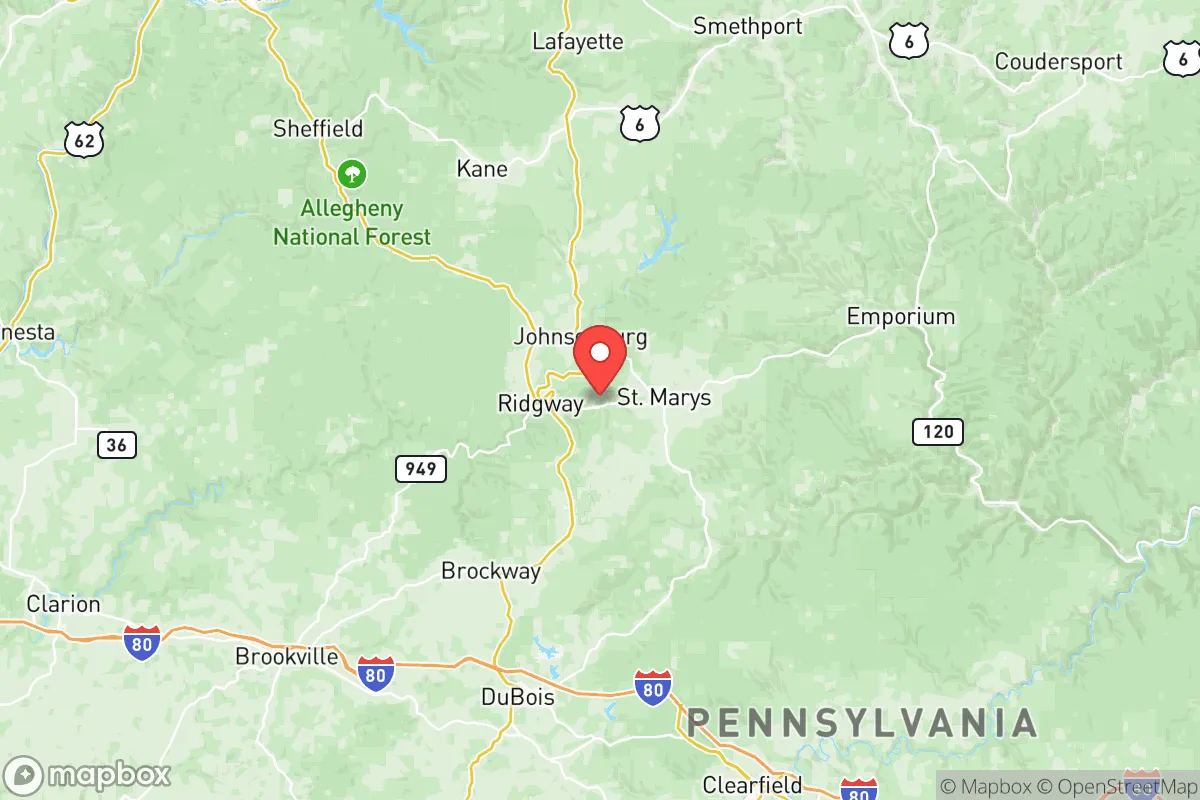
Photo: Wikipedia
Strategic Assessment of Elk County
Workable tactical position. Some exposure to population density or targets, but generally defensible in a crisis.
What does the Strategic Assessment tell us?
Our Strategic Assessment grades tactical survivability of an area. Major population centers, military targets, fallout zones, natural disasters, and border exposure all drive risk — lower exposure means a more defensible position in a crisis.
This is heavily inspired by Joel Skousen's Strategic Relocation book. Highly recommended you checkout the book ($)What does this tell us?
Our Strategic Assessment grades tactical survivability of an area. Major population centers, military targets, fallout zones, natural disasters, and border exposure all drive risk — lower exposure means a more defensible position in a crisis.
This is heavily inspired by Joel Skousen's Strategic Relocation book. Highly recommended you checkout the book ($)Strategic Pillars
Key Distances
Strategic Assessment Analysis
Elk County, Pennsylvania, offers a compelling strategic profile for relocators prioritizing disaster readiness and self-sufficiency, balancing genuine geographic insulation with practical, everyday resilience. Its location in the north-central Appalachian highlands provides a natural buffer from the dense population centers and critical infrastructure targets that define higher-risk zones, while its working-class timber and manufacturing history has fostered a culture of practical independence. For a single individual or family looking to step off the grid of major risk corridors, Elk County presents a defensible, resource-rich option that rewards preparation without demanding isolation.
Geographic position and natural defensive advantages
Elk County sits squarely in the Pennsylvania Wilds, a region of deep forests and steep ridges that create a natural defensive perimeter. The county's terrain is dominated by the Allegheny Plateau, with elevations ranging from roughly 1,000 to over 2,200 feet, which provides both vantage points and natural barriers to movement. The county seat, Ridgway, lies along the Clarion River, while St. Marys, the largest municipality, sits on a high plateau roughly 30 miles from the New York state line. This positioning places Elk County well outside the blast and fallout zones of any major metropolitan area: Pittsburgh is about 120 miles southwest, Buffalo is roughly 100 miles northwest, and State College is 70 miles southeast. No major interstate highways cross the county; the primary routes are US 219 and PA 120, which limits through-traffic and reduces the likelihood of being caught in evacuation gridlock. The county's low population density—roughly 30,000 residents spread over 832 square miles—means that even a significant local event would strain resources less than in a suburban county. The surrounding Moshannon State Forest and Elk State Forest provide a contiguous green buffer that complicates any large-scale approach, whether from natural disaster or man-made disruption.
Risks, exposures, and proximity to fallout-relevant landmarks
While Elk County avoids the highest-risk zones, it is not without exposures that a strategic relocator must weigh. The most significant man-made risk within the county itself is the Keystone Generating Station, a coal-fired power plant located just outside Ridgway along the Clarion River. While not a nuclear facility, a major industrial accident or targeted disruption at this plant could affect air quality and local power distribution. Further afield, the Westinghouse nuclear fuel fabrication facility in Columbia, South Carolina is too distant to be a direct concern, but the Beaver Valley Nuclear Power Station near Shippingport, PA (roughly 100 miles southwest) and the Perry Nuclear Power Plant in Ohio (about 130 miles west) are within a plausible fallout plume range under worst-case meteorological conditions. More immediately, the county lies within the general downwind shadow of the Pittsburgh industrial corridor, which includes multiple chemical plants and refineries along the Ohio River. Natural risks are modest: the region experiences occasional ice storms and heavy snow (average annual snowfall is 50-60 inches), and the steep terrain can produce localized flash flooding in valleys like those around Johnsonburg and Ridgway. Tornado risk is low compared to the Midwest, and seismic activity is negligible. The primary strategic concern is not a single catastrophic event but the cumulative effect of a prolonged grid-down scenario, where Elk County's relative isolation becomes both an asset and a liability—harder to reach for help, but also harder for chaos to reach you.
Practical resilience for a relocator: food, water, energy, and defensibility
For someone serious about self-sufficiency, Elk County's practical resilience is its strongest selling point. Water is abundant: the Clarion River, the Bennett Branch of Sinnemahoning Creek, and numerous smaller streams and springs run year-round, and the county's high annual rainfall (40-45 inches) means that rainwater catchment is viable for most properties. Groundwater quality is generally good, though well depth varies significantly with elevation—properties on ridge tops may need deeper wells than those in valleys. Food production potential is solid: the growing season is short (roughly 120-140 frost-free days), but the region's acidic, loamy soils support potatoes, root vegetables, apples, and hardy greens. Deer hunting is a cultural staple—the county is part of Pennsylvania's famed Game Lands system—and small game like turkey and squirrel are plentiful. Local agriculture is limited, but the St. Marys Farmers Market and smaller roadside stands in Kersey and Ridgway provide seasonal produce and meat. Energy resilience is mixed: grid power is reliable in normal times, but the rural distribution network is vulnerable to ice storms and tree falls. Wood heat is the dominant backup—nearly 40% of homes use wood as a primary or secondary heat source, and firewood permits from state forests are inexpensive. Solar potential is moderate (the region gets about 160 sunny days per year, below the national average), but with battery storage, a modest array can cover basic loads. Propane is widely available for cooking and backup generation. Defensibility is naturally strong: the county's road network is sparse and winding, with only a handful of paved routes connecting the main towns. A small group could effectively monitor the few access points into a valley or ridge-top property. The local population is generally armed and self-reliant—Pennsylvania has permissive firearm laws and a strong hunting culture—which acts as a deterrent to casual threats. Law enforcement presence is thin: the Pennsylvania State Police cover most of the county, with local police only in St. Marys and Ridgway, so response times in remote areas can exceed 30 minutes. This reinforces the need for personal preparedness rather than reliance on external help.
The overall strategic picture for Elk County is one of balanced, low-profile resilience. It lacks the immediate resource abundance of a major agricultural region or the fortress-like isolation of a mountain redoubt, but it offers something arguably more valuable for a family or individual: a livable, functional environment where self-sufficiency is achievable without extreme measures. The county's working-class ethos means neighbors are more likely to help than to exploit, and the local economy—centered on timber, paper (the Johnsonburg paper mill), and manufacturing—provides a baseline of practical skills and equipment. The trade-off is clear: you trade the convenience and connectivity of suburban life for a slower, harder, but more secure existence. For a relocator who values preparedness over prepping-as-hobby, Elk County is a solid, unglamorous choice that passes the strategic sniff test. It is not a bug-out location for the weekend warrior; it is a place to build a life that can withstand disruption.

* Values derived from national, state, county, city and local statistics and may differ in a specific area. Last updated: 2026-11-11T04:43:24.000Z
Narrative content on this page is AI-generated and may contain mistakes. Verify any details that matter before acting on them.
ReloMaps may earn a commission from affiliate links at no extra cost to you.

