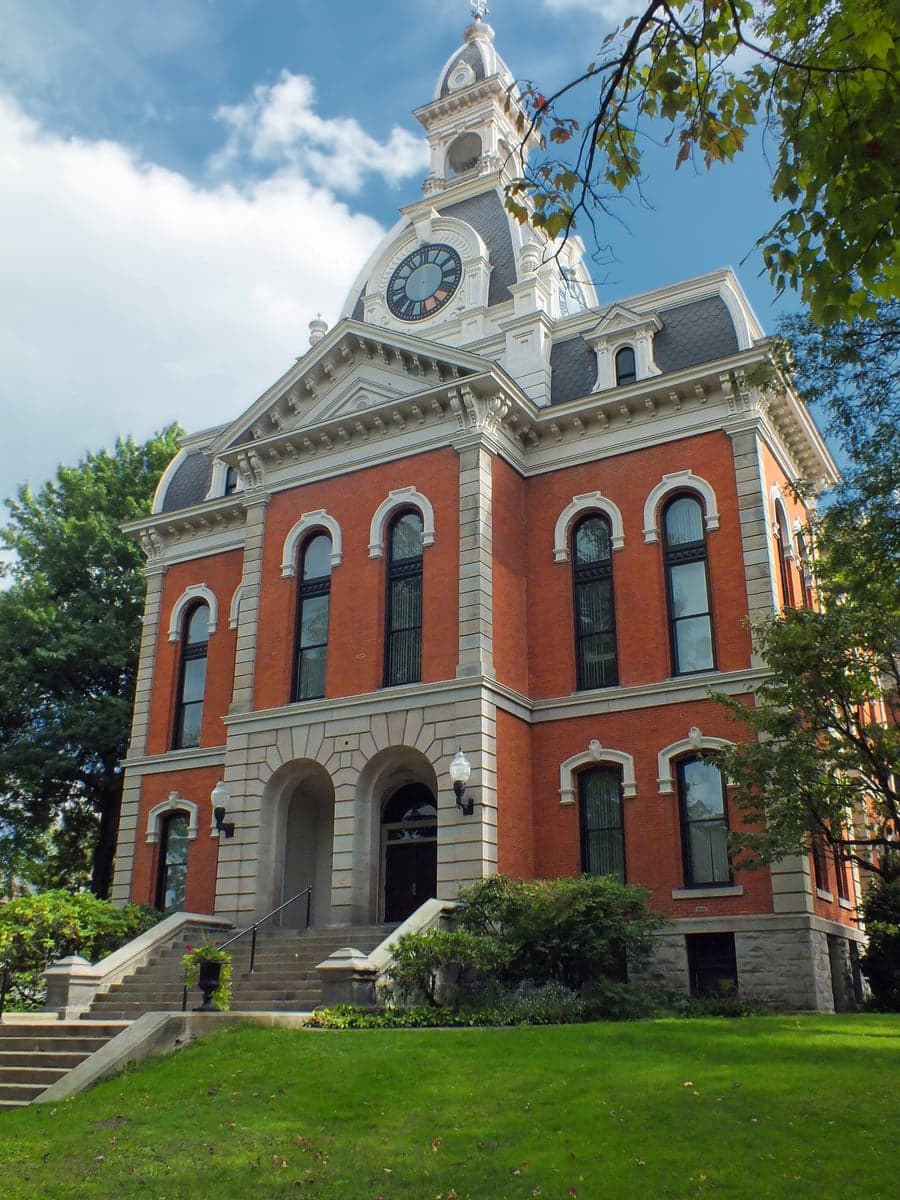
Photo: Wikipedia
Political ClimatePolitical Climate in Elk County
Showing county-level results — no local-only data available.
Lean and PVI are calculated from this county’s 2020 and 2024 presidential results, Cook-style.
Political rankings in Pennsylvania
- Most Conservative Cities in Pennsylvania
- Most Liberal Cities in Pennsylvania
- Best Conservative-Leaning Towns in the Northeast
- Best Conservative-Leaning Towns in the Mid-Atlantic
- Most Affordable Liberal-Leaning Small Towns in the U.S.
- Safest Liberal-Leaning Cities in the U.S.
- Most Conservative Counties in Pennsylvania
- Most Liberal Counties in Pennsylvania
Local Political AnalysisPolitical Analysis of Elk County
Elk County, Pennsylvania, is one of the most reliably Republican areas in the state, carrying a Cook PVI of R+24. That means the county votes about 24 points more Republican than the nation as a whole, a stark contrast to Pennsylvania’s statewide PVI of EVEN, which reflects a true swing state. In the 2024 presidential election, Elk County went for Donald Trump by roughly a 70-28 margin, a pattern that has held for decades with only minor variation. The county’s political identity is deeply rooted in its rural character, its history as a resource-extraction hub, and a population that has remained stable and culturally conservative even as other parts of Pennsylvania have shifted.
How it compares
Compared to Pennsylvania as a whole, Elk County is a political outlier. The state’s EVEN rating means it is a battleground where Philadelphia and its suburbs pull left while the central and northern tiers pull right. Elk County sits firmly in the latter camp, voting more like neighboring Potter or Cameron counties than the state’s swing regions. Within Elk County itself, there is some variation. The borough of Ridgway, the county seat, tends to be slightly more moderate than the rest of the county, with Democratic candidates occasionally winning precincts near the downtown area. St. Marys, the largest town, is reliably red but has a small pocket of blue-leaning voters around the university and hospital. Johnsonburg and Kersey are among the most conservative areas, often delivering margins of 80% or more for Republican candidates. The swing precincts are few and far between, but they exist in the more populated parts of Ridgway and St. Marys where younger professionals and public-sector workers live.
What this means for residents
For conservative residents, Elk County feels like a political safe haven. Local offices—county commissioners, school boards, and township supervisors—are almost entirely held by Republicans, and policy tends to reflect that, from low taxes to limited land-use regulations. Conservative residents can expect their values to be reflected in local governance without much pushback. For liberal residents, the reality is different. They are a distinct minority, and while there is no active hostility, they often feel politically isolated. Democratic candidates rarely campaign in the county, and progressive policy proposals—like renewable energy mandates or gun control measures—are nonstarters. That said, the county’s small size means that personal relationships often override political differences; a liberal neighbor is still a neighbor. The practical effect is that liberal residents may need to travel to DuBois or State College for more politically aligned social or civic groups.
Culturally, Elk County’s political lean is reinforced by its economic and social fabric. The county’s largest employers—Imerys (mining), Domtar (paper), and local healthcare—are industries that tend to favor conservative economic policies. There is a strong tradition of hunting, fishing, and outdoor recreation, which aligns with Second Amendment advocacy. Unlike some parts of Pennsylvania that have seen an influx of out-of-state transplants, Elk County’s population has been stable or slightly declining, meaning the political culture has changed little over the past 30 years. The county also has a notable Catholic and Lutheran heritage, which influences its social conservatism on issues like abortion and marriage. Looking ahead, the political trajectory is likely to remain R+24 or even shift slightly redder, as younger residents who leave for college often don’t return, and those who stay tend to hold the same views as their parents. For anyone moving to Elk County, the political climate is predictable: reliably conservative, with a small but resilient liberal minority that keeps things from becoming a complete echo chamber.

State Political ClimatePolitical Climate in Pennsylvania
State Political AnalysisPolitical Environment in the State
Pennsylvania is the ultimate swing state, holding a Cook PVI of EVEN and having voted for the winning presidential candidate in every election since 2008, often by razor-thin margins. The state’s political identity is a tug-of-war between the heavily Democratic, union-heavy southeast (Philadelphia and its collar counties) and the sprawling, ancestrally Republican but increasingly Trump-leaning rural and exurban north and west. Over the last 20 years, the old "blue dog" Democrat has nearly vanished from the state legislature, replaced by a polarized map where the outcome of every statewide race hinges on a handful of suburban swing counties like Bucks, Chester, Delaware, and Montgomery outside Philadelphia, and Erie and Northampton in the northwest and east.
Urban vs. rural divide
The political map of Pennsylvania is a story of two states. Philadelphia and Pittsburgh are deep blue anchors, delivering massive Democratic margins that often exceed 80% in the city proper. The Philadelphia suburbs—the four collar counties mentioned above—have shifted dramatically leftward since 2016, driven by college-educated professionals repelled by Trumpism; these areas now vote reliably Democratic in presidential and Senate races. In contrast, the vast rural interior—places like Lancaster County (historically a GOP stronghold), York, and the northern tier counties along the New York border—vote Republican by 30-40 points. The key battlegrounds are the "T" of the state: the old industrial cities of Scranton, Wilkes-Barre, and Erie, plus the fast-growing exurbs of the Lehigh Valley (Allentown, Bethlehem). These areas have trended rightward on cultural issues even as they remain economically populist, making them the decisive swing voters in every close race.
Policy environment
Pennsylvania’s policy environment reflects its divided government. The state has a flat income tax rate of 3.07%, one of the lowest in the nation, and no tax on retirement income (Social Security, 401(k) withdrawals, pensions), which is a major draw for conservative retirees. Sales tax is 6% (higher in Philadelphia and Pittsburgh for local transit). Property taxes are high, averaging around 1.5% of home value, and are the primary funding mechanism for schools, leading to wide disparities between wealthy suburbs and poorer rural districts. The state has a right-to-work law? No—Pennsylvania is not a right-to-work state, and union density remains above the national average, especially in public sector and construction. Education policy is decentralized: there is no statewide school choice voucher program, though a limited tax credit scholarship program exists. Election laws are moderately restrictive: voter ID is required for first-time voters, but not for regular voters; no-excuse mail-in voting was enacted in 2019 (Act 77) but remains a partisan flashpoint. The state has a Republican-controlled legislature and a Democratic governor (Josh Shapiro as of 2026), creating a policy stalemate on most major issues.
Recent policy direction
Recent legislation shows a state pulling in contradictory directions. On gun rights, Pennsylvania is a "shall-issue" state for concealed carry permits, and in 2022 the legislature passed preemption laws preventing local municipalities from enacting their own gun ordinances (like Philadelphia’s lost-and-stolen reporting requirement). However, the Democratic governor has vetoed permitless carry bills. On abortion, the state remains a regional haven: abortion is legal up to 24 weeks, and the governor has signed executive orders protecting out-of-state patients and providers from prosecution. On education, the legislature passed a $100 million expansion of the Educational Improvement Tax Credit (EITC) program in 2023, but a full school choice bill failed. On energy, Pennsylvania is the second-largest natural gas producer in the US, and the state has no carbon tax or cap-and-trade system, though the governor has attempted to join the Regional Greenhouse Gas Initiative (RGGI) via executive action—a move blocked by the courts. On voting, Act 77 (no-excuse mail-in voting) remains law, but the legislature has repeatedly tried to add stricter voter ID requirements and ban ballot drop boxes, with mixed success in court. On property rights, the state has no statewide rent control ban, but Philadelphia and Pittsburgh have local rent stabilization ordinances. On privacy, Pennsylvania has a data breach notification law but no comprehensive consumer privacy law like California’s. The overall direction is a stalemate: the legislature pushes right on guns, school choice, and election integrity; the governor pushes left on abortion, energy, and voting access.
Civil unrest & political movements
Pennsylvania has seen significant political activism on both sides. The 2020 election aftermath was particularly intense: Philadelphia’s ballot counting center was the site of protests and counter-protests, and the "Stop the Steal" movement held large rallies in Harrisburg and outside the governor’s mansion. In 2021, a group of Republican state senators held a widely publicized "election integrity" hearing in Gettysburg, featuring testimony from Trump allies. On the left, the Black Lives Matter protests in Philadelphia in 2020 were large and occasionally violent, leading to looting and property damage. Immigration politics are less visible than in border states, but Philadelphia is a self-declared "sanctuary city," and the state has a law (Act 40 of 2022) that prohibits local governments from enacting sanctuary policies—though it is being challenged in court. The most visible flashpoint for a new resident would be the constant yard sign and bumper sticker warfare in swing suburbs: you’ll see "Let’s Go Brandon" flags next to "In This House, We Believe" signs in the same neighborhood. The state also has a strong Second Amendment movement, with regular gun rights rallies at the state capitol. There is no serious secession or nullification movement, but rural counties have passed "Second Amendment sanctuary" resolutions declaring they will not enforce certain gun laws.
Projection
Over the next 5-10 years, Pennsylvania is likely to remain a toss-up state, but the demographic trends favor Democrats slightly. The Philadelphia suburbs are growing and becoming more diverse and educated, while the rural north and west are shrinking and aging. However, the growth of the exurbs in the Lehigh Valley and along the I-81 corridor (near Harrisburg) is bringing in more conservative-leaning families from New York and New Jersey. The state’s electoral college votes (19) will remain critical. The biggest wild card is the state’s aging population: Pennsylvania has the third-oldest median age in the nation, and older voters lean Republican but are less reliable for mail-in voting. If the GOP can turn out its rural base while making inroads with working-class voters in Scranton and Erie, the state could shift right. If Democrats continue to dominate the suburbs and Philadelphia, it will stay blue-leaning in presidential years. For a new resident, expect the policy gridlock to continue: no major tax increases or cuts, no dramatic expansion of school choice, and continued legal battles over abortion and voting. The state will not become Texas or California; it will remain a purple battleground where every election feels like a national referendum.
For a conservative relocator, Pennsylvania offers low income taxes, strong gun rights, and a high quality of life in its rural and exurban areas, but you will live in a state where your vote is contested and your values are not always reflected in state policy. For a liberal relocator, the state provides abortion access, union protections, and vibrant cities, but you will face a legislature that constantly tries to restrict voting and expand gun rights. The practical takeaway: Pennsylvania is a state where your vote truly matters, and where the political culture is defined by constant, exhausting negotiation. If you enjoy being in the center of the national political conversation, you’ll love it. If you want a state where your side consistently wins, look elsewhere.
* Values derived from national, state, county, city and local statistics and may differ in a specific area. Last updated: 2026-11-11T04:43:24.000Z
Narrative content on this page is AI-generated and may contain mistakes. Verify any details that matter before acting on them.
ReloMaps may earn a commission from affiliate links at no extra cost to you.

